Navy ship inspectors give palmtops a thumbs-up

Navy quality-assurance inspectors left their spiral notebooks at home this spring when they boarded the USS O'Kane at the Bath Iron Works in Maine. Instead, they took palmtop computers from 3Com Corp. of Santa Clara, Calif., to check shipboard equipment prior to the destroyer's maiden voyage.

By Richard W. WalkerGCN StaffNavy quality-assurance inspectors left their spiral notebooks at home this spring when they boarded the USS O'Kane at the Bath Iron Works in Maine. Instead, they took palmtop computers from 3Com Corp. of Santa Clara, Calif., to check shipboard equipment prior to the destroyer's maiden voyage.By all accounts, the palmtops passed inspection.'Once [the inspectors] got comfortable with the different way of entering data, namely into a computer rather than on a piece of paper, they all came around to liking the unit quite well,' said Walt Koscinski, lead yard production manager for the Navy's Program Executive Office for Theater Surface Combatants (PEOTSC) in Arlington, Va., which is responsible for ship procurement for the Navy.Koscinski compared the ship inspection process'known as the builder's trial'to developing a punch list when buying a newly built house. The purchaser carefully inspects every nook and cranny of the house, listing items that need to be completed, touched up or repaired or that are otherwise inconsistent with the plans and specifications of the home at the time of closing.In the builder's trial, 'every square foot and every piece of equipment gets inspected,' Koscinski said.Until the O'Kane trial, the Navy's crew of 30 shipbuilding inspectors in Bath were accustomed to recording their observations in spiral notebooks as they worked their way through hatchways and other tight spaces, looking for discrepancies between what was ordered and what was delivered and deficiencies in everything from air conditioners to radar equipment.After making their notations, the inspectors would return to their desks and fill out bulky forms that were then forwarded to programmers for keying into a main database. 'There was a lot of passing of paper previously,' PEOTSC production officer John Ingram said.It was a cumbersome process with a lot of potential for error during the handoffs. In a classic example, a programmer might have mistakenly keyed in 'portable' for 'potable' in a reference to water.In addition, the data that the 30 inspectors scribbled into their notebooks often contained inconsistent nomenclature.For example, one inspector might have referred to a particular shipboard air conditioner as 'AC Unit #1' while another would call it 'No. 1 AC Unit,' leading to confusion once the information was in the database.'When you get terms like that into a database, it makes sorting and selecting equipment a little difficult,' said Pat Templeton, project manager for Technology, Management & Analysis Corp. of McLean, Va., which developed the software for the new palmtop system.It was a different story last March during the O'Kane builder's trial, the first time the handhelds were used by all 30 inspectors during an inspection process. It went almost without a hitch.During the trial, inspectors scrutinized the ship with their Palm devices, using the unit's stylus to select standardized equipment names from a pull-down menu. They either picked a discrepancy type from another pull-down menu or entered discrepancy information into text fields with Palm's Graffiti handwriting-recognition system.The data was then uploaded into the database using Palm's HotSync technology.The new palmtop system has gone a long way toward standardizing terms and eliminating mistakes, PEOTSC officials said. Moreover, using consistent nomenclature makes it easier to track and analyze trends in discrepancies and deficiencies.The system also has sped up the inspection process. 'What used to take up to five days'to transfer the handwritten information from the inspections down to our centrally managed database'now takes a matter of hours,' Koscinski said. 'In fact, we can have reports available and printed out even while we're still out at sea writing discrepancies.'The PEOTSC team began looking at handheld computers about a year ago as a way to automate the inspection process. After reviewing a variety of handhelds, they settled on the Palm III, and later switched to the IIIx, which has 4M of RAM.'I believe there were several [handhelds] that could have performed the function,' Ingram said. 'We did a cost-benefit analysis and chose the one we're using now.'They also liked that the Palm device could store thousands of records without memory problems. And no hardware modifications were necessary'the off-the-shelf palmtop would do the trick.In November, after Technology, Management & Analysis developed the software, the team enlisted an inspector to try out the system during the builder's trial in Bath for another destroyer, the USS Higgins. They then began to train the rest of the inspection crew to use the devices in preparation for the O'Kane trial last March.'Initially, we had some resistance to a different way of doing business,' Koscinski said. 'They had to get used to using a stylus rather than a pencil and using the goofy letters rather than standard script.'The only challenge proved to be using the device in direct sunlight.'Direct sunlight will wipe out the screen, so you've got to work your body around a little bit and use the lid to block the sunlight. But no inspectors found that issue so tremendous that they wouldn't use the unit,' Koscinski said.Battery life was adequate. The Palm's two AAA batteries provide enough juice for about a month's use, Koscinski said. And the unit's backlighting was effective in dark spaces, he added.PEOTSC officials are gearing up to implement the palmtop inspection system at Ingalls Shipbuilding in Pascagoula, Miss., the Navy's other destroyer shipyard.'We're in the process of getting the units now,' Koscinski said. 'We want to be ready for the next trial, probably next winter. As soon as we get the units we'll start training the people down there.'The team also plans to expand the system to more types of shipboard inspections. The inspectors even envision automating the system from end-to-end, using handhelds to exchange data with the shipbuilders.
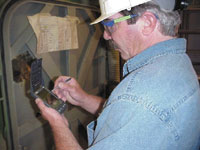
Jeremy Garner, a Navy shipbuilding

Quality-assurance crew trades its spiral notebooks for computers to check out new destroyer


Taking note


What's in a name


Goofy letters


NEXT STORY: Mobile and wireless computing

X
This website uses cookies to enhance user experience and to analyze performance and traffic on our website. We also share information about your use of our site with our social media, advertising and analytics partners. Learn More / Do Not Sell My Personal Information
Accept Cookies
X
Cookie Preferences Cookie List

Do Not Sell My Personal Information

When you visit our website, we store cookies on your browser to collect information. The information collected might relate to you, your preferences or your device, and is mostly used to make the site work as you expect it to and to provide a more personalized web experience. However, you can choose not to allow certain types of cookies, which may impact your experience of the site and the services we are able to offer. Click on the different category headings to find out more and change our default settings according to your preference. You cannot opt-out of our First Party Strictly Necessary Cookies as they are deployed in order to ensure the proper functioning of our website (such as prompting the cookie banner and remembering your settings, to log into your account, to redirect you when you log out, etc.). For more information about the First and Third Party Cookies used please follow this link.

Allow All Cookies

Manage Consent Preferences

Strictly Necessary Cookies - Always Active

We do not allow you to opt-out of our certain cookies, as they are necessary to ensure the proper functioning of our website (such as prompting our cookie banner and remembering your privacy choices) and/or to monitor site performance. These cookies are not used in a way that constitutes a “sale” of your data under the CCPA. You can set your browser to block or alert you about these cookies, but some parts of the site will not work as intended if you do so. You can usually find these settings in the Options or Preferences menu of your browser. Visit www.allaboutcookies.org to learn more.

Sale of Personal Data, Targeting & Social Media Cookies

Under the California Consumer Privacy Act, you have the right to opt-out of the sale of your personal information to third parties. These cookies collect information for analytics and to personalize your experience with targeted ads. You may exercise your right to opt out of the sale of personal information by using this toggle switch. If you opt out we will not be able to offer you personalised ads and will not hand over your personal information to any third parties. Additionally, you may contact our legal department for further clarification about your rights as a California consumer by using this Exercise My Rights link

If you have enabled privacy controls on your browser (such as a plugin), we have to take that as a valid request to opt-out. Therefore we would not be able to track your activity through the web. This may affect our ability to personalize ads according to your preferences.

Targeting cookies may be set through our site by our advertising partners. They may be used by those companies to build a profile of your interests and show you relevant adverts on other sites. They do not store directly personal information, but are based on uniquely identifying your browser and internet device. If you do not allow these cookies, you will experience less targeted advertising.

Social media cookies are set by a range of social media services that we have added to the site to enable you to share our content with your friends and networks. They are capable of tracking your browser across other sites and building up a profile of your interests. This may impact the content and messages you see on other websites you visit. If you do not allow these cookies you may not be able to use or see these sharing tools.

If you want to opt out of all of our lead reports and lists, please submit a privacy request at our Do Not Sell page.

Save Settings
Cookie Preferences Cookie List

Cookie List

A cookie is a small piece of data (text file) that a website – when visited by a user – asks your browser to store on your device in order to remember information about you, such as your language preference or login information. Those cookies are set by us and called first-party cookies. We also use third-party cookies – which are cookies from a domain different than the domain of the website you are visiting – for our advertising and marketing efforts. More specifically, we use cookies and other tracking technologies for the following purposes:

Strictly Necessary Cookies

We do not allow you to opt-out of our certain cookies, as they are necessary to ensure the proper functioning of our website (such as prompting our cookie banner and remembering your privacy choices) and/or to monitor site performance. These cookies are not used in a way that constitutes a “sale” of your data under the CCPA. You can set your browser to block or alert you about these cookies, but some parts of the site will not work as intended if you do so. You can usually find these settings in the Options or Preferences menu of your browser. Visit www.allaboutcookies.org to learn more.

Functional Cookies

We do not allow you to opt-out of our certain cookies, as they are necessary to ensure the proper functioning of our website (such as prompting our cookie banner and remembering your privacy choices) and/or to monitor site performance. These cookies are not used in a way that constitutes a “sale” of your data under the CCPA. You can set your browser to block or alert you about these cookies, but some parts of the site will not work as intended if you do so. You can usually find these settings in the Options or Preferences menu of your browser. Visit www.allaboutcookies.org to learn more.

Performance Cookies

We do not allow you to opt-out of our certain cookies, as they are necessary to ensure the proper functioning of our website (such as prompting our cookie banner and remembering your privacy choices) and/or to monitor site performance. These cookies are not used in a way that constitutes a “sale” of your data under the CCPA. You can set your browser to block or alert you about these cookies, but some parts of the site will not work as intended if you do so. You can usually find these settings in the Options or Preferences menu of your browser. Visit www.allaboutcookies.org to learn more.

Sale of Personal Data

We also use cookies to personalize your experience on our websites, including by determining the most relevant content and advertisements to show you, and to monitor site traffic and performance, so that we may improve our websites and your experience. You may opt out of our use of such cookies (and the associated “sale” of your Personal Information) by using this toggle switch. You will still see some advertising, regardless of your selection. Because we do not track you across different devices, browsers and GEMG properties, your selection will take effect only on this browser, this device and this website.

Social Media Cookies

We also use cookies to personalize your experience on our websites, including by determining the most relevant content and advertisements to show you, and to monitor site traffic and performance, so that we may improve our websites and your experience. You may opt out of our use of such cookies (and the associated “sale” of your Personal Information) by using this toggle switch. You will still see some advertising, regardless of your selection. Because we do not track you across different devices, browsers and GEMG properties, your selection will take effect only on this browser, this device and this website.

Targeting Cookies

We also use cookies to personalize your experience on our websites, including by determining the most relevant content and advertisements to show you, and to monitor site traffic and performance, so that we may improve our websites and your experience. You may opt out of our use of such cookies (and the associated “sale” of your Personal Information) by using this toggle switch. You will still see some advertising, regardless of your selection. Because we do not track you across different devices, browsers and GEMG properties, your selection will take effect only on this browser, this device and this website.