
Attacks on telecom infrastructure are growing, report says
Ashley Cooper via Getty Images




 By
Chris Teale
By
Chris Teale
Industry groups found that over 18,000 incidents were reported last year, which represented a 59% jump from 2024. Better enforcement and regulation could prevent it, the groups said.
Attacks on telecommunications infrastructure jumped 59% last year compared to 2024, according to a report released last week by various industry groups.
More than 18,000 incidents were reported nationwide last year, an average of just over 1,500 attacks a month that impacted 11.8 million customers, according to the joint report by the NCTA — The Internet and Television Association; CTIA — The Wireless Association; USTelecom — The Broadband Association; NTCA — The Rural Broadband Association; the Wireless Infrastructure Association; and America’s Communications Association.
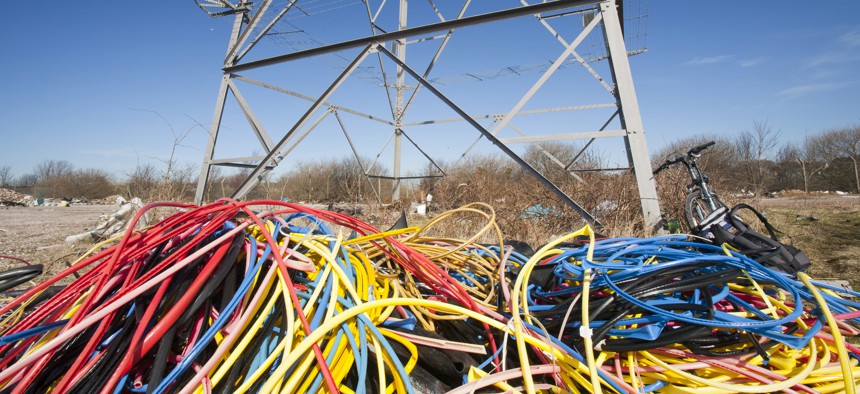
There are various factors behind this rise in attacks, according to the report, including the increased price of copper incentivizing thieves to steal it from utilities and communications equipment. The groups also argued there is weak oversight in the scrap metal market with few rules for transactions and determining if any wire has been stolen, while penalties for destroying property are often too low.
The consequences can be dramatic, too. A separate economic analysis of the impact attacks have had on telecommunications infrastructure by Edward Lopez, an academic economist, found that outages last year imposed $294 million to $1.47 billion in societal costs, which he noted is many times the replacement cost of stolen copper or damaged equipment. Those estimated societal costs reached $252.6 million in California and $97.4 million in Texas, Lopez estimated.
“These incidents of critical infrastructure theft and vandalism cannot be viewed as isolated property crimes,” Lopez’s report, which was underwritten by the aforementioned industry groups, says. “By attacking communications networks, they generate cascading economic losses for households, businesses, public services, and communities. Because these estimates are based only on reported incidents and their outage-related losses, the true societal cost is almost certainly higher.”
The hardest hit states, the report found, were California, Texas, Missouri, Washington state and Georgia, with Los Angeles being the hardest hit at over 1,100 reported instances of vandalism. California’s more-than 6,000 reported attacks far outpaced Texas (2,428), Missouri (1,030) and the rest.
The report noted the immense consequences of vandalism against telecommunications infrastructure and equipment. That can include disruptions to 911 systems and emerging services, as well as hospital networks, telemedicine, airport operations, flight systems, military bases and government buildings, the groups said.
“In today’s always-connected economy, broadband and wireless service disruptions are not merely inconveniences — they can create immediate and widespread harm,” the report says.
In response, the telecommunications industry has taken several steps, the report says, including by beefing up physical security, coordinating with local law enforcement, carrying out public information campaigns, redesigning infrastructure, having rewards programs for tips on vandals, and improving verification protocols for contractors to access facilities.
Meanwhile, the report praises state and local governments for taking various regulatory actions. So far, more than 23 states have introduced — and 13 have passed — legislation to boost regulations around scrap metal and strengthening protections for critical communications infrastructure. Those efforts include expanding the definition of critical infrastructure to include communications equipment; increasing penalties for intentionally damaging networks; and strengthening requirements around scrap metal transactions to include seller verification, transaction records and documentation. But there is more to do.
“Effective long-term mitigation will depend on a combination of strengthened laws, improved oversight, deeper collaboration across sectors and enhanced penalties,” the report says.
Those additional efforts, the groups said, should include further strengthening scrap metal regulation to include banning cash purchases for restricted metals and other rule changes; continuing to harmonize state laws where gaps remain to ensure communications infrastructure is clearly defined and covered under critical infrastructure protections; improving coordination to increase prevention, enforcement and rapid response; prioritizing law enforcement and prosecution; and enhancing penalties.
Lopez said vandalism and other attacks on telecommunications infrastructure must be gotten under control, as the consequences are vast.
“These incidents do not only burden the affected customers and owners of damaged or stolen infrastructure,” his report says. “Instead, because these illegal incidents affect communications networks, their harms cascade onto millions of households and businesses nationwide, multiplying into hundreds of millions of dollars, and potentially well over one billion dollars, in economic losses. These costs impose a significant drag on economic wellbeing across the nation.”
NEXT STORY: More states restrict 3D-printed firearms