
New guide aims to help build digital service teams

Nico De Pasquale Photography via Getty Images






Digital service teams are valuable to state and local government service delivery, but launching one is not always straightforward, one expert says. A new guide looks to assist officials in their efforts to create them.
New York City launched a new digital services team last month, with the aim of addressing the city government’s challenges with digital solutions that it hopes will ultimately improve service delivery.
It makes New York the largest city to create a team dedicated to optimizing government efficiency and customer experience, like many other states and localities across the U.S.
The city’s Public Interest Technology Crews — known as PIT Crews — will begin by working with other agencies to launch an online portal to help residents file complaints against “hard-to-cancel, costly subscriptions,” city officials said in July. The PIT Crews will include product managers, engineers, data experts and user researchers, among others, to carry out their digital service goals.
More broadly, New York City’s PIT Crews aim to improve residents’ access to government services and resources, like housing and child care assistance, through enhanced data and digital services that are user-friendly and enabled by modern technology.
Launching such teams are a growing priority for state and local governments looking to design, modernize and enhance digital solutions, particularly amid ongoing budget and staffing shortfalls, according to new guidance from the nonprofit U.S. Digital Response.
The toolkit, released last week, offers government leaders, IT professionals, program leaders and others practical guidance for structuring, staffing, launching and expanding a digital service team, Keith Wilson, talent engagement manager at USDR, told Route Fifty. Its findings are largely based on USDR’s experience working with federal, state and local governments, he said.
Digital service teams can be established under an executive model, where the group sits within a leadership office — like under the mayor, governor or agency head — which enables the team to “operate with executive authority for faster [cross-organization] coordination,” the guidance reads.
The executive model “can sometimes be the easiest first step” to creating a digital service team “because you have a really strong champion for it” when a single individual or agency wants to make it happen, Wilson said. However, this model can be vulnerable to leadership changes that can then impact the team’s priorities and funding streams, according to the toolkit.
An enterprise approach, where the digital team is embedded more in government operations and offers cross-agency service, offers “greater longevity and are better suited for long-term projects” since they are generally less influenced by elections or appointments, the toolkit says.
Enterprise-based digital service teams could also be more resilient because they are funded through budget appropriations or shared services within government, but those funding sources may make it complicated to coordinate across agencies and meet administrative requirements, the guidance warns.
Leaders could also design their digital service teams to begin at the executive level and then transition to enterprise operations as the team’s capacity and deliverables gain momentum, Wilson said.
“It’s pretty rare to have a big budget upfront to be able to launch [digital service teams],” he said, “but I think as the value of digital service teams in general across government is seen, I think there's more and more willingness or openness to provide that [funding] upfront.”
The toolkit suggests that government and agency leaders should also evaluate their broader digital maturity — or their capacity to design, build and improve digital services based on current team structure and roles, hiring and workforce capacity and governance — to better focus on what projects, processes or systems to focus on with their digital service teams.
Governments can be at various stages of maturity, ranging from an “exploring” phase where digital service delivery is ad hoc or otherwise done with no official team or budget to a “leading” phase where agency staff consistently deliver quality digital services, the toolkit adds.
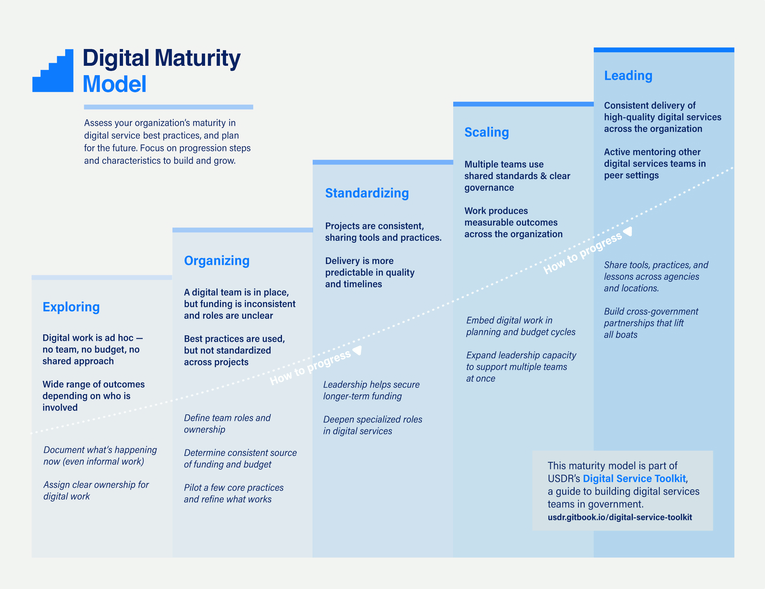
While advanced digital maturity is not required to launch a digital service team, “without the right foundations, a team may face unclear ownership, limited capacity, slow decisions and difficulty sustaining what it delivers,” the toolkit says.
It then urges organizations to develop a clear vision of their digital maturity, so they can decide the more specific aspects of a digital service team, such as its official directive, key user groups to be served, job roles and descriptions and digital infrastructure it will use.
Governments should then identify the right people to be involved, to ensure those in and supporting a digital service team share a common vision and direction for its launch and ongoing work, Wilson said. That can include policymakers, tech leaders within government, procurement managers, HR staff and others.
The guide points to cross-agency workshops as one strategy for aligning stakeholders. For instance, officials could hold a couple of one- or two-hour working sessions where participants discuss the team’s priorities, clarify ownership and responsibilities and identify action steps, among others.
Such discussions can promote conversations about stakeholders’ “hopes and fears” about launching the digital service team, plans to measure the team’s impact and progress and strategies for deciding how digital solution projects will be prioritized, according to the toolkit.
For government leaders looking to establish digital service teams, they often quickly “realize it’s a lot of steps and [the process] can be a lot,” Wilson said.