
Los Alamos and University of Michigan want to build a national security ‘data center’ in Ypsilanti. Residents and local officials see few benefits
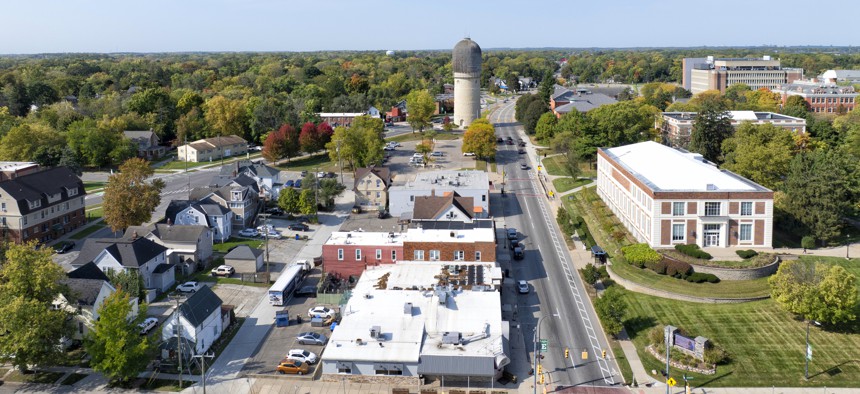
Gerville via Getty Images





Local officials allege the University of Michigan is being “deceptive” over its plans for the $1.2 billion “computation center,” which could bring few benefits and many costs to Ypsilanti Township.
This article was originally published by Inside Climate News.
The Huron River winds through parks and wooded areas in eastern Ypsilanti Township where thousands of residents fish, canoe and swim. Now the University of Michigan and Los Alamos National Laboratory want to add a 300,000-square-foot taxpayer-subsidized data center with a 20-acre electric substation to the landscape.
The proposal has ignited a controversy. Township leadership has accused the university of being deceptive about its plans for the $1.25 billion data center, and wants U-M to instead build it in an industrial area.
Meanwhile, a group of about 300 residents called Stop The Data Center does not want a data center anywhere in Ypsilanti Township. They oppose it over potential increases in utility bills, local water pollution, regional air emissions and the center’s national security role. They labeled the township’s plan to relocate the center near a low-income area as “environmental racism,” and have protested at township meetings and board members’ homes.
“There are just a lot of community concerns and issues created by U-M at a time when people are struggling,” Ypsilanti Township Supervisor Brenda Stumbo said. “It’s sad. It’s frustrating.”
Township officials said they aim to force U-M to the industrial site change during the state environmental review process.
The controversy is one of multiple unfolding in Michigan in which grassroots campaigns from across the political spectrum have, or may, derail data center plans. Ypsilanti Township, a municipality of about 55,000 just a few miles west of Ann Arbor, is one of three communities in the area where residents are pushing back against similar plans.
The university did not respond to specific questions from Inside Climate News about the center, resident concerns or township accusations. Instead it noted information posted to its website.
Data centers house infrastructure for facilitating internet traffic and the artificial intelligence boom. Los Alamos, owned by the U.S. Department of Energy, is a federal national security and energy research lab. U-M describes the project in Ypsilanti as a “computation center,” in which Los Alamos would focus on “federal, classified research” in one building, and the university would conduct AI research in another. Construction would begin in 2027.
As data centers’ financial and environmental tolls have become clearer, there has been growing public concern about their impact and costs on nearby communities. In many communities, the centers, which require massive electricity and water consumption, have increased residential utility bills. In Michigan and elsewhere, the centers have required more fossil fuel plants to be built or delay retiring and threaten to derail the transition to clean energy. Opponents also have raised concerns that the centers can be a source of light, noise, water and air pollution.
The anti-data center campaigns in Michigan may succeed at the local level where levers to block projects are available, said Sean McBrearty, director of the Clean Water Action nonprofit, which has called for more environmental and financial protections around data centers.
“The state has a duty to balance the needs of our residents with the desires of these companies and that hasn’t happened,” McBrearty said. “Every step that holds these things up is critical to making sure Michigan residents have a say.”
The U-M center would use about 200,000 gallons of water daily, local utility officials said, while state documents show it would consume about 100 MW of power–as much as the rest of the township, by some estimates.
U-M has said it is taking measures “to ensure energy efficiency, water conservation, occupant comfort and minimal environmental impact to the project site.” A university newsletter in September offered that the facility’s “rooftops are being designed to accommodate solar panels, and the buildings will be fully electric. Cooling water will come from municipal sources.” It would not “draw or release any water into the Huron River.”
The project’s opponents say the center’s cooling water will ultimately end up in the river or environment, and fossil fuel will be used to generate electricity. Data and computation centers typically require backup generators that often run on diesel and are used monthly during routine maintenance. U-M has said its generators won’t use diesel, but has not said what will fuel them.
Though the township’s legal options are limited, local leadership should “use their creativity and actually succeed in their roles of protecting people,” said Vidhya Aravind, 39, a township resident and Stop Data Centers member. The group of area residents formed after the plans were announced, and includes people who live nearby, and U-M employees.
“It seems like they are resigning to having the data centers because the legal struggles in fighting it are too difficult, which feels like cowardice to me, especially when the entire township is at risk,” Aravind said.
“Condescension and Disrespect”
Township officials said the university has been deceptive about its plans since they were first made public in 2024, and accused U-M of ramming through the project over the local government’s and residents’ objections. They say the situation is especially galling because the university does not pay taxes and has refused to help cover infrastructure costs local taxpayers must foot related to public safety, roads and utilities, Ypsilanti Township Attorney Doug Winters told Inside Climate News.
U-M in late 2024 submitted plans in a tax incentive application to the state that proposed a data center, also referred to as a computation center, on a 26-acre property along the river. But the university in early 2025 quietly bought an adjacent 120-acre property, then dramatically scaled up the proposal’s size once the tax incentive was approved in late 2024, Winters said.
Township officials, who are in lockstep in their concerns about the project, said the plan’s details remain unclear to this day. The project was presented as a light industrial development, Stumbo said, but she has since visited a similar-sized data center in Ohio. She said she was shocked to find massive generators, high tension wires, substations and large buildings.
“The first time I saw one I said: ‘Holy cow this is heavy industrial use,’” she said.
The university also told officials the center would create 200 high paying jobs. Stumbo said the township later learned only 30 would be local.
As township leadership learned more about the project early this year during ongoing discussion with U-M, they determined that it would not fit among the area’s parks, but could be built at the American Center for Mobility (ACM), a former General Motors plant site.
U-M officials balked at the suggestion. Stumbo said officials were stunned when the university told them that it had negotiated with ACM for 18 months but it had failed to secure a deal.
U-M agreed, in the face of some outrage among township officials, to try to re-negotiate with ACM, but will not allow the township to be part of that process.
The township also learned during a recent meeting with DTE Energy, the region’s energy utility, that it was only planning for upgrades to the site next to the parks and river.
Winters, the township attorney, said he now believes the university had no intention of using the ACM site and was “going through the motions” to placate the township. “As the old saying goes, ‘We may have been born at night, but not last night,’” Winters wrote in an Aug. 29 letter to U-M obtained via a Freedom of Information Act Request, that lambasted the university. The ongoing deceit and exclusion of the township from the process was the “height of condescension and disrespect,” he added.
“It is unbecoming for the stature of the University of Michigan, truly one of the best universities in the world, to tell Ypsilanti Township ‘thanks but no thanks’ when it comes to making decisions that will have a permanent and lasting impact upon the future of Ypsilanti Township,” Winters wrote in his letter.
The township is pursuing a “sound” environmental review and will explore other ways to force U-M at the state level to move the project to ACM. “We’re going to do our due diligence,” Winter told Inside Climate News..
“Unreasonably Consumptive”
Aravind of Stop the Data Center said the group opposes building data centers anywhere in the township because of the energy use, pollution and potential impacts on utility bills.
“All of these AI data centers are unreasonably consumptive in terms of electricity and water,” she said. “They are all contributing to the destruction of the planet, and also rapidly causing destruction of areas around them.”
She noted the research will support national security: “This one in particular seems to be contributing to research on weapons of war, which we are categorically against.”
The group opposes building the center at the ACM site because Ypsilanti Township is among the lowest income communities in Washtenaw County, and the state scores West Willow, a neighborhood near the ACM site, in the 85th percentile in its environmental justice screening system.
Ann Arbor, where the U-M is located a few miles from Ypsilanti Township, is a much wealthier community, Aravind noted. “It has access to water and land,” she said. “But they did not choose to build it there, even though it would be closer to campus.”
Ultimately, the economic reward is too little and the environmental and climate costs are too high, Aravind said.
“Short-term economic development is not worth the destruction of the human species,” Aravind said. “Politicians have a tendency to talk about the economy as something important and tangible, and, yeah, it has impacts, but what is also important and tangible is growing up in a clean environment.”