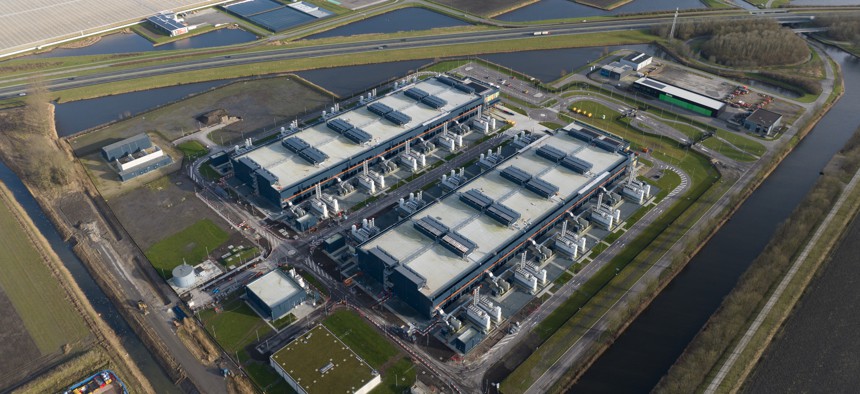
How to make data centers less thirsty

Hugo Kurk via Getty Images

There’s a way to reduce both the climate and water harms of data centers: build them in places with lots of wind and solar energy.

This article was originally published by Grist.

Data centers are notoriously thirsty. Researchers at Lawrence Berkeley National Laboratory have found that, in 2023, the facilities consumed roughly 17 billion gallons of water for their operations in the U.S. alone. But that’s only a small part of the picture: A much, much larger share of data center water-intensity is indirect, a byproduct of the facilities’ enormous appetites for energy. That’s because most power plants themselves require huge amounts of water to operate. This off-site, indirect water consumption amounted to a whopping 211 billion gallons in the Berkeley lab’s 2023 tally — well over 10 times the direct on-site usage. As Silicon Valley continues to pour hundreds of billions of dollars into artificial intelligence and demand for data centers grows, these water needs are only going to grow in tandem. 

However, new research from Cornell University shows that there’s a way to mitigate both the climate and water footprints of these facilities: build them in places with lots of wind and solar energy. “Location really matters,” said Fengqi You, an energy systems engineering professor at Cornell and co-author of the new study. Where companies choose to locate their data centers could alter their combined environmental footprints by a factor of up to 100.

In the course of their operations, data centers use water as a coolant. Energy-hungry servers generate substantial heat, and water circulates through cooling systems to prevent the equipment from overheating and breaking down. But substantial amounts of water are also used indirectly through the generation of electricity to run the facilities. Thermoelectric power plants, regardless of whether they use coal, gas, or nuclear material, use that fuel to generate heat that converts water into steam, which is then used to spin a turbine and generate electricity. And since hydroelectric plants typically store large volumes of water in reservoirs behind dams, there is water loss there as well, as water continually evaporates from the surface of reservoirs.

All told, water use during power generation can be responsible for more than 70 percent of a data center’s total water consumption, according to the new Cornell research. “That’s why the electricity power grid mix is very critical,” said You. 

You and his co-authors examined the energy and water use of data centers across the country to project where future investments should be made to reduce environmental impacts. The study assumes that the data center boom, which is being fueled by staggering levels of investment in artificial intelligence, is unlikely to slow down anytime soon. Against that backdrop, the question the study then poses is: Where in the country is the most environmentally sustainable place to build a data center?

The researchers considered both the direct and indirect uses of energy and water as a result of building a data center in a specific location. The most promising region they identified might turn heads: bone-dry West Texas. But because the region is sparsely populated, has groundwater that can be drawn on for use as a coolant, and produces ample wind energy, it scored highest on both energy and water stress metrics. In fact, the grid-related water footprint in West Texas is among the lowest in the country, thanks to the large amount of wind energy produced, according to the study.

“From an energy and water efficiency perspective, the states that have enough dry renewables will be the best choice,” said You, adding that Montana, Nebraska, and South Dakota all appear to be prime locations for future AI servers, alongside the Lone Star State.

Conversely, most parts of the Pacific Northwest didn’t score as well because of the region’s reliance on hydropower. Although the cost of electricity is low in the area, the associated loss of water through power generation means that building more data centers is likely to have a substantially larger water footprint than it would in other parts of the country.

Another recent study from researchers at Purdue University came to a similar conclusion. They looked at the availability of water across the country and mapped out how that might change over time, particularly as climate change makes some regions hotter and drier. The researchers also examined the water impact of existing Google data centers and found that the majority were located in areas with low water stress.

“Companies absolutely take the environment into consideration in their decisions — not just the economic factor,” said Yi Ding, one of the authors of the paper and an electrical and computer engineering professor at Purdue. “We infer that Google already somewhat considered water stress because they put most of the data centers in low-stress regions.”

Texas already has more than 400 data centers located in the state, second only to Virginia. The state’s grid infrastructure, potential for renewables, and availability of cheap land has made it an attractive proposition for tech companies. But the other states identified by the Cornell study as having a small environmental footprint — Nebraska, South Dakota, and Montana — have just 70 or so data centers combined, out of more than at least 4,200 nationally. That’s because a number of other factors, such as the policy environment and infrastructure considerations, are deterring companies from building new facilities there. But if those states geared their policymaking toward attracting data centers, it could make a difference, You said.

X
This website uses cookies to enhance user experience and to analyze performance and traffic on our website. We also share information about your use of our site with our social media, advertising and analytics partners. Learn More / Do Not Sell My Personal Information
Accept Cookies
X
Cookie Preferences Cookie List

Do Not Sell My Personal Information

When you visit our website, we store cookies on your browser to collect information. The information collected might relate to you, your preferences or your device, and is mostly used to make the site work as you expect it to and to provide a more personalized web experience. However, you can choose not to allow certain types of cookies, which may impact your experience of the site and the services we are able to offer. Click on the different category headings to find out more and change our default settings according to your preference. You cannot opt-out of our First Party Strictly Necessary Cookies as they are deployed in order to ensure the proper functioning of our website (such as prompting the cookie banner and remembering your settings, to log into your account, to redirect you when you log out, etc.). For more information about the First and Third Party Cookies used please follow this link.

Allow All Cookies

Manage Consent Preferences

Strictly Necessary Cookies - Always Active

We do not allow you to opt-out of our certain cookies, as they are necessary to ensure the proper functioning of our website (such as prompting our cookie banner and remembering your privacy choices) and/or to monitor site performance. These cookies are not used in a way that constitutes a “sale” of your data under the CCPA. You can set your browser to block or alert you about these cookies, but some parts of the site will not work as intended if you do so. You can usually find these settings in the Options or Preferences menu of your browser. Visit www.allaboutcookies.org to learn more.

Sale of Personal Data, Targeting & Social Media Cookies

Under the California Consumer Privacy Act, you have the right to opt-out of the sale of your personal information to third parties. These cookies collect information for analytics and to personalize your experience with targeted ads. You may exercise your right to opt out of the sale of personal information by using this toggle switch. If you opt out we will not be able to offer you personalised ads and will not hand over your personal information to any third parties. Additionally, you may contact our legal department for further clarification about your rights as a California consumer by using this Exercise My Rights link

If you have enabled privacy controls on your browser (such as a plugin), we have to take that as a valid request to opt-out. Therefore we would not be able to track your activity through the web. This may affect our ability to personalize ads according to your preferences.

Targeting cookies may be set through our site by our advertising partners. They may be used by those companies to build a profile of your interests and show you relevant adverts on other sites. They do not store directly personal information, but are based on uniquely identifying your browser and internet device. If you do not allow these cookies, you will experience less targeted advertising.

Social media cookies are set by a range of social media services that we have added to the site to enable you to share our content with your friends and networks. They are capable of tracking your browser across other sites and building up a profile of your interests. This may impact the content and messages you see on other websites you visit. If you do not allow these cookies you may not be able to use or see these sharing tools.

If you want to opt out of all of our lead reports and lists, please submit a privacy request at our Do Not Sell page.

Save Settings
Cookie Preferences Cookie List

Cookie List

A cookie is a small piece of data (text file) that a website – when visited by a user – asks your browser to store on your device in order to remember information about you, such as your language preference or login information. Those cookies are set by us and called first-party cookies. We also use third-party cookies – which are cookies from a domain different than the domain of the website you are visiting – for our advertising and marketing efforts. More specifically, we use cookies and other tracking technologies for the following purposes:

Strictly Necessary Cookies

We do not allow you to opt-out of our certain cookies, as they are necessary to ensure the proper functioning of our website (such as prompting our cookie banner and remembering your privacy choices) and/or to monitor site performance. These cookies are not used in a way that constitutes a “sale” of your data under the CCPA. You can set your browser to block or alert you about these cookies, but some parts of the site will not work as intended if you do so. You can usually find these settings in the Options or Preferences menu of your browser. Visit www.allaboutcookies.org to learn more.

Functional Cookies

We do not allow you to opt-out of our certain cookies, as they are necessary to ensure the proper functioning of our website (such as prompting our cookie banner and remembering your privacy choices) and/or to monitor site performance. These cookies are not used in a way that constitutes a “sale” of your data under the CCPA. You can set your browser to block or alert you about these cookies, but some parts of the site will not work as intended if you do so. You can usually find these settings in the Options or Preferences menu of your browser. Visit www.allaboutcookies.org to learn more.

Performance Cookies

We do not allow you to opt-out of our certain cookies, as they are necessary to ensure the proper functioning of our website (such as prompting our cookie banner and remembering your privacy choices) and/or to monitor site performance. These cookies are not used in a way that constitutes a “sale” of your data under the CCPA. You can set your browser to block or alert you about these cookies, but some parts of the site will not work as intended if you do so. You can usually find these settings in the Options or Preferences menu of your browser. Visit www.allaboutcookies.org to learn more.

Sale of Personal Data

We also use cookies to personalize your experience on our websites, including by determining the most relevant content and advertisements to show you, and to monitor site traffic and performance, so that we may improve our websites and your experience. You may opt out of our use of such cookies (and the associated “sale” of your Personal Information) by using this toggle switch. You will still see some advertising, regardless of your selection. Because we do not track you across different devices, browsers and GEMG properties, your selection will take effect only on this browser, this device and this website.

Social Media Cookies

We also use cookies to personalize your experience on our websites, including by determining the most relevant content and advertisements to show you, and to monitor site traffic and performance, so that we may improve our websites and your experience. You may opt out of our use of such cookies (and the associated “sale” of your Personal Information) by using this toggle switch. You will still see some advertising, regardless of your selection. Because we do not track you across different devices, browsers and GEMG properties, your selection will take effect only on this browser, this device and this website.

Targeting Cookies

We also use cookies to personalize your experience on our websites, including by determining the most relevant content and advertisements to show you, and to monitor site traffic and performance, so that we may improve our websites and your experience. You may opt out of our use of such cookies (and the associated “sale” of your Personal Information) by using this toggle switch. You will still see some advertising, regardless of your selection. Because we do not track you across different devices, browsers and GEMG properties, your selection will take effect only on this browser, this device and this website.