
States will keep pushing AI laws despite Trump’s efforts to stop them
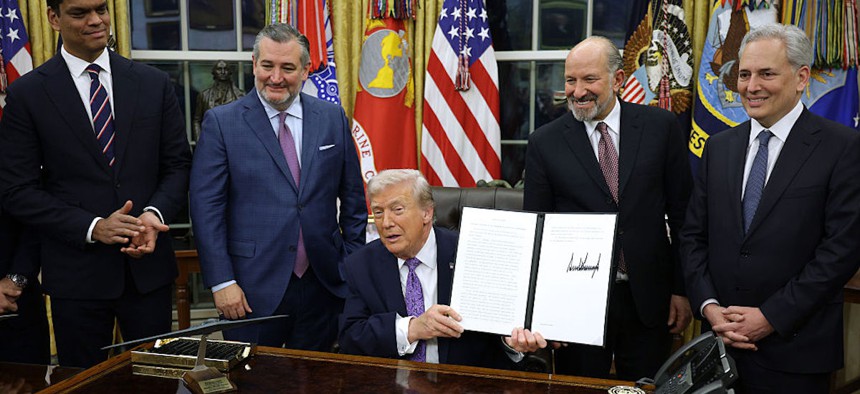
President Donald Trump displays a signed executive order that curbs states' ability to regulate artificial intelligence on Dec. 11, 2025, in Washington, DC. Alex Wong/Getty Images




Nearly 40 states have adopted or enacted artificial intelligence measures this year, and more are expected in 2026.
This story was originally published by Stateline.
State lawmakers of both parties said they plan to keep passing laws regulating artificial intelligence despite President Donald Trump’s efforts to stop them.
Trump signed an executive order Thursday evening that aims to override state artificial intelligence laws. He said his administration must work with Congress to develop a national AI policy, but that in the meantime, it will crack down on state laws.
The order comes after several other Trump administration efforts to rein in state AI laws and loosen restrictions for developers and technology companies.
But despite those moves, state lawmakers are continuing to prefile legislation related to artificial intelligence in preparation for their 2026 legislative sessions. Opponents are also skeptical about — and likely to sue over — Trump’s proposed national framework and his ability to restrict states from passing legislation.
“I agree on not overregulating, but I don’t believe the federal government has the right to take away my right to protect my constituents if there’s an issue with AI,” said South Carolina Republican state Rep. Brandon Guffey, who penned a letter to Congress opposing legislation that would curtail state AI laws.
The letter, signed by 280 state lawmakers from across the country, shows that state legislators from both parties want to retain their ability to craft their own AI legislation, said South Dakota Democratic state Sen. Liz Larson, who co-wrote the letter.
Earlier this year, South Dakota Republican Gov. Larry Rhoden signed the state’s first artificial intelligence law, authored by Larson, prohibiting the use of a deepfake — a digitally altered photo or video that can make someone appear to be doing just about anything — to influence an election.
South Dakota and other states with more comprehensive AI laws, such as California and Colorado, would see their efforts overruled by Trump’s order, Larson said.
“To take away all of this work in a heartbeat and then prevent states from learning those lessons, without providing any alternative framework at the federal level, is just irresponsible,” she said. “It takes power away from the states.”
Trump’s Efforts
Thursday’s executive order will establish an AI Litigation Task Force to bring court challenges against states with AI-related laws, with exceptions for a few issues such as child safety protections and data center infrastructure.
The order also directs the secretary of commerce to notify states that they could lose certain funds under the Broadband Equity, Access, and Deployment Program if their laws conflict with national AI policy priorities.
Trump said the order would help the United States beat China in dominating the burgeoning AI industry, adding that Chinese President Xi Jinping did not have similar restraints.
“This will not be successful unless they have one source of approval or disapproval,” he said. “It’s got to be one source. They can’t go to 50 different sources.”
In July, the Trump administration released the AI Action Plan, an initiative aimed at reducing regulatory barriers and accelerating the growth of AI infrastructure, including data centers. Trump also has revoked Biden-era AI safety and anti-discrimination policies.
The tech industry had lobbied for Trump’s order.
“This executive order is an important step towards ensuring that smart, unified federal policy — not bureaucratic red tape — secures America’s AI dominance for generations to come,” said Amy Bos, vice president of government affairs for NetChoice, a technology trade association, in a statement to Stateline.
As the administration looks to address increasing threats to national defense and cybersecurity, a centralized, national approach to AI policy is best, said Paul Lekas, the executive vice president for global public policy and government affairs at the Software & Information Industry Association.
“The White House is very motivated to ensure that there aren’t barriers to innovation and that we can continue to move forward,” he said. “And the White House is concerned that there is state legislation that may be purporting to regulate interstate commerce. We would be creating a patchwork that would be very hard for innovation.”
Congressional Republicans tried twice this year to pass moratoriums on state AI laws, but both efforts failed.
In the absence of a comprehensive federal artificial intelligence policy, state lawmakers have worked to regulate the rapid development of AI systems and protect consumers from potential harms.
Trump’s executive order could cause concern among lawmakers who fear possible blowback from the administration for their efforts, said Travis Hall, the director for state engagement at the Center for Democracy & Technology, a nonprofit that advocates for digital rights and freedom of expression.
“I can’t imagine that state legislators aren’t going to continue to try to engage with these technologies in order to help protect and respond to the concerns of their constituents,” Hall said. “However, there’s no doubt that the intent of this executive order is to chill any actual oversight, accountability or regulation.”
State Rules
This year, 38 states adopted or enacted measures related to artificial intelligence, according to a National Conference of State Legislatures database. Numerous state lawmakers have also prefiled legislation for 2026.
But tensions have grown over the past few months as Trump has pushed for deregulation and states have continued to create guardrails.
It doesn't hold any water and it doesn't have any teeth because the president doesn't have the authority to supersede state law.– Colorado Democratic state Rep. Brianna Titone
In 2024, Colorado Democratic Gov. Jared Polis signed the nation’s first comprehensive artificial intelligence framework into law. Under the law, developers of AI systems will be required to protect consumers from potential algorithmic discrimination.
But implementation of the law was postponed a few months until June 2026 after negotiations stalled during a special legislative session this summer aiming to ensure the law did not hinder technological innovation. And a spokesperson for Polis told Bloomberg in May that the governor supported a U.S. House GOP proposal that would impose a moratorium on state AI laws.
Trump’s executive order, which mentions the Colorado law as an example of legislation the administration may challenge, has caused uncertainty among some state lawmakers focused on regulating AI. But Colorado state Rep. Brianna Titone and state Sen. Robert Rodriguez, Democratic sponsors of the law, said they will continue their work.
Unless Congress passes legislation to restrict states from passing AI laws, Trump’s executive order can easily be challenged and overturned in court, she said.
“This is just a bunch of hot air,” Titone said. “It doesn’t hold any water and it doesn’t have any teeth because the president doesn’t have the authority to supersede state law. We will continue to do what we need to do for the people in our state, just like we always have, unless there is an actual preemption in federal law.”
California and Illinois also have been at the forefront of artificial intelligence legislation over the past few years. In September, California Democratic Gov. Gavin Newsom signed the nation’s first law establishing a comprehensive legal framework for developers of the most advanced, large-scale artificial intelligence models, known as frontier artificial intelligence models. Those efforts are aimed at preventing AI models from causing catastrophic harm involving dozens of casualties or billion-dollar damages.
California officials have said they are considering a legal challenge over Trump’s order, and other states and groups are likely to sue as well.
Republican officials and GOP-led states, including some Trump allies, also are pushing forward with AI regulations. Efforts to protect consumers from AI harms are being proposed in Missouri, Ohio, Oklahoma, South Carolina, Texas and Utah.
Earlier this month, Florida Republican Gov. Ron DeSantis also unveiled a proposal for an AI Bill of Rights. The proposal aims to strengthen consumer protections related to AI and to address the growing impact data centers are having on local communities.
In South Carolina, Guffey said he plans to introduce a bill in January that would place rules on AI chatbots. Chatbots that use artificial intelligence are able to simulate conversations with users, but raise privacy and safety concerns.
Artificial intelligence is developing fast, Guffey noted. State lawmakers have been working on making sure the technology is safe to use — and they’ll keep doing that to protect their constituents, he said.
“The problem is that it’s not treated like a product — it’s treated like a service,” Guffey said. “If it was treated like a product, we have consumer protection laws where things could be recalled and adjusted and then put back out there once they’re safe. But that is not the case with any of this technology.”
Stateline reporter Madyson Fitzgerald can be reached at mfitzgerald@stateline.org.
Stateline is part of States Newsroom, a nonprofit news network supported by grants and a coalition of donors as a 501c(3) public charity. Stateline maintains editorial independence. Contact Editor Scott S. Greenberger for questions: info@stateline.org.