
Amid the AI-driven boom in energy demand, rural Texans fight a high-voltage transmission line
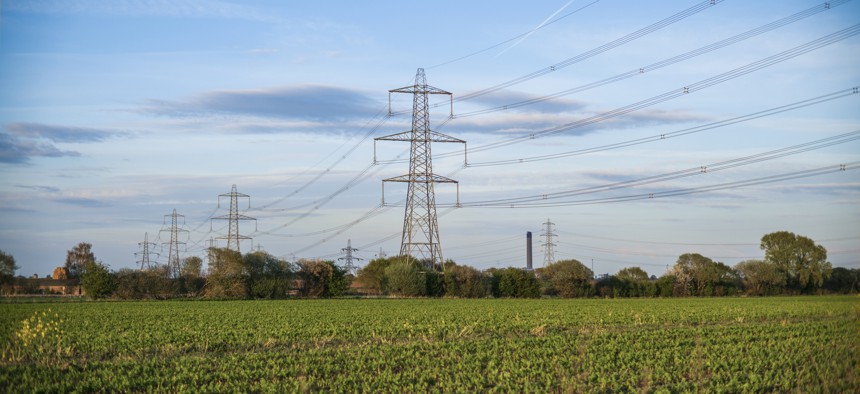
Chris McLoughlin via Getty Images



Texas’s most powerful transmission line threatens pristine river basins and family ranches. Locals and conservationists are fighting to reroute it.
This article was originally published by Daily Yonder.
Rural landowners and conservation advocates across Central and West Texas are mobilizing in response to a proposed extra-high-voltage transmission line that would stretch hundreds of miles across Hill Country and the Lower Pecos regions, raising concerns about environmental harm, property rights, public health, and local economies.
The Howard–Solstice Transmission Line Project is a state-approved plan to build a 765-kilovolt power line designed to improve electric reliability in West Texas, marking the first use of this voltage level in Texas. The project follows a directive from the Texas Legislature and Governor Greg Abbott to address growing electricity demand in the Permian Basin, a region in southwestern Texas where expanding data centers and the oil and gas industry require significant power. The line would connect substations near Fort Stockton and San Antonio.
For many residents along the proposed routes, the project raised red flags.
“My neighbor about half a mile down the road sent me a small blip from an article mentioning these proposed transmission lines,” said Jada Jo Smith, who lives in the Hill Country town of Utopia. “I started doing some research and quickly realized, whoa, these things are massive. We don’t even have anything like this in the state of Texas. Then I found the map with the spider-web network of proposed routes and a huge hub coming right through the center of the Hill Country, crossing all of these pristine rivers.”
After Smith learned about the proposal, she attended an open house to gather information and quickly organized a grassroots, multi-county effort to educate communities, host townhalls, and help residents complete questionnaires that were central to the project’s assessments. That organizing work grew into broader regional advocacy and ultimately led to the formation of the Hill Country Preservation Coalition (HCPC).
Amanda Griffin, a Real County resident in Camp Wood and long-time Nueces River paddler, also attended one of the utility’s open meetings and found herself on the frontlines of the fight to protect the local ecosystem as part of HCPC. She said Real County residents fear the transmission line could fragment family properties, harm the tourism-based economy, and depress land values, while providing no local electricity benefits. And many are both frustrated that they have little say in the planning process and concerned about the line’s possible environmental and health impacts.
“We were all just locals and residents and neighbors and people that had an interest, and we just started mobilizing,” Griffin said. “People are upset that we didn't have any say in this original plan… We're just the avenue that they're taking to fuel more data centers and the oil and gas industry. So there's a lot of real worry and indignation that the governor and ERCOT would do this to such a treasured part of Texas.”
ERCOT, the Electric Reliability Council of Texas, operates and manages the flow of electricity on over 90% of the state’s grid.
Constructing the Howard–Solstice line through the Hill Country would require 200-foot-wide easements and deep excavation into the karst landscape, which sustains the region’s water table, to install towers 140 to 160 feet tall.
The extensive digging needed for the transmission towers could disrupt the region’s fragile karst geology, threatening underground water flows and long-standing wells far beyond the project’s easements.
“For a lot of locals, their grandparents, or their great grandparents, dug the water well,” Griffin said. “They have seen the changes in the water table generally, and they're really concerned about this heavy digging that will go really deep and could change our karst geography in a lot of places.”
The transmission line is planned to run directly from San Antonio to Fort Stockton, carrying electricity to West Texas without any substations in between. Smith said the Hill Country would bear the brunt of the ecosystem damage while receiving none of the electricity benefits.
“The Hill Country just becomes the superhighway,” Smith said. “We do not get any of that energy. There's no stopping point that actually gives or provides any of that electricity to anywhere in the Hill Country.”
HCPC has advocated to reroute the proposed line along existing energy corridors, adjacent to Interstate 10.
Griffin said that when residents asked why the new lines couldn’t share existing easements along Interstate 10, CPS Energy initially explained that the lines were so “caustic” they would accelerate degradation and require extra maintenance on nearby infrastructure. They later offered different explanations, leaving the community skeptical and frustrated that the towers would instead cut through pristine river basins.
Similar to the Hill Country, the proposed transmission line threatens areas further west that also have geographic and environmental vulnerabilities. The proposed route crosses sensitive landscapes, including the Devils and Pecos Rivers, which sit atop fragile karst formations that play a critical role in the region’s water.
“The Devils and Pecos are both karst, and we’re concerned about impacts on groundwater recharge and sedimentation,” said Julie Lewey, the Lower Pecos and Devils River program director for The Nature Conservancy. “There’s also the potential for increased flooding, as well as effects on historical sites and on species of conservation concern.”
Beyond the immediate ecological risks, the line could have long-term consequences for conservation efforts in the region. Romey Swanson, executive director of the Devils River Conservancy, highlighted how Val Verde County has become a leader in land protection.
“As of this year, Val Verde County moved into the number one rank out of all 254 counties in the state of Texas for the number of acres of land in conservation easements,” Swanson said. “In Val Verde County we have this beautiful story of connection to people, ecology, the wildlife, and the water. All of that creates a really beautiful nexus that allows us to accomplish conservation and preservation in this area.”
Over 150,000 acres in Val Verde County are under conservation easements. Swanson said that, based on the original maps, project managers for the transmission line appeared to intentionally avoid lands with existing conservation easements.
“But this isn't a static game,” Swanson said. “We've already added about 45,000 acres of new conservation easements, or pending conservation easements, in Val Verde County alone since the inception of this first map and [the proposed transmission line] is impairing currently pending conservation easement projects.”
The transmission line has also galvanized local landowners to organize in opposition. The Lower Pecos region, in particular, has seen landowners band together to advocate for alternatives to crossing sensitive areas.
“The Lower Pecos landowners have really rallied in opposition [to the line],” Lewey said. “I can't speak for all of them, but a significant number of them have come together to try to fight this and push it to follow existing right of ways, along I-10 and not cross the Lower Pecos.”
Swanson said that the stakes go beyond the immediate footprint of the project. Large infrastructure projects often set precedents, opening the door for additional development that can permanently alter landscapes and local culture.
“This project will be the first injury. We see where these big projects happen, it creates inroads for other incompatible land use projects, and it completely changes the dynamics of the landscape and the culture,” Swanson said. “I've already got landowners that have told me that if this project comes across, they're likely going to sell their ranches, and that ranch will then go to a developer and get broken up into smaller and smaller ranches. People want to be somewhere where the land is being held and respected intact.”
For landowners and conservationists alike, the goal is not to oppose energy development outright, but to find a balance that meets electricity needs while protecting vulnerable land and rural communities.
“We need grid reliability, but we can do this in a way that looks towards something more balanced, as opposed to exploitative,” Swanson said.
Many county governments have publicly opposed the proposed route. County commissioners in Bandera, Uvalde, Medina, Edwards, and Val Verde counties have passed resolutions opposing the proposed route.
“As a landowner and as a cancer survivor myself, I have great concerns about losing my property rights,” said Uvalde County Judge Bill Mitchell at a County Commissioners meeting. “I also have great concerns about how this could affect our health for generations to come.”
Since the project was approved by the legislature and governor, counties are focused on minimizing local damage.
“This has already been approved at the state level. This power line is going to happen. We can’t stop it, but we can stop it from being in Bandera County,” said Bandera County Commissioner Troy Konvicka at an August meeting. “That’s what we’ve got to focus on.”
For Griffin, the struggle over the Howard–Solstice line reflects a broader pattern of rural communities across Texas, and the country, feeling overlooked in decisions about energy and development.
“This is an issue affecting rural communities everywhere,” Amanda Griffin said. “Data centers are creeping in everywhere, and AI companies are creeping in everywhere, and these power issues are happening everywhere.”
But the Hill Country Preservation Coalition isn’t backing down.
“So many times, rural communities feel forgotten in politics, they feel forgotten in decision making, and so we're really trying to help people let their voices be heard,” Griffin said. “We have to keep talking about it. We just have to finish strong, because they need to know that Texas Hill Country and the West River region are as important assets to our state as our electric grid, and they deserve to be protected as much as the Permian Basin deserves to get more electricity…We’re not going quietly.”
“This isn't just our generation. This has a forever impact on our community and the planet,” Smith said. “Texans deserve to be a part of this. Texans deserve to have a say in this.”