
As data centers look to rural New England, Maine considers a moratorium
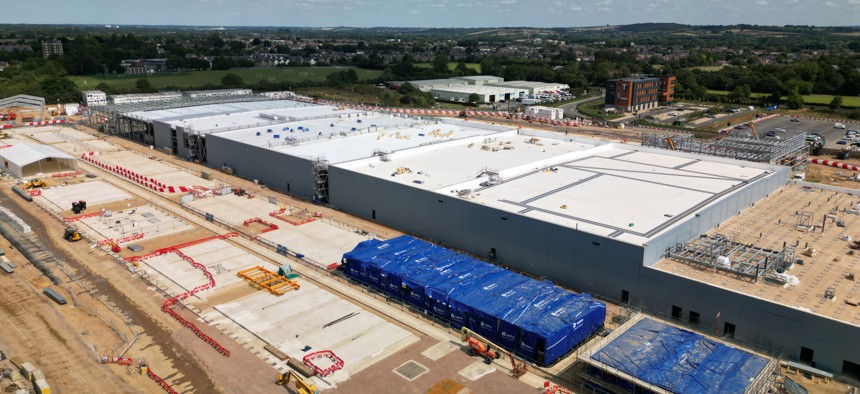
Richard Newstead via Getty Images





The bill’s advocates want answers about how data centers will affect energy costs in the region, which already has some of the country’s highest electricity prices.
This article was originally published by Daily Yonder.
When local officials in rural Wiscasset, Maine, voted on November 4, 2025, to pause a data center discussion in the community of around 4,000 year-round residents, it may have been a sign of what’s to come. As the nationwide expansion of data centers arrives in New England, questions about electricity prices, grid reliability, and impact on water resources are forcing elected leaders to pump the brakes.
One idea floating around Maine’s statehouse is to impose a moratorium on data center development. As the 2026 legislative session gets underway, it has seen state lawmakers try to balance residents’ concerns with the economic development opportunities that data centers bring to communities.
How Maine navigates these challenges could be a model for the rest of New England, which shares an aging electric grid and faces a similar set of circumstances.
From Pause to Moratorium
Maine legislators are currently considering LD 307, a resolution bill that would establish a data center coordination council to provide input and evaluate policy options for data center development in the state. The bill comes after a series of data center proposals have been met with local pushback.
Shortly after Wiscasset voted to pause its data center conversations in November of 2025, residents in Lewiston, Maine, lobbied their city councilors to reject a $300 million AI data center on December 16, 2025. There, community members organized over a weekend to change city councilors’ minds from supporting the idea when it was first made public on December 11, 2025, to voting unanimously to reject it the following week.
“It really speaks to the importance of adequate public participation and notice,” said Dana Colihan, the co-executive director of Slingshot, an environmental health and justice organization in New England. Colihan is based in Maine and helped residents of Wiscasset and Lewiston organize. “When community members do find out about these projects, they have really serious concerns around the impacts to their local environment and wellbeing.”
Richard Davis was among the residents in Wiscasset and neighboring Westport Island who, in November of 2025, pushed Wiscasset’s town selectboard, which functions like a city council, to pause conversations about developing a $5 billion data center on a town-owned parcel of land along the Back River, which empties into Maine’s Casco Bay.
Davis, who lives along the Back River about a mile and a half from the proposed development, said little information about the facility’s end user, utility usage, or power source was provided after it was first made public on September 16, 2025.
This caused him and others to worry about how the site would affect the town’s resources, including the grid. Along with his neighbors, Davis started Protect Wiscasset, a grassroots campaign opposing the data center.
“It appeared that [town officials] had not really taken a look at the potential downsides and what other municipalities all over the country have been experiencing,” said Davis, mentioning water and power usage as well as noise and light pollution.
Since voting to put a pin in data center conversations after residents voiced concerns last fall, Wiscasset’s selectboard is working to develop a coordinated and transparent process for how proposals are presented and evaluated.
When asked about the current status of the pause, Wiscasset’s town manager Dennis Simmons responded that it’s ongoing and that there’s no established timeline for when the work will be completed. “We will take whatever time is necessary to ensure we come up with a fair and open process,” Simmons wrote in a statement to the Daily Yonder.
The pause in Wiscasset is not unlike the moratorium amendment that Maine’s state legislature is currently considering. During a work session of the legislature’s Energy, Utilities and Technology Committee on February 12, 2026, state representative Melanie Sachs, a Democrat of Freeport, Maine, and the bill’s sponsor, proposed adding a moratorium to the bill that would pause the building, permitting, and establishment of data centers with loads above 20 megawatts until July 1, 2028, according to the latest draft of the bill shared with the Daily Yonder.
The proposed amendment was met with opposition from state senator Matt Harrington, a Republican of York, Maine. Senator Harrington said during the work session that a moratorium “would harm” a data center development in his district, which includes several towns in the state’s more urban southern region.
The committee convened for another work session on Thursday, February 19, 2026, where discussion focused on questions about the proposed data center in Sanford, Maine, in Senator Harrington’s district. The moratorium is still on the table, and legislators are seeking to better understand whether the proposed Sanford development would qualify for an exemption. The committee will meet again the week of February 23 for another work session on the bill.
If passed, the moratorium would not affect another AI data center in the works at the former site of Loring Air Force Base in Limestone, Maine, in rural Aroostook County. LiquidCool Solutions, the developer, plans to use a patented immersion-cooling technology rather than traditional air conditioning to keep the racks of servers from overheating inside an existing building that’s now part of Loring Commerce Centre.
The development is slated to open at two megawatts, according to Herb Zien, LiquidCool Solutions’ vice chair.
“The two megawatts is already in the building, and so… the energy's there,” said Zien. The company has a will-serve agreement with Versant Power, a utility in northern and eastern Maine, to provide an additional 24 megawatts using an existing substation in the neighborhood, Zien said. “It starts out as two megawatts, and it could easily become 26 megawatts in a couple of years.”
In a statement to the Daily Yonder, Zien wrote that if LD 307 passes, LiquidCool’s “hope and expectation is that the Loring data center will receive a waiver because the facility consumes no water for cooling servers and, at 26 megawatts, its power will come from generation already in place and underutilized.” If a waiver is not granted, LiquidCool would limit power demand to 20 megawatts, Zien wrote.
Regional Power Questions
Across the Northeast, ratepayers face some of the highest electricity prices in the country, driven in part by volatile gas prices and an aging regional grid. All six New England states – Maine, Massachusetts, New Hampshire, Rhode Island, Vermont, and Connecticut – rank in the top 10 states with the most expensive residential electricity rates, according to Choose Energy, which compiles data from government sources. Massachusetts has the third-highest residential electricity rates in the nation after Hawaii and California, respectively. Within the top 10, Maine saw the greatest year-over-year increase in residential electricity rates in November 2024 and November 2025, with a 10.6% spike.
Now, some advocates in Maine are concerned that data centers demanding power to run 24/7 could raise electricity prices for everyone. This is one reason why Seth Berry, executive director of Our Power, a Maine-based nonprofit organization advocating for energy democracy, supports the moratorium. Berry previously spent 14 years in the Maine legislature and is the former House Chair of the legislature’s Joint Standing Committee on Energy, Utilities and Technology.
“There are just so many unknowns,” Berry said. “We really have to slow this down and step back and look at this massive new development, preferably as a region.”