
Maine enlists AI to help combat rising home insurance rates
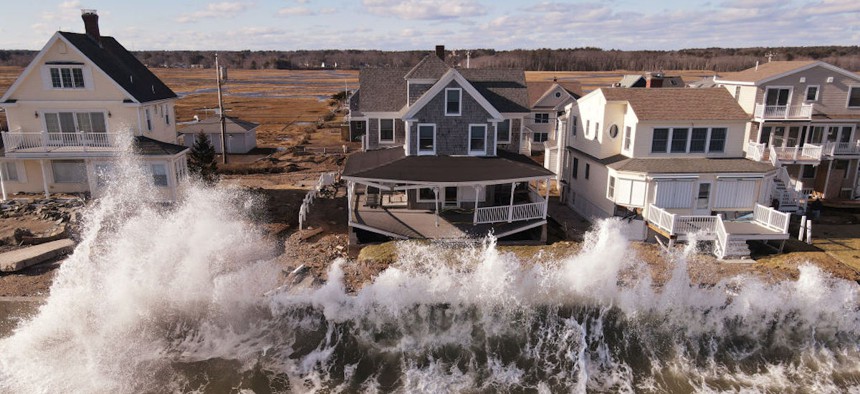
A wave breaks against a sea wall in front of homes along Wells Beach in Wells, Maine, on Sunday, Jan. 14, 2024. Gregory Rec/Portland Press Herald via Getty Images






The state is administering a grant program for residents to retrofit their homes with climate resilient roofs, and an artificial intelligence-enabled platform looks to enhance program speed and efficiency.
Maine, known for its picturesque coastal cottages and rocky shores adorned with lighthouses, is also reckoning with the impacts of climate change that have grown more severe and frequent in recent years. Rising sea levels and skyrocketing temperatures have pushed state officials to pursue solutions to help residents protect their homes, and artificial intelligence has emerged as a key player.
The Maine Bureau of Insurance is rolling out a grant program for state residents this year that will partially finance roof repairs to build their homes’ resilience against severe climate events, like hurricanes. The program comes as homeowners insurance premiums have seen a 23% rate increase in recent years.
Through the $15 million Fortify Maine Homes program, homeowners could be eligible for at least $10,000 and up to $15,000 in grant money to support their climate resilience projects. To efficiently approve applications and dole out funds, officials realized the program needed a platform to streamline and expedite the process, said Charlie Mercer, the program lead.
“There are a lot of players in the program — everyone from applicants to contractors to evaluators and other individuals,” he said, adding that BOI wanted to “build a system that allows all of those people to communicate with each other and move as efficiently as possible.”
Helping the state build and implement such a system is Forerunner, a geospatial platform provider. For BOI, Forerunner has designed an online portal where residents can apply for grant money based on required criteria, such as holding state residency, owning a single-family or duplex home, having an in-force homeowners’ insurance policy and others.
AI is then used to assist BOI staff with conducting application reviews, prompting human staff to confirm if the application is missing information or contains incorrect data that the original applicant needs to address, Mercer explained. An independent evaluator will also inspect the property to determine if the home meets the program’s standards for qualification, the results of which will be examined by the AI tool.
The online platform will generate an AI-enabled summary to inform BOI staff’s decision to approve or deny an application, after which the state will send homeowners a list of state-approved contractors who can complete the construction project, he said.
“AI is going to be able to do a number of things for us that will speed up the process,” Mercer said. “If AI can tell me if that's a real correct address, I want AI to tell me that. If AI can tell me [a house is] in a flood zone, I want AI to tell me that, rather than the staff person having to go look up addresses and make sure they're real addresses. That’s going to allow our folks to focus on the bigger, more important issues in terms of getting applications processed.”
Once an application is approved, the AI tool also helps users draft and send emails and other communications between homeowners, contractors and evaluators through the portal to ensure stakeholders are updated on the project’s progress, Mercer said.
The program and the platform used to implement it “will bring a new market” to Maine, he said. For example, homeowners will be able to engage with businesses more, and businesses will have new and more work opportunities through the initiative. For the state government, leaders could see service delivery speed and efficiency improve.
To get there, “we want to tiptoe before we walk and walk before we run,” Mercer said. That’s why the home improvement program will first be piloted in four counties where data shows homeowners face relatively high costs from insurance claims. The application period is slated to open in June.
Next year, officials plan to expand program coverage for flood mitigation projects, such as drain installation, sealing home foundations and opening and retrofitting electrical systems.
“Eventually we'll be able to show the state of Maine a return on investment on their dollars [through] how much we were able to help homeowners across the state, how much homeowners invest in these properties as well, and what insurance savings [we] were able to receive and achieve because of the work that was done through this program,” Mercer said. “I can't imagine the number of people or what we'd have to do if we had to do this all manually, so the portal and AI together really are going to be a huge help to us.”