State bolsters passport security

The State Department has declared that electronic passports will be safe from identity thieves.

The State Department has declared that electronic passports will be safe from identity thieves.The department has decided to adopt metallic shields and is seriously considering 'basic access control' as a further means of preventing the skimming of personal data stored on a passport's chip.One form of basic access control under consideration is to imprint data on a passport's machine-readable zone. The data would exchange an algorithm with a reader at the border station, which in turn would unlock the chip embedded in the passport.A government source said that some observers consider encryption of the signal emitted by the chip as a form of basic access control as well. A spokeswoman for State's Bureau of Consular Affairs said that State has not made a final decision on the security technology because it has not chosen a vendor.Privacy organizations have criticized State for not integrating more security features early in the design of the electronic passport's radio frequency identification technology. They worried that someone equipped with a card reader close to the passport holder could skim personal data.'We will not issue a new-designed U.S. passport to the public with a chip until we have successfully addressed the risk of skimming,' said Frank Moss, deputy assistant secretary of State for consular affairs. 'The technology we're looking at with the most intensity is putting on the front cover metallic or some type of material, which serves as a Faraday shield, and prevents the reading of the book while it's closed or mostly closed.'A Faraday shield is a general name for an electrostatic shield.The National Institute of Standards and Technology has been testing various shields included in e-passport procurement proposals. They are all based on the principle that the shield will prevent the chip and the reader from communicating as long as the passport is closed, he said.NIST by sometime this month expects to complete testing of the chips for normal wear-and-tear durability and electromagnetic durability and security. The results will carry a lot of weight in State's decision to award the contracts, Moss said.'This issue of security of personal information written into the chip is one we take very seriously. We are looking at it from a variety of angles, and we will produce a passport that will not endanger the privacy of those carrying it,' Moss said.The passports will work much like building-access cards. The chip, which would let Customs agents quickly process passengers entering the country, will hold a digital record of the information contained on the paper passport, such as name, document number and a photograph, agency officials have said.The chip has a built-in antenna that uses radio waves to transmit information when it comes close to a machine reader, for contactless reading of the information. The reader will grab the data from the chip from up to four inches away, State officials have said.Critics, such as the American Civil Liberties Union, have said that identity thieves or terrorists could capture information, even from a distance greater than four inches, with readers equipped with more powerful antennae.The more a passport has to be used and removed from its protective cover, the more opportunities others have to skim the information, said Jay Stanley, spokesman for ACLU's technology and liberty program.Even implementing a shield, State should come up with a new standard that does not include an unencrypted RFID tag and should include privacy protections, Stanley said.But supporters of the e-passport shield discount critics' fears.'These have been proven to be inaccurate statements,' said Randy Vanderhoof, executive director of the Smart Card Alliance, a trade group in Princeton Junction, N.J.With a higher-powered antenna, the reader could not read the contents of the passport, but only know that an e-passport was in the room.'This standard RFID was chosen because the technology operates within a prescribed range of only 10 centimeters, or four inches,' Vanderhoof said.
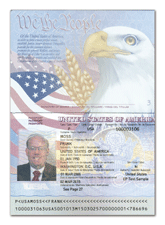
The State Department released this photo of what new passports would look like.


Put to the test


X
This website uses cookies to enhance user experience and to analyze performance and traffic on our website. We also share information about your use of our site with our social media, advertising and analytics partners. Learn More / Do Not Sell My Personal Information
Accept Cookies
X
Cookie Preferences Cookie List

Do Not Sell My Personal Information

When you visit our website, we store cookies on your browser to collect information. The information collected might relate to you, your preferences or your device, and is mostly used to make the site work as you expect it to and to provide a more personalized web experience. However, you can choose not to allow certain types of cookies, which may impact your experience of the site and the services we are able to offer. Click on the different category headings to find out more and change our default settings according to your preference. You cannot opt-out of our First Party Strictly Necessary Cookies as they are deployed in order to ensure the proper functioning of our website (such as prompting the cookie banner and remembering your settings, to log into your account, to redirect you when you log out, etc.). For more information about the First and Third Party Cookies used please follow this link.

Allow All Cookies

Manage Consent Preferences

Strictly Necessary Cookies - Always Active

We do not allow you to opt-out of our certain cookies, as they are necessary to ensure the proper functioning of our website (such as prompting our cookie banner and remembering your privacy choices) and/or to monitor site performance. These cookies are not used in a way that constitutes a “sale” of your data under the CCPA. You can set your browser to block or alert you about these cookies, but some parts of the site will not work as intended if you do so. You can usually find these settings in the Options or Preferences menu of your browser. Visit www.allaboutcookies.org to learn more.

Sale of Personal Data, Targeting & Social Media Cookies

Under the California Consumer Privacy Act, you have the right to opt-out of the sale of your personal information to third parties. These cookies collect information for analytics and to personalize your experience with targeted ads. You may exercise your right to opt out of the sale of personal information by using this toggle switch. If you opt out we will not be able to offer you personalised ads and will not hand over your personal information to any third parties. Additionally, you may contact our legal department for further clarification about your rights as a California consumer by using this Exercise My Rights link

If you have enabled privacy controls on your browser (such as a plugin), we have to take that as a valid request to opt-out. Therefore we would not be able to track your activity through the web. This may affect our ability to personalize ads according to your preferences.

Targeting cookies may be set through our site by our advertising partners. They may be used by those companies to build a profile of your interests and show you relevant adverts on other sites. They do not store directly personal information, but are based on uniquely identifying your browser and internet device. If you do not allow these cookies, you will experience less targeted advertising.

Social media cookies are set by a range of social media services that we have added to the site to enable you to share our content with your friends and networks. They are capable of tracking your browser across other sites and building up a profile of your interests. This may impact the content and messages you see on other websites you visit. If you do not allow these cookies you may not be able to use or see these sharing tools.

If you want to opt out of all of our lead reports and lists, please submit a privacy request at our Do Not Sell page.

Save Settings
Cookie Preferences Cookie List

Cookie List

A cookie is a small piece of data (text file) that a website – when visited by a user – asks your browser to store on your device in order to remember information about you, such as your language preference or login information. Those cookies are set by us and called first-party cookies. We also use third-party cookies – which are cookies from a domain different than the domain of the website you are visiting – for our advertising and marketing efforts. More specifically, we use cookies and other tracking technologies for the following purposes:

Strictly Necessary Cookies

We do not allow you to opt-out of our certain cookies, as they are necessary to ensure the proper functioning of our website (such as prompting our cookie banner and remembering your privacy choices) and/or to monitor site performance. These cookies are not used in a way that constitutes a “sale” of your data under the CCPA. You can set your browser to block or alert you about these cookies, but some parts of the site will not work as intended if you do so. You can usually find these settings in the Options or Preferences menu of your browser. Visit www.allaboutcookies.org to learn more.

Functional Cookies

We do not allow you to opt-out of our certain cookies, as they are necessary to ensure the proper functioning of our website (such as prompting our cookie banner and remembering your privacy choices) and/or to monitor site performance. These cookies are not used in a way that constitutes a “sale” of your data under the CCPA. You can set your browser to block or alert you about these cookies, but some parts of the site will not work as intended if you do so. You can usually find these settings in the Options or Preferences menu of your browser. Visit www.allaboutcookies.org to learn more.

Performance Cookies

We do not allow you to opt-out of our certain cookies, as they are necessary to ensure the proper functioning of our website (such as prompting our cookie banner and remembering your privacy choices) and/or to monitor site performance. These cookies are not used in a way that constitutes a “sale” of your data under the CCPA. You can set your browser to block or alert you about these cookies, but some parts of the site will not work as intended if you do so. You can usually find these settings in the Options or Preferences menu of your browser. Visit www.allaboutcookies.org to learn more.

Sale of Personal Data

We also use cookies to personalize your experience on our websites, including by determining the most relevant content and advertisements to show you, and to monitor site traffic and performance, so that we may improve our websites and your experience. You may opt out of our use of such cookies (and the associated “sale” of your Personal Information) by using this toggle switch. You will still see some advertising, regardless of your selection. Because we do not track you across different devices, browsers and GEMG properties, your selection will take effect only on this browser, this device and this website.

Social Media Cookies

We also use cookies to personalize your experience on our websites, including by determining the most relevant content and advertisements to show you, and to monitor site traffic and performance, so that we may improve our websites and your experience. You may opt out of our use of such cookies (and the associated “sale” of your Personal Information) by using this toggle switch. You will still see some advertising, regardless of your selection. Because we do not track you across different devices, browsers and GEMG properties, your selection will take effect only on this browser, this device and this website.

Targeting Cookies

We also use cookies to personalize your experience on our websites, including by determining the most relevant content and advertisements to show you, and to monitor site traffic and performance, so that we may improve our websites and your experience. You may opt out of our use of such cookies (and the associated “sale” of your Personal Information) by using this toggle switch. You will still see some advertising, regardless of your selection. Because we do not track you across different devices, browsers and GEMG properties, your selection will take effect only on this browser, this device and this website.