
‘No time to waste’ in prepping governments for AI cyber threats, top Dem lawmaker says
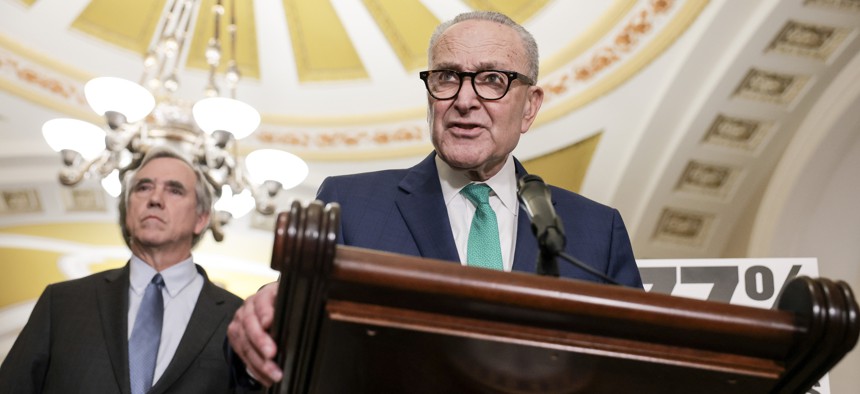
U.S. Sen. Chuck Schumer speaks during a recent press conference on Capitol Hill. The Senate Minority Leader called on DHS to work closely with states and localities on cyber issues. Anna Moneymaker via Getty Images




 By
Chris Teale
By
Chris Teale
Senate Minority Leader Chuck Schumer called on the Department of Homeland Security to work closer with states and localities, and bemoaned the end of federal funding to an information-sharing center.
The U.S. Senate’s top Democrat called on the Department of Homeland Security last week to better coordinate its response to artificial intelligence-driven cyber threats with state, local, tribal and territorial governments.
Sen. Chuck Schumer, the New York Democrat who serves as Senate Minority Leader, said in a letter to Homeland Security Secretary Markwayne Mullin that the world is “coming to grips” with the fact that AI systems will soon be better than humans at finding software vulnerabilities. Schumer’s letter came after Anthropic announced last month that its Claude Mythos Preview model is “strikingly capable” at finding cybersecurity vulnerabilities.
Schumer called on Mullin and DHS to work closely with other units of government to prepare them properly for those cyber threats from AI. He noted the threats that states, localities and others face, including to their critical infrastructure, and urged the federal government to do more to protect them. AI could be capable of hacking such systems within a year, he said.
“As AI continues its rapid development — including important cybersecurity advances as well as dangerous new hacking tools — it is imperative that all levels of our government have access to this technology so they can prepare before it’s too late. We must beat cyber criminals in the race to defend our most critical systems from AI-enabled hacking or attacks,” Schumer said in a statement accompanying the letter. “There is no excuse for the Department of Homeland Security’s delay in bolstering state and local government cybersecurity capabilities. We must begin this process now — before there are any major disruptions to hospitals or energy grids — or worse.”
In his letter, Schumer asked Mullin to provide information on how DHS will coordinate with SLTT governments and the private sector to conduct risk assessments of critical infrastructure, and share information about vulnerability discovery and response. He also asked Mullin how DHS will work with other governments to provide remediation solutions, facilitate rapid vulnerability patching, offer access to modern testing and evaluation, and advise governments on identifying top AI talent and training to prepare the next generation of tech workers.
Schumer’s letter noted that those questions come on the heels of the federal government pulling funding for the Multi-State Information Sharing and Analysis Center, which he noted was designated in 2010 as the “primary source” for those functions and more. Since the Cybersecurity and Infrastructure Security Agency announced it had pulled funding for MS-ISAC, the center has moved to a membership model.
For their part, officials in President Donald Trump’s administration have promised more information sharing, especially after the release of the National Cyber Strategy in early March. In a previous public appearance, White House National Cyber Director Sean Cairncross said agencies — including CISA as well as the Department of Justice and Federal Bureau of Investigation — were “looking for ways to streamline information sharing from the [U.S. government] side.”
“Often how we know things is super sensitive,” he continued. “What we know is less so. We want to figure out how to communicate that in a helpful, actionable way, as we work through that on the interagency side, with partners on the state and local side.”
Schumer, however, said the decision to cut funding to the MS-ISAC was a poor one given how AI has shifted the threat landscape.
“Given the monumental changes quickly coming to cybersecurity as the result of frontier AI, and the need for organizations to be able to perceive and contextualize risks earlier than ever before, there could not be a worse time to undercut proven, longstanding MS-ISAC processes, procedures, and resources for sharing cyberthreat intelligence with SLTTs,” the letter said.
Schumer asked for a plan for “coordinating our nation’s response to frontier AI-enabled hacking” by July 1, as well as a nominee to lead CISA.
“AI is changing the cyber battlefield fast — and we cannot let hackers get there first,” Schumer said in a statement. “Hospitals, power grids, water systems, schools, elections, and emergency services cannot be left exposed while criminal gangs and state-backed hackers race to exploit new AI tools. DHS must immediately help states and localities find and fix vulnerabilities before Americans are hit with outages, disruptions, and attacks that could put lives and livelihoods at risk. This is a race between cyber defenders and AI-enabled hackers — and with communities across the country at risk, there is no time to waste.”