
Mobile and wireless computing





Defense Secretary William Cohen has gone wireless.
By Richard W. WalkerGCN StaffDefense Secretary William Cohen has gone wireless.Cohen and several aides recently picked up new Palm VII wireless handheld computers for use as connected personal information managers and for e-mail, said John Inkley, federal sales manager for Palm Computing Inc., a subsidiary of 3Com Corp. of Santa Clara, Calif.'The fact that he could be anywhere in the U.S. and get a wireless e-mail is pretty cool,' Inkley said.The Defense secretary has jumped on the bandwagon early. The Palm VII is available only in the New York area; 3Com doesn't expect to complete its nationwide rollout until early October.Cohen's alacrity in adopting wireless handheld computing reflects a groundswell of mobile computing in the federal government.Another sign of the times is the General Services Administration's fledgling Office Anywhere program.Just now getting staffed and cranked up for business, Office Anywhere is a GSA division that will focus on providing remote-access systems to the growing federal mobile work force.The mission of Office Anywhere is 'to market mobile computing to the federal government and use the contract vehicles that already exist within the Federal Technology Service, Federal Supply Service and Public Buildings Service to provide the products and services,' chief operations officer Wanda Smith said.An assortment of factors is driving the upsurge in mobile computing: The Internet The rising popularity of notebook computing and declining prices for notebooks The emergence of new remote-access and wireless technologies Shifts in work patterns to such things as telecommuting and flexible schedules.'The workplace is changing,' Smith said. 'The new wave is to do your job where you have to do it'on the road, in a hotel, from home. People aren't working 9 to 5 anymore, so they want to be able to access that enterprise, that data, that e-mail and those files anytime, anywhere. Otherwise, they're not productive.'As a result, agencies must get ready to provide for the information technology needs of mobile workers.'I tell agencies that I don't think it's a question of whether we're going to do it,' Smith said. 'We're going to have to do it.'Is the enterprise prepared? That's a key question for Smith.'We have to start thinking about how we structure our enterprise,' she said. 'As we develop applications, we have to start thinking about the remote worker and how they're going to be accessing data.'Smith gave an example: To access an enterprise, users typically go through a modem pool, and it can handle only a limited number of remote-access users. 'You can't just all of a sudden decide that another 100 [users] can work from the road and give them a modem,' she said.There will be a host of other vexing considerations, such as whether and how to replace desktop PCs.'We have mobility, but we're still tethered to our stationary desktops,' Smith said. 'I don't think that's going to last. So you have to decide: Do you need a full-size desktop PC or can you go with something like a ThinkPad [from IBM Corp.]? Or do you want your full-blown desktop and [also] go with something like the little Libretto [from Toshiba America Information Systems Inc.]?'It's difficult for people to make those kinds of decisions, she said, because the smaller machines can be difficult to work on and are expensive.In addition, handing mobile workers both a desktop and a notebook PC means providing technical support for two seats, not one'an expensive proposition.'You get everyone running into support not only when their desktop is down but when their laptop is down,' Smith said. 'Now we're getting up in the dollars.'An alternative, Smith said, is docking stations. She noted that FTS' new Willow Woods facility in Vienna, Va., has equipped workers with notebooks, docking stations and flat-panel monitors. No more desktop PCs.'That was very clever. That's how they resolved the issue of two computers and two seats,' she said.By all accounts, notebooks will continue to grab a larger portion of the federal computing landscape. A recent GCN poll found that feds expect to increase their use of notebook PCs from 20 percent of their work time to 27 percent in the next three years [GCN, March 15, Page 22].'More and more, we're seeing the selection of notebooks by federal government customers for their primary computing media,' said Phil Kennett, federal sales manager for Gateway Inc.Feds are using notebook PCs for a spectrum of critical applications. For example, 3,000 Agriculture Department meat inspectors across the country are toting Gateway Solos so they can communicate with supervisors via e-mail and access databases as they inspect poultry plants and slaughterhouses. Until recently, keeping in touch with supervisors meant playing phone tag.'We now have the ability, with a single command, to send messages to four-fifths of our work force,' said Peter Kuhmerker, the agency's director of field automation and management.The program has been so effective that the department plans to equip another 1,400 inspectors with notebooks by 2000.At the Treasury Department's Office of the Comptroller of the Currency, about 120 bank examiners use notebooks as they travel around the nation making sure that banks meet federal standards.At banks, OCC examiners collect data in Examiner View, a new OCC application that uses Sybase Inc.'s Adaptive Server Anywhere, a mobile database. When they get access to their modems, they simply click on an icon to upload the data to a central database in Landover, Md.OCC officials expect that about 170 more bank examiners will be using the new system by the end of the summer.Notebook PCs are on the move, but watch out for handheld computers.The latest handheld devices, boasting vastly increased functionality and power, also are making their way into the government, though with more limited applications.The killer app for pen-based handhelds, which let users work while standing or walking, is data collection.At Bath Iron Works in Maine, 30 Navy quality-assurance inspectors used Palm III handhelds in March to check equipment on the USS O'Kane before the destroyer's maiden voyage.The ability to use standardized equipment names and upload the data to a central database has markedly improved and expedited the ship inspection process. Previously, inspectors scribbled their observations into notebooks. The data then had to be keyed into a database. The process was time-consuming and error-prone.The service now plans to implement inspections using handhelds at the other Navy destroyer shipyard, in Pascagoula, Miss.Bucky Buchanan, division head at the Naval Computer and Telecommunications Station'Washington, is developing systems for palmtops to gather data aboard Navy mine ships. He is gung-ho on handhelds.'Mobile phones have shown us that we can be somewhere else and get a lot done,' he said, 'but handheld devices take that mind-set to a higher level with more possibilities.'At the Federal Emergency Management Agency, inspectors use pen-tablet computers from Fujitsu Personal Systems Inc. of Santa Clara to inspect disaster areas. The Housing and Urban Development Department, the Bureau of Labor Statistics, the IRS' Internal Security Division and the Atomic Energy Commission also use pen tablets for a variety of data collection purposes.So what's ahead? Think wireless.'Wireless computing will probably represent the next boom in technology for federal government customers,' Kennett said.At the Veterans Affairs Department's medical center in Phoenix, information systems managers are testing a wireless LAN that gives nurses using Dell Latitude notebooks instant access to a database containing patient prescription information. The system is designed to ensure that patients are given the correct medications.'In the four or five weeks we've been testing it, we've seen a significant drop in medication errors,' said Richard Moore, chief information officer at the medical center.'We think the time is right for wireless LANs,' said Diana Roberson, director of product marketing for 3Com's wireless and home connectivity division, a new unit designed to capitalize on the growing wireless market.Feeding interest in wireless LANs is the Institute of Electrical and Electronics Engineers' new 802.11 high-rate standard, which ramps up data transmission rates to 11 Mbps, more than five times the previous 2-Mbps standard rate.'We had customers who told us they're not going to implement wireless LANs because it's not fast enough,' Roberson said. 'But now we have Ethernet speeds, so we're there.'Another factor is a drop in price. Roberson said 3Com can now offer wireless LAN products at half the price of a year ago.The growth in wireless technologies also portends a new set of concerns.'Defense agencies will have to have some fairly bulletproof security measures before they're going to adopt it in a wholesale fashion,' Kennett said. 'Concerns about security are going to have to be well-documented and well-accommodated, and as soon as that is done we'll see an increasing marketplace for it, certainly in the DOD community.'But for all that's happening in federal mobile computing, observers aren't quite ready to call it a revolution.'It's evolutionary, not revolutionary,' GSA's Smith said. 'Mobility is not really a new concept. We've always had to be mobile. It's just that now we have the tools to be more productive when we're mobile.'
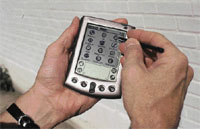 Remote federal users let their fingers do the working
Everybody in the pool?
Phone tag's over
Everybody in the pool?
Phone tag's over