Curing cancer, one computer model at a time

A lot can happen between a couple of proteins in one-millionth of a second.

By Patricia DaukantasGCN StaffA lot can happen between a couple of proteins in one-millionth of a second.Understanding such interactions, uncovered by hundreds of hours of number-crunching on a supercomputer, might someday pave the way for drugs to fight cancer at its chemical core.'We're simulating on the atomic level various processes that proteins undergo, to see if there's something that can be used to therapeutic advantage,'' said biophysicist Stanley K. Burt, director of the National Cancer Institute's Advanced Biomedical Computing Center (ABCC) in Frederick, Md.The center recently leased a Cray Research SV1 vector supercomputer to create detailed simulations of the interactions between proteins and other biochemical molecules.Under a three-year, $6.5 million agreement with SGI, the laboratory will swap its 8-year-old Cray Y-MP vector supercomputer for an SV1 rated at 115 billion floating-point operations per second. SGI announced this month that it will spin off the Cray supercomputing line as a separate business unit.Burt said the lab took delivery of the four-node, 64-processor SV1 at the end of June. Later this year it will be upgraded to 96 processors, each rated at 1.2 GFLOPS.'Technology is changing so fast, we thought leasing would be the prudent choice,'' Burt said.The arrangement will keep ABCC open to Cray's planned SV2 architecture or other options that might arise, said Bob Lebherz, computer operations manager at the Frederick facility.The SV1 has 96G of memory and 1.2T of Fibre Channel storage, Lebherz said. A high-speed SGI GigaRing input/output subsystem connects the SV1 cluster's four nodes.NCI officials chose the SV1 largely for its compatibility with early supercomputers such as the Y-MP, said biochemist Jacob Maizel Jr., chief of NCI's Laboratory of Experimental and Computational Biology.Lebherz praised the SV1's checkpoint restart utility, which lets system administrators stop the supercomputer temporarily for maintenance and then bring it back up without having to restart a lengthy simulation from scratch. 'Checkpoint restart is just essential,'' he said.The calculations used in Burt's quantum-chemistry simulations require lots of storage for intermediate results and lots of access to the stored data. The SV1's local-memory storage gives better performance than scalar computers can, Maizel said.A typical quantum-chemistry simulation involves 500,000 lines of Fortran or C code to simulate tiny motions for only about one microsecond of real time, Burt said.Less powerful hardware had restricted the center's scientists to simulating only a billionth or a trillionth of a second of time. Simulations of a millisecond-long chemical reaction are still several computer generations in the future, Burt said.ABCC scientists base many of their simulations on a Gaussian algorithm originally developed by John A. Pople of Northwestern University. Pople shared last year's Nobel Prize in chemistry for his work in developing computational methods in quantum chemistry.Gaussian algorithms calculate everything from first principles and require about 16G of memory to run, Maizel said. Other molecular-mechanical simulations start with more assumptions and use less memory, but they have to run for a long time, he said.To study the large data sets produced by the calculations, NCI scientists use data analysis and visualization tools from Molecular Simulations Inc. of San Diego, Maizel said.The elastic interactions between two biological molecules depend on how their shapes fit together, Maizel said. 'These are very lumpy, bumpy molecules, and the lumps have to fit into the holes and sockets on the complementary molecules,'' he said. 'Calculating all that is a big job.''In his own research, Burt studies proteases'enzymes that break down proteins into smaller groups of amino acids known as peptides.Several years ago Burt and an NCI colleague, chemist Yuri Abashkin, performed computer simulations of proteases made by the virus that causes AIDS. Their simulation took about 1,500 CPU hours on the Cray Y-MP. The same model would probably take only 300 hours on the SV1, Burt said.When cancer cells metastasize, they use proteases to enter various tissues within the body. 'If you could understand how to block it, that would be good,'' Maizel said.The malaria parasite uses similar proteases to dissolve the hemoglobin that it lives on in the human bloodstream, Maizel said. Many other viruses, including those that cause the common cold, need proteases to replicate themselves.The Cray SV1 and ABCC's other high-performance computers are available to scientists from NCI, other divisions of the National Institutes of Health and general biomedical researchers, Maizel said. A 12-member panel representing the different groups reviews proposals and allocates time on the big machines. Most researchers submit their computational jobs from their own institutions rather than make the trek to Frederick.Unlike the nation's other publicly accessible supercomputer centers, ABCC focuses exclusively on computing that's related to biology, Burt said. Only recently have computers become big and fast enough to simulate biological phenomena, but such models already have had a large impact on the invention of new drugs, he said.


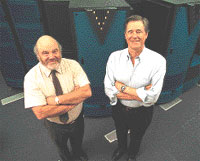
Biophysicists Stanley K. Burt, left, and Jacob Maizel Jr. will use this Cray Research supercomputer to simulate protein interactions.


Work together


Faster now


X
This website uses cookies to enhance user experience and to analyze performance and traffic on our website. We also share information about your use of our site with our social media, advertising and analytics partners. Learn More / Do Not Sell My Personal Information
Accept Cookies
X
Cookie Preferences Cookie List

Do Not Sell My Personal Information

When you visit our website, we store cookies on your browser to collect information. The information collected might relate to you, your preferences or your device, and is mostly used to make the site work as you expect it to and to provide a more personalized web experience. However, you can choose not to allow certain types of cookies, which may impact your experience of the site and the services we are able to offer. Click on the different category headings to find out more and change our default settings according to your preference. You cannot opt-out of our First Party Strictly Necessary Cookies as they are deployed in order to ensure the proper functioning of our website (such as prompting the cookie banner and remembering your settings, to log into your account, to redirect you when you log out, etc.). For more information about the First and Third Party Cookies used please follow this link.

Allow All Cookies

Manage Consent Preferences

Strictly Necessary Cookies - Always Active

We do not allow you to opt-out of our certain cookies, as they are necessary to ensure the proper functioning of our website (such as prompting our cookie banner and remembering your privacy choices) and/or to monitor site performance. These cookies are not used in a way that constitutes a “sale” of your data under the CCPA. You can set your browser to block or alert you about these cookies, but some parts of the site will not work as intended if you do so. You can usually find these settings in the Options or Preferences menu of your browser. Visit www.allaboutcookies.org to learn more.

Sale of Personal Data, Targeting & Social Media Cookies

Under the California Consumer Privacy Act, you have the right to opt-out of the sale of your personal information to third parties. These cookies collect information for analytics and to personalize your experience with targeted ads. You may exercise your right to opt out of the sale of personal information by using this toggle switch. If you opt out we will not be able to offer you personalised ads and will not hand over your personal information to any third parties. Additionally, you may contact our legal department for further clarification about your rights as a California consumer by using this Exercise My Rights link

If you have enabled privacy controls on your browser (such as a plugin), we have to take that as a valid request to opt-out. Therefore we would not be able to track your activity through the web. This may affect our ability to personalize ads according to your preferences.

Targeting cookies may be set through our site by our advertising partners. They may be used by those companies to build a profile of your interests and show you relevant adverts on other sites. They do not store directly personal information, but are based on uniquely identifying your browser and internet device. If you do not allow these cookies, you will experience less targeted advertising.

Social media cookies are set by a range of social media services that we have added to the site to enable you to share our content with your friends and networks. They are capable of tracking your browser across other sites and building up a profile of your interests. This may impact the content and messages you see on other websites you visit. If you do not allow these cookies you may not be able to use or see these sharing tools.

If you want to opt out of all of our lead reports and lists, please submit a privacy request at our Do Not Sell page.

Save Settings
Cookie Preferences Cookie List

Cookie List

A cookie is a small piece of data (text file) that a website – when visited by a user – asks your browser to store on your device in order to remember information about you, such as your language preference or login information. Those cookies are set by us and called first-party cookies. We also use third-party cookies – which are cookies from a domain different than the domain of the website you are visiting – for our advertising and marketing efforts. More specifically, we use cookies and other tracking technologies for the following purposes:

Strictly Necessary Cookies

We do not allow you to opt-out of our certain cookies, as they are necessary to ensure the proper functioning of our website (such as prompting our cookie banner and remembering your privacy choices) and/or to monitor site performance. These cookies are not used in a way that constitutes a “sale” of your data under the CCPA. You can set your browser to block or alert you about these cookies, but some parts of the site will not work as intended if you do so. You can usually find these settings in the Options or Preferences menu of your browser. Visit www.allaboutcookies.org to learn more.

Functional Cookies

We do not allow you to opt-out of our certain cookies, as they are necessary to ensure the proper functioning of our website (such as prompting our cookie banner and remembering your privacy choices) and/or to monitor site performance. These cookies are not used in a way that constitutes a “sale” of your data under the CCPA. You can set your browser to block or alert you about these cookies, but some parts of the site will not work as intended if you do so. You can usually find these settings in the Options or Preferences menu of your browser. Visit www.allaboutcookies.org to learn more.

Performance Cookies

We do not allow you to opt-out of our certain cookies, as they are necessary to ensure the proper functioning of our website (such as prompting our cookie banner and remembering your privacy choices) and/or to monitor site performance. These cookies are not used in a way that constitutes a “sale” of your data under the CCPA. You can set your browser to block or alert you about these cookies, but some parts of the site will not work as intended if you do so. You can usually find these settings in the Options or Preferences menu of your browser. Visit www.allaboutcookies.org to learn more.

Sale of Personal Data

We also use cookies to personalize your experience on our websites, including by determining the most relevant content and advertisements to show you, and to monitor site traffic and performance, so that we may improve our websites and your experience. You may opt out of our use of such cookies (and the associated “sale” of your Personal Information) by using this toggle switch. You will still see some advertising, regardless of your selection. Because we do not track you across different devices, browsers and GEMG properties, your selection will take effect only on this browser, this device and this website.

Social Media Cookies

We also use cookies to personalize your experience on our websites, including by determining the most relevant content and advertisements to show you, and to monitor site traffic and performance, so that we may improve our websites and your experience. You may opt out of our use of such cookies (and the associated “sale” of your Personal Information) by using this toggle switch. You will still see some advertising, regardless of your selection. Because we do not track you across different devices, browsers and GEMG properties, your selection will take effect only on this browser, this device and this website.

Targeting Cookies

We also use cookies to personalize your experience on our websites, including by determining the most relevant content and advertisements to show you, and to monitor site traffic and performance, so that we may improve our websites and your experience. You may opt out of our use of such cookies (and the associated “sale” of your Personal Information) by using this toggle switch. You will still see some advertising, regardless of your selection. Because we do not track you across different devices, browsers and GEMG properties, your selection will take effect only on this browser, this device and this website.