
INTERVIEW: Col. Philip E. Vermeer, Guard's network scout





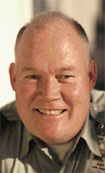
Col. Philip E. Vermeer is chief of the Information Systems Division Directorate at the Army National Guard Readiness Center, a job he began in March after working as the organization's director of strategic initiatives.
Col. Philip E. Vermeer is chief of the Information Systems Division Directorate at the Army National Guard Readiness Center, a job he began in March after working as the organization's director of strategic initiatives.As product manager for the National Guard Bureau Distributive Training Technology Project, Vermeer leads the development of the bureau's distance-learning initiative, through which his organization constructed the first federal asynchronous transfer mode network with points of presence in all 50 states and the U.S. territories.An Iowa guardsman who enlisted in 1970, Vermeer was personnel officer for the General Officer Personnel Management Office until 1993. He was also project officer for the Iowa National Guard Lightways Research Project. He moved to the National Guard Bureau headquarters in 1995.Vermeer has a bachelor's degree from Iowa State University and a master's in public administration from Drake University. He has won the Meritorious Service Medal, the Army Achievement Medal, the National Defense Service Medal, the Army Command Overseas Training Medal and the Humanitarian Service Award.GCN DOD reporter Bill Murray interviewed Vermeer at his office in Arlington, Va.'Have the Defense Information Systems Agency's recent security-tightening measures slowed productivity in your organization? In the Defense Department, we focus on security, security, security, with performance being in fourth place, if that. The steely-eyed killers want to shut down non-Defense Information Systems Network computers. 'We're at war with hackers,' they say. As a result, we could be losing millions in lost productivity.At the Army National Guard, we access the Non-Classified IP Router Network through three ports at DISA. Through that network, we get to the Internet service provider set up by DISA. From 8 a.m. to 5 p.m., performance goes down the tubes because there are so many thousands of people using the Internet service provider.DISA is working on opening up six ports and increasing bandwidth. We also need more firewalls.We've been using T1 speeds into a server running Microsoft Exchange, and we're upgrading that to OC-3 speeds. The poor thing got overloaded. With help from Microsoft experts, we're re-engineering our Exchange mail system to process more traffic.'When do you expect to roll out the Integration Information System? It's in beta test right now, and we plan to roll it out in September or October. It's a Web system that can be used for metering, billing and reservations. If someone wanted to teach a community college class, they could reserve the space through the system.'What's your vision for the next generation of Reserve Component Automation System hardware? We're creating a storage area network concept, instead of having storage on networks. We're speaking with vendors about high-speed storage systems that could connect such clients.We have Amdahl Corp. mainframes and Hewlett-Packard 9000 series servers in the 54 states and territories, as well as PC servers running Microsoft Windows NT. They all need to use the same storage facilities. During the next two to three years, we'll be developing the storage area network concept.Especially in a facility like the National Guard Bureau Readiness Center, it's ludicrous to have secretaries with 10G hard drives. They need to access e-mail, read Microsoft PowerPoint presentations, create Microsoft Excel spreadsheets and create Word documents. If they have any extra time, they can use the network for training.'Do you feel that you're on the leading edge with the asynchronous transfer mode network for distance learning? This is a big R&D project. No one else is doing it. Everyone is talking a good game, but no one else is doing it.We have the top engineers from Fore Systems Inc. [of Warrendale, Pa.] working with us. We just found out the other day that a Cisco 4500 router, from Cisco Systems Inc. of San Jose, Calif., and a Fore switch couldn't communicate properly when the load was increased. They started crashing. We found that it was a software glitch. No one had ever loaded them to the point of failure.We get the attention because we're the first ones doing it. Being the lead scout, you catch the most arrows, but you need the most artillery. Every day is a new experience.The other day, we were doing a 30-node session [on the distance-learning network]. Then a 10-node session came on, and the ATM switch locked up. It was overloaded'too much stuff on it. We're working on distributing some of the load to other switches.Next year, we want to add multicasting units at the hub, which allow several people into a videoconference using multiple video streams together. The cost is $250,000 a pop for 48 ports. You can click on a phone number on any videoconference in the network and join them. 'Could you describe your desktop PC configurations? Originally, there was a requirement for Apple Macintosh systems in the distance-learning network because of the number of Mac users in education. We tested Virtual PC [from Connectix Corp. of San Mateo, Calif.] so that if, say, the 12th workstation in each distance-learning classroom were a Mac, we could use Windows NT or Windows 95. But the demand for Macs went down in the classrooms, so we converted to all PCs running Windows.I haven't heard any feedback from classrooms that needed Macs. They usually save in Windows format anyway. The development of Microsoft Office 98 for Mac made that easier, after Billy Gates and Steve Jobs said, 'Let's make nice-nice,' and then they created a cross-platform Office 98.'Could you explain the differences between the classrooms that you've set up? We have medium training classrooms, which have four student computers and videoconferencing capabilities. We also have multimedia classrooms, which have 12 student computers and videoconferencing capabilities. Then we have dual multimedia classrooms for high-population areas with demand for training. These sites have 18 computers and the capability to do dual, simultaneous videoconferences.'How did you gain your technical knowledge? I was working as a general officer personnel manager in the Pentagon. In 1993, I asked if I could work with troops, and they sent me to Iowa. I worked in an emergency operations center during the floods there. I learned in spades as water was coming around us.They then told me to take over the fiber-optic network project. I didn't know what a fiber-optic network was. I immersed myself in network terminology and went to a NetWorld+Interop conference and signed up to receive information from vendors and trade publications. At first it was all Greek. Voila, I'm now a network engineer.As the months went by, I learned more and more, until I became dangerous. Now I have to rely on my young guys for technical expertise. They're working for half of what they could make in the commercial world, guys like Lt. Col. Hank Kaylor and Maj. Rusty Lingenfelter from the National Guard Bureau Readiness Center. 'Is the bandwidth on your distance-learning network sufficient to handle the demand? We are behind the curve in terms of increasing performance on the network. The network traffic is increasing exponentially on a monthly basis. MCI WorldCom Corp. is doing traffic service on the ATM network. They found they couldn't service the traffic out of one port. We wanted to dynamically allocate bandwidth as we went along.We're in the process of adding bandwidth. We have a T3 link in every state headquarters except for three, and we're finding that the traffic-shaping problem is going down. Demand on this network is growing faster than we thought.We want to use multicasting units in California so that the western U.S. offices can do their videoconferencing. That way we can keep that traffic off the backbone, and we don't have to increase the backbone's bandwidth.The video streaming is going well. This is the best 384-kilobit video I've seen, bar none.'How are you using satellite technology on the network? Satellite links will be needed for troop mobilization. You can't cut them off from the day-to-day information they've come to rely on through RCAS.We need to use wireless networks. But the satellite technology has had a difficult transition from analog to digital technology and from large-disk to small-disk technology. There have also been problems with getting transponder time and getting bumped for other services.
GCN:
VERMEER:
GCN:
VERMEER:
GCN:
VERMEER:
GCN:
VERMEER:
GCN:
VERMEER:
GCN:
VERMEER:
GCN:
VERMEER:
GCN:
VERMEER:
GCN:
VERMEER:
What's More
Col. Philip E.Vermeer
GCN:
VERMEER:
GCN:
VERMEER:
GCN:
VERMEER:
GCN:
VERMEER:
GCN:
VERMEER:
GCN:
VERMEER:
GCN:
VERMEER:
GCN:
VERMEER:
GCN:
VERMEER:
What's More
- Family: Wife and 18 year old son
- Car: 1999 Dodge Dakota 4 by 4
- Motto: "Pause to be amazed, then live the amazement."
- Worst job: Sewer cleaner
- Dream job: Owner of a computer/coffeehouse''
NEXT STORY: ENTERPRISE COMPUTING NEW PRODUCTS