Court finds a software cure

To support its ballooning workload, the U.S. District Court in Portland, Maine, expanded from one server running Microsoft Windows NT to five within three years.

By Drew RobbSpecial to GCNTo support its ballooning workload, the U.S. District Court in Portland, Maine, expanded from one server running Microsoft Windows NT to five within three years.After the hardware upgrades, however, users still complained about long delays in accessing files. Directory listings and file openings sometimes took up to 10 seconds, they said.'One server took 20 minutes to shut down and reboot,' senior automation manager Kevin Beaulieu said. 'System deterioration over time was the reality of the NT world as far as we were concerned.'Although the newer parts of the network were less affected, performance of all the servers began to deteriorate steadily.The court investigated the suspects and found the guilty party: disk fragmentation.Fragmentation in client-server environments results from hundreds of documents constantly being written to and deleted from disks. The file fragments scatter into whatever disk space is immediately available.The practice saves time that would otherwise be consumed in looking for enough contiguous free space for depositing the files. Although it simplifies writing to disk, it divides documents into thousands of pieces, and for every 1,000 fragments, 1,000 system input/output operations are required to pull them back together.The original dual 200-MHz Pentium Pro server had three 4G drives. It ran Microsoft Exchange Server, Windows Internet Naming Service, Dynamic Host Configuration Protocol, NT primary domain controller software, Computer Associates International Inc. ARCServe backup software, Corel WordPerfect, and court-specific applications for restitution payments and jury tracking.After three years, the server's files had become so splintered that some server operations took 25 times longer than normal. 'With the multitude of reboots that NT requires during software installations or configuration changes, fragmentation wasted a great deal of network resources,' Beaulieu said.The slow performance caused court officials to upgrade the primary domain controller to a dual 450-MHz Pentium II system with 512M of RAM and 52G of RAID Level 5 storage.It hosts Microsoft Exchange Server, Systems Management Server, NetShow Server and Internet Information Server; Netscape Enterprise Server; fax software from RightFax Inc. of Tucson, Ariz.; and file and print services.After initially performing well, however, the upgraded server also began to fragment.The court finally installed network defragmenter software on each server. It checks each file and partition to determine which files need to be defragmented and which should be moved to another location to provide more contiguous free space.To accomplish this online so that defragmenting could occur in background, the court chose Diskeeper for Windows NT from Executive Software Inc. of Glendale, Calif.Diskeeper's MoveFile function, developed in cooperation with Microsoft Corp., makes a contiguous copy of a fragmented file to a specified location.The function changes the file pointers to indicate the new contiguous copy, and then it deallocates the space given to the original file fragments.From his desk, Beaulieu remotely loaded the defragmenter software onto each server and workstation across the network. He used Diskeeper's proprietary Set It and Forget It option, which schedules online defragmentation for times of minimal system overhead. Some critical files are unsafe to defragment online, such as the master file table and the paging files, although their fragmentation can significantly hurt network responsiveness.In the NT File System, the master file table maps every file on the volume and is itself a file. Every time a new file is created, a record of it is made in the master file table, which expands as more files are added. Files that constantly grow are susceptible to extreme fragmentation.Similarly, paging files are at risk in any system that becomes highly fragmented. Because an active paging file is held open for the exclusive use of the NT operating system, online defragmenters cannot access it.Microsoft advises against bypassing NT to defragment the critical files online. Alternatives include offline defragmentation during rebooting.A new approach in Diskeeper 5.0 prevents fragmentation through a monitoring process called Frag Guard.If the defragmentation software finds the master file table or paging files are fragmented when it is first installed, it defragments them at boot time and sets Frag Guard to work to keep them from becoming fragmented again.The Maine court's servers had become so badly fragmented that Diskeeper had to be rerun several times in the beginning.'The results compared favorably to what I've seen from major hardware upgrades,' Beaulieu said.He said the time that Diskeeper took to down a server dropped from 20 minutes to 45 seconds, and file access went from five or 10 seconds down to one to three seconds.


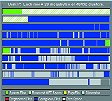
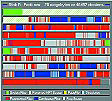
Before'and'after images of 20M rows of disk clusters show contiguous files as blue and fragmented ones as red. A Maine District Court found that defragmenting disks reduced file access time.


District Court in Maine installs Diskeeper utility to combat fragmentation


Not again


Critical condition


Drew Robb writes about information technology from Tujunga, Calif.
NEXT STORY: POWER USER

X
This website uses cookies to enhance user experience and to analyze performance and traffic on our website. We also share information about your use of our site with our social media, advertising and analytics partners. Learn More / Do Not Sell My Personal Information
Accept Cookies
X
Cookie Preferences Cookie List

Do Not Sell My Personal Information

When you visit our website, we store cookies on your browser to collect information. The information collected might relate to you, your preferences or your device, and is mostly used to make the site work as you expect it to and to provide a more personalized web experience. However, you can choose not to allow certain types of cookies, which may impact your experience of the site and the services we are able to offer. Click on the different category headings to find out more and change our default settings according to your preference. You cannot opt-out of our First Party Strictly Necessary Cookies as they are deployed in order to ensure the proper functioning of our website (such as prompting the cookie banner and remembering your settings, to log into your account, to redirect you when you log out, etc.). For more information about the First and Third Party Cookies used please follow this link.

Allow All Cookies

Manage Consent Preferences

Strictly Necessary Cookies - Always Active

We do not allow you to opt-out of our certain cookies, as they are necessary to ensure the proper functioning of our website (such as prompting our cookie banner and remembering your privacy choices) and/or to monitor site performance. These cookies are not used in a way that constitutes a “sale” of your data under the CCPA. You can set your browser to block or alert you about these cookies, but some parts of the site will not work as intended if you do so. You can usually find these settings in the Options or Preferences menu of your browser. Visit www.allaboutcookies.org to learn more.

Sale of Personal Data, Targeting & Social Media Cookies

Under the California Consumer Privacy Act, you have the right to opt-out of the sale of your personal information to third parties. These cookies collect information for analytics and to personalize your experience with targeted ads. You may exercise your right to opt out of the sale of personal information by using this toggle switch. If you opt out we will not be able to offer you personalised ads and will not hand over your personal information to any third parties. Additionally, you may contact our legal department for further clarification about your rights as a California consumer by using this Exercise My Rights link

If you have enabled privacy controls on your browser (such as a plugin), we have to take that as a valid request to opt-out. Therefore we would not be able to track your activity through the web. This may affect our ability to personalize ads according to your preferences.

Targeting cookies may be set through our site by our advertising partners. They may be used by those companies to build a profile of your interests and show you relevant adverts on other sites. They do not store directly personal information, but are based on uniquely identifying your browser and internet device. If you do not allow these cookies, you will experience less targeted advertising.

Social media cookies are set by a range of social media services that we have added to the site to enable you to share our content with your friends and networks. They are capable of tracking your browser across other sites and building up a profile of your interests. This may impact the content and messages you see on other websites you visit. If you do not allow these cookies you may not be able to use or see these sharing tools.

If you want to opt out of all of our lead reports and lists, please submit a privacy request at our Do Not Sell page.

Save Settings
Cookie Preferences Cookie List

Cookie List

A cookie is a small piece of data (text file) that a website – when visited by a user – asks your browser to store on your device in order to remember information about you, such as your language preference or login information. Those cookies are set by us and called first-party cookies. We also use third-party cookies – which are cookies from a domain different than the domain of the website you are visiting – for our advertising and marketing efforts. More specifically, we use cookies and other tracking technologies for the following purposes:

Strictly Necessary Cookies

We do not allow you to opt-out of our certain cookies, as they are necessary to ensure the proper functioning of our website (such as prompting our cookie banner and remembering your privacy choices) and/or to monitor site performance. These cookies are not used in a way that constitutes a “sale” of your data under the CCPA. You can set your browser to block or alert you about these cookies, but some parts of the site will not work as intended if you do so. You can usually find these settings in the Options or Preferences menu of your browser. Visit www.allaboutcookies.org to learn more.

Functional Cookies

We do not allow you to opt-out of our certain cookies, as they are necessary to ensure the proper functioning of our website (such as prompting our cookie banner and remembering your privacy choices) and/or to monitor site performance. These cookies are not used in a way that constitutes a “sale” of your data under the CCPA. You can set your browser to block or alert you about these cookies, but some parts of the site will not work as intended if you do so. You can usually find these settings in the Options or Preferences menu of your browser. Visit www.allaboutcookies.org to learn more.

Performance Cookies

We do not allow you to opt-out of our certain cookies, as they are necessary to ensure the proper functioning of our website (such as prompting our cookie banner and remembering your privacy choices) and/or to monitor site performance. These cookies are not used in a way that constitutes a “sale” of your data under the CCPA. You can set your browser to block or alert you about these cookies, but some parts of the site will not work as intended if you do so. You can usually find these settings in the Options or Preferences menu of your browser. Visit www.allaboutcookies.org to learn more.

Sale of Personal Data

We also use cookies to personalize your experience on our websites, including by determining the most relevant content and advertisements to show you, and to monitor site traffic and performance, so that we may improve our websites and your experience. You may opt out of our use of such cookies (and the associated “sale” of your Personal Information) by using this toggle switch. You will still see some advertising, regardless of your selection. Because we do not track you across different devices, browsers and GEMG properties, your selection will take effect only on this browser, this device and this website.

Social Media Cookies

We also use cookies to personalize your experience on our websites, including by determining the most relevant content and advertisements to show you, and to monitor site traffic and performance, so that we may improve our websites and your experience. You may opt out of our use of such cookies (and the associated “sale” of your Personal Information) by using this toggle switch. You will still see some advertising, regardless of your selection. Because we do not track you across different devices, browsers and GEMG properties, your selection will take effect only on this browser, this device and this website.

Targeting Cookies

We also use cookies to personalize your experience on our websites, including by determining the most relevant content and advertisements to show you, and to monitor site traffic and performance, so that we may improve our websites and your experience. You may opt out of our use of such cookies (and the associated “sale” of your Personal Information) by using this toggle switch. You will still see some advertising, regardless of your selection. Because we do not track you across different devices, browsers and GEMG properties, your selection will take effect only on this browser, this device and this website.