
SCAN AND DELIVER





Scanners are fixtures in most offices. Many users need to be able to move hard copy, photos or graphics onto a PC or workstation hard drive so it can be stored, edited or otherwise manipulated for later use.
By J.B. MilesSpecial to GCNScanners are fixtures in most offices. Many users need to be able to move hard copy, photos or graphics onto a PC or workstation hard drive so it can be stored, edited or otherwise manipulated for later use.In workgroups and small departments, forms processing, records management and document imaging are a few of the uses for an in-house scanner.Most scanners are built around similar technology, but their features and performance levels often vary. For $100 or less, you can buy a simple handheld scanner that offers the benefits of low cost and ease of use for scanning several columns of text or small images into larger documents.Low-cost sheetfed scanners use a series of rollers to move the paper past the imaging elements, just as fax machines do. You can use one to scan sequential pages of different sizes, but the risk of jamming and other mechanical failure is high.For $100 to $300, you can buy a serviceable flatbed scanner capable of rendering fairly high-quality color photo and text images. Easy to set up and use with a PC or Macintosh, they operate at maximum speeds of only several pages per minute and are too lightweight for workgroup use, except in a pinch.Specialized image and photo scanners, available for under $500, reproduce graphics or photo images and are the consumer-targeted relatives of more expensive professional and production graphics scanners.This buying guide features scanners that meet the document processing requirements of typical workgroups and small departments. These units are optimized for scanning black-and-white text pages clearly at fast speeds, not the fine line and color details produced by image scanners.Most are flatbed scanners that have scanning heads sealed in a glass compartment. Original documents are passed either manually or via an automatic feeder over the top of the glass, with the scanning heads passing beneath to capture the image. The units listed provide at least 10-ppm or faster text output, with optical resolutions of 200 to 600 dots per inch.Virtually all workgroup scanners come with a built-in or optional automatic document feeder and specialized software for cropping or redesigning photos or graphics, and optical character recognition software for text editing.A workgroup scanner must also come with components robust enough to guarantee a mean-time-between-failure rating in the thousands or hundreds of thousands of hours. A good MTBF rating backed up with a warranty is one of your best insurance policies against Murphy's Law, which, for scanners, dictates that a unit will fail at 4:59 on Friday afternoon when dozens of users are vying to accomplish scanning tasks.The workgroup scanners in the chart range in price from $995 to more than $50,000 and generally are not available at computer retail stores. You need to hunt them down from value-added suppliers or on manufacturers' Web sites. But this shouldn't deter you if you're looking for quality and performance.It should come as no surprise that, given the relatively high prices, there are only a few genuine workgroup scanners available from less than a dozen manufacturers.Some scanner manufacturers focus exclusively on under-$500 models for the small-office, home-office market. Others, such as Hewlett-Packard Co., have discontinued their workgroup products'HP's Network ScanJet5 series, for example'in favor of less expensive and theoretically more salable models, such as HP's ScanJet 6200 and 6250 series.The prices of the 38 workgroup scanners listed reflect their features and capabilities.Fujitsu America Inc.'s $995 ScanPartner 15C and $1,795 ScanPartner 600C can be considered workgroup scanners, but just barely. The 15-ppm throughput of these color simplex units is attainable only when scanning text pages at 200 dpi. If you scan a full-page color image, the process will be slowed to 1 page or less per minute.Epson America Inc.'s $999 Expression 636 and 800 color units have similar configurations for output and other features, but an optional automatic document feeder must be added to each, which boosts the cost of both units. The 636 and 800 are simplex models, meaning they provide single-sided scanning.At the other end of the scale, Eastman Kodak Co.'s $51,000 Document Scanner 7500 can crank out 80 ppm in simplex mode and 120 ppm of monochrome text in duplex, or double-sided, mode at 300-dpi resolution, which is plenty for high-quality text rendering. The unit boasts a powerful scanning mechanism, and its standard document feeder holds 200 sheets of paper.Fujitsu's $2,795, 27-ppm ScanPartner 93GX and its $4,495 M3093DE/DG duplex flatbed or $6,995 M3097DE/DG are better for midrange workgroup service than the low-end ScanPartner 15C and 600C products. Operating at maximum resolutions of 600 dpi, the M3093DE/DG and M3097DE/DG provide 27-ppm and 36-ppm monochrome output, respectively.Canon U.S.A. Inc.'s $7,000 DR-5020 simplex/duplex flatbed provides an astounding 90-ppm throughput, but not at its maximum 400-dpi resolution. The company's DR-5080C offers monochrome and color output starting at $10,000. Both come with a 500-sheet document feeder.Bell & Howell Co. offers the widest range of simplex and duplex monochrome scanners for workgroup use with its Copiscan and Copiscan II series. The duplex Copiscan 4040D is the company's most advertised scanner for workgroup service, with 40-ppm output, a maximum 300-dpi resolution and a respectable 100-sheet document feeder for $7,495. Depending on simplex or duplex operating modes and paper requirements'typically 8.5 inches by 11 inches, or tabloid-size 11 inches by 14 inches'the company's Copiscan II units have up to 42-ppm output at prices between $6,995 and $11,995.All workgroup scanners use either a charge-coupled device (CCD) or contact image sensor (CIS) to capture or process images. Both are made of photosensitive silicon cells and are on the scanning head.A CCD includes a lens, light source and chip set, along with an analog-to-digital converter for translating the data gathered into digital information. A CIS uses an LED and processes the analog-to-digital data translation via an on-board logic system.CCD sensors are more expensive than CIS sensors but render better images. CIS sensors use fewer components than CCDs, and the LED light sources use less power so last longer. Because the price gap between CCD and CIS technology is only about $50 per unit, I prefer CCD workgroup scanners.If output speed is your first concern, a monochrome scanner is fine for most workgroup requirements. In many cases, using a low-cost desktop PC color scanner or a dedicated image or photo scanner may take up the slack when color is required. Color scanning requires many more pixels than grayscale scanning, slows down the processing and takes up much more disk space per file than monochrome scanning.Most workgroup scanners offer optical resolution ranges of 200 to 600 dpi. The higher you go, the slower the scan. Thus, 200 dpi results in very fast scans, while moving up to 400 or 600 dpi produces slower scans but sharper images.A scanner's optical resolution is hardware-based and is a function of its CCD or CIS sensors. Many scanner manufacturers advertise resolutions of 1,200 dpi or higher, without mentioning that these are interpolated resolutions that use software and hardware algorithms to fill in the blanks between pixels to make image and text outlines appear clearer and sharper.The SCSI-2 interfaces coming with virtually all the scanners listed are necessary to handle high-bandwidth graphics and document management tasks faster than the parallel interfaces used with inexpensive personal or small-office scanners.Universal Serial Bus connectors are popular industrywide, but SCSI-2, along with an occasional RS-232C video connection, will continue to hold sway among workgroup scanners for some time to come.Manufacturers usually offer a choice between simplex and duplex models of the same scanner. Duplex costs more. Although many vendors still make the choice within models, more products such as Canon's DR-5020 and DR-5080C are packaged with user-selectable simplex and duplex modes.As for image editing vs. OCR software, it is not a question of one or the other but of both. Image editing software often comes with filters to apply special effects and helps you manipulate the colors and tones of images to improve the display. OCR software bundled with a document scanner turns an image file into an editable text file via its OCR capability. It's useful to have both in a document scanner, but OCR software is essential in a workgroup scanner.An automatic document feeder, preferably built-in, allows smooth transfer of the original to the body of the scanner, where the data on the paper can be read by the scanning heads and passed on to the host computer. Fifty- and 100-page document feeders are common; more expensive scanners often hold more, but Canon's DR-5020 and DR-5080C win the prize in this category with capacities of 500 pages each. Scanners with automatic document feeders can handle documents from small 3-by-5 cards to 11-by-17 tabloid pages in various paper textures. XXXSPLITXXX-
Check out scanners designed for a workgroup's no-frills imaging needs
Shop for quality
Feeder time
Silicon cells
On one hand
J.B. Miles of Pahoa, Hawaii, writes about communications and computers.
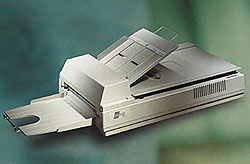 | Fujitsu's ScanPartner 15C can scan up to 15 color pages per minute at 300-dpi resolution and can handle paper in sizes up to 8.5 inches by 14 inches. It's priced at $995. |
Check out scanners designed for a workgroup's no-frills imaging needs
Shop for quality
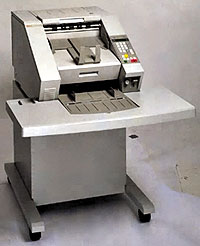 | The Kodak Document Scanner 7500 has a CIS sensor, simplex or duplex modes, and can scan up to 120 ppm. Its price ranges from $51,000 to $56,000. |
Feeder time
Silicon cells
| ||||||||||||
On one hand
J.B. Miles of Pahoa, Hawaii, writes about communications and computers.
| Vendor | Product | Maximum resolution in dots per inch | Mode | Sensor | Interface | Maximum paper size in inches | Automatic document feeder capacity in sheets | Maximum Speed | Price |
| AVision Labs Inc.'' Westminster, Mass. 978-632-2591 www.avision-labs.com | AV-810C | 600 | Simplex | Color CCD | SCSI-2 | 8.5 by 14 | 50 | 10 ppm | $1,339 |
| AV-820C | 600 | Simplex | Color CCD | SCSI-2 | 8.5 by 14 | 50 | 20 ppm | $2,399 | |
| Bell & Howell Co. Skokie, Ill. 847-357-0630 www.bhscanners.com | 500 FB | 800 | Simplex | B&W CCD | SCSI-2 | 12 by 17 | 30 | 34 ppm | $3,995 |
| 1000 FB | 800 | Simplex | B&W CCD | SCSI-2 | 12 by 17 | 100 | 46 ppm | $4,995 | |
| 1500 FB | 800 | Simplex | B&W CCD | SCSI-2 | 12 by 17 | 150 | 64 ppm | $6,995 | |
| Copiscan 4040D | 300 | Duplex | B&W CCD | SCSI-2 | 8.5 by 14 | 100 | 40 ppm | $7,495 | |
| Copiscan II 3338 | 300 | Simplex | B&W CCD | Proprietary, optional SCSI-2 | 11.8 by 17 | Optional ADF | 42 ppm | $6,995 | |
| Copiscan II 3338A | 300 | Simplex | B&W CCD | Proprietary, optional SCSI-2 | 11.8 by 17 | Optional ADF | 42 ppm | $11,995 | |
| Copiscan 6338'' | 300 | Duplex | B&W CCD | Proprietary, optional SCSI-2 | 11.8 by 17 | Optional ADF | 42 ppm | $19,995 | |
| Copiscan 2138A | 200 | Simplex | B&W CCD | Proprietary, optional SCSI-2 | 8.5 by 17 | Optional ADF | 72 ppm | $9,995 | |
| Canon U.S.A. Inc.'' Lake Success, N.Y. 516-488-6700 www.usa.canon.com | DR-5020 | 400 | Simplex/ duplex | B&W CIS | SCSI-2 | 11 by 17 | 500 | 90 ppm | $7,000 |
| DR-5080C | 400 | Simplex/ duplex | Color CIS | SCSI-2 | 11 by 17 | 500 | 90 ppm | $10,000 | |
| Eastman Kodak Co.'' Rochester, N.Y. 716-724-4000 www.kodak.com | Document Scanner 5500 | 300 | Simplex/ duplex | B&W CIS | SCSI-2 | 12 by 20 | 200 | 80 ppm | $30,000 to $41,000 |
| Document'' Scanner 7500 | 300 | Simplex/ duplex | B&W CIS | SCSI-2 | 12 by 20 | 200 | 120 ppm | $51,000 to $56,000 | |
| Epson America Inc.'' Torrance, Calif. 310-782-0770 www.epson.com | Expression 636 | 600 | Simplex | Color CCD | SCSI-2 | 8.5 by 11.7 | Optional ADF | 5.5 ms per line | $999 |
| Expression 800 | 800 | Simplex | Color CCD | SCSI-2 | 8.5 by 11.7 | Optional ADF | 7.5 ms per line | $999 | |
| Fujitsu America Inc. San Jose, Calif. 408-432-6333 www.fcpa.com | ScanPartner 15C | 300 | Simplex | Color CCD | SCSI-2 | 8.5 by 14 | 50 | 15 ppm | $995 |
| ScanPartner 600C | 600 | Simplex | Color CCD | SCSI-2 | 8.5 by 14 | 50 | 15 ppm | $1,795 | |
| ScanPartner 93GX | 400 | Simplex | B&W CCD | SCSI-2 | 8.5 by 14 | 50 | 27 ppm | $2,795 | |
| M3093DE/DG | 600 | Duplex | B&W CCD | SCSI-2 or video | 8.5 by 14 | 50 | 27 ppm | $4,995 | |
| M3093EX | 400 | Simplex | B&W CCD | Video | 8.5 by 14 | 50 | 27 ppm | $4,595 | |
| M3097DE/DG | 600 | Duplex | B&W CCD | SCSI-2 or video | 11.7 by 16.5 | 100 | 39 ppm | $6,995 | |
| M3097D | 400 | Duplex | B&W CCD | Video | 11.7 by 17 | 100 | 39 ppm | $10,995 | |
| Ricoh Corp.'' West Caldwell, N.J. 973-882-2000 www.ricoh.com | ISO1 | 400 | Simplex | B&W CCD | SCSI-2 | 11 by 17 | 30 | 24 ppm | $3,995 |
| ISO420 | 400 | Simplex | B&W CCD | SCSI-2 or video | 11 by 17 | 100 | 36 ppm | $6,400 | |
| ISO430 | 400 | Simplex | B&W CCD | SCSI-2 or video | 11 by 17 | 150 | 50 ppm | $6,995 | |
| ISO450DE | 400 | Simplex | B&W CCD | SCSI-2 | 11 by 17 | 150 | 57 ppm | $21,995 | |
| Scan-Optics Inc. Manchester, Conn. 860-645-7878 www.scanoptics.com | 7400S | 400 | Simplex | B&W CCD | SCSI-2 | 12 by 14.3 | 500 | 70 ppm | $19,125 |
| 7400D | 400 | Duplex | B&W CCD | SCSI-2 | 12 by 14.3 | 500 | 70 ppm | $24,600 | |
| 7440S | 400 | Simplex | B&W CCD | SCSI-2 | 12 by 14.3 | 500 | 40 ppm | $31,800 | |
| 7440D | 400 | Duplex | B&W CCD | SCSI-2 | 12 by 14.3 | 500 | 40 ppm | $35,400 | |
| 7470S | 400 | Simplex | B&W CCD | SCSI-2 | 12 by 14.3 | 500 | 70 ppm | $33,300 | |
| 7470D | 400 | Duplex | B&W CCD | SCSI-2 | 12 by 14.3 | 500 | 70 ppm | $39,600 | |
| VisionShape Inc.'' Placentia, Calif. 714-792-3612 www.visionshape.com | VS-1000E | 400 | Simplex | B&W CCD | SCSI-2 or video | 10.1 by 14.3 | 100 | 45 ppm | $3,995 |
| VS-1251E | 300 | Simplex | B&W CCD | SCSI-2 or video | 11 by 17 | 100 | 45 ppm | $4,995 | |
| VS-1266A | 400 | Simplex | B&W CCD | SCSI-2 or video | 11 by 17 | 100 | 52 ppm | $7,995 | |
| VS-7590A | 400 | Simplex | B&W CCD | SCSI-2 or video | 11 by 17 | 100 | 75 ppm | $14,995 | |
| Xerox Corp.'' Stamford, Conn. 203-968-3000 www.xerox.com | DocuImage 620S | 600 | Simplex | B&W CCD | SCSI-2 | 11.6 by 17 | 50 | 40 ppm | $11,995 |