Command center ready to lead the way into Y2K

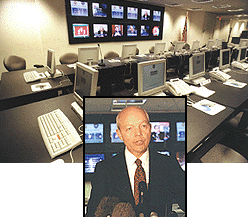
Large high-definition, flat-screen television monitors hover over the Year 2000 Information Coordination Center in Washington, displaying time zones around the world as if symbolizing the international magnitude of the center's purpose.

By Christopher J. DorobekGCN StaffLarge high-definition, flat-screen television monitors hover over the Year 2000 Information Coordination Center in Washington, displaying time zones around the world as if symbolizing the international magnitude of the center's purpose.Beginning at 6 a.m. on New Year's Eve as New Zealand leads the world into 2000, the center will begin monitoring the global impact of the date change.The $50 million center, unveiled during a media tour last week, was constructed over the past four months. The center is just blocks from the White House in a building formerly used by the Secret Service.The center will serve as the information traffic cop for incoming information as organizations report their year 2000 status and for outgoing data as officials keep the world informed.'The challenge to the federal government is to deal with a volume of information that we've never had to deal with before,' said John A. Koskinen, chairman of the President's Council on Year 2000 Conversion.The ICC team will not make policy decisions, Koskinen said. Instead, the center will gather, analyze and summarize a stream of updates from the government and private sector on systems performance across the country and around the world.The status reports will be sent to federal decision-makers. The public will also be kept up-to-date through regularly scheduled briefings and on the council's Web site, at .At the heart of the ICC itself is a glass-walled room with 16 television monitors along one wall. In the center of the room are 16 desks arranged in a rectangle, each with a PC and a flat-screen monitor.Koskinen, retired Lt. Gen. Peter A. Kind, the ICC's director, and other top officials will be working in the central office coordinating the information as it comes in.Outside the glassed office are groups of desks, each with a flat-panel screen and a small camera for videoconferences. The desks are grouped into sectors'government, financial institutions, energy and telecommunications.Each sector will have a staff of agency designees. The sector experts will analyze incoming data.About 30 people are working at the ICC, but that number will increase to about 200 over the New Year's weekend.Koskinen and Kind have established a reporting network that largely follows disaster-reporting processes used in weather-related and other emergencies. The year 2000 problem differs from such incidents, however, because it is not geographically limited.'When the president or the public or the media wants to know what's happening, what they mean by what's happening is what's happening everywhere in the world at one time,' Koskinen said.The information will flow from the field, eventually ending up at the ICC sector desks, and then to Koskinen and Kind.The ICC has been developed largely using existing infrastructures. Internationally, the center will cull data from State Department embassies, Defense Department bases and other international groups. Within the United States, the ICC is working with the Federal Emergency Management Agency and other federal agencies, as well as state and local governments.Federal agencies will report on the readiness of mission-critical systems, as well as designated sectors. In addition, agencies will report on the high-impact programs earmarked by the Office of Management and Budget.The ICC is also working with eight trade groups that will run industry information centers to provide additional year 2000 data.Kind has created templates to standardize the status reports and make it possible for organizations to file reports quickly. The templates ask organizations to classify their operations as normal, suffering minor problems or suffering major problems.A normal ranking might not mean that there are no problems, because there are almost always some computer problems occurring at any given time, Koskinen said.Instead, a situation ought to be considered normal if systems are operating within defined acceptable parameters. The ICC is working on a definition for those parameters.Most of the status reports will be filed via the Web, although the ICC has backup provisions. Contingency plans for submitting information include using fax machines, mobile phones and dedicated telephone lines.The center is instructing agencies and organizations to report on their status even if there are no problems. That way, if an outage isolates an agency or area, the center will be alerted to possible problems if no reports come in.Some agency year 2000 officials said the report filing process was slower than they expected. ICC officials said, however, that despite some initial problems, the center will be ready.'We've done some tests,' Koskinen said, and there have been some glitches. There were some problems with the way the information was routed, he said.The center has run two tests so far'one internally and one with agencies'and will do a full operational stress test early next month, he said.The ICC will formally open for business on Dec. 28 and stay open from 8 a.m. to 8 p.m. It will begin 24-hour operations on Dec. 30. Nonstop operations will continue until Jan. 3, when the center will go on a reduced schedule until Feb. 29, when the ICC will be on alert for the leap year.
Teams made up of officials from across government will begin global monitoring effort on Dec. 28


During a media tour of the Year 2000 Information Coordination Center last week, John A. Koskinen, chairman of the President's Council on Year 2000 Conversion, said the creation
of the center was a prudent step that should not cause anxiety.


www.y2k.gov

Set up for action


Routing problems


NEXT STORY: FBI deputy director to retire

X
This website uses cookies to enhance user experience and to analyze performance and traffic on our website. We also share information about your use of our site with our social media, advertising and analytics partners. Learn More / Do Not Sell My Personal Information
Accept Cookies
X
Cookie Preferences Cookie List

Do Not Sell My Personal Information

When you visit our website, we store cookies on your browser to collect information. The information collected might relate to you, your preferences or your device, and is mostly used to make the site work as you expect it to and to provide a more personalized web experience. However, you can choose not to allow certain types of cookies, which may impact your experience of the site and the services we are able to offer. Click on the different category headings to find out more and change our default settings according to your preference. You cannot opt-out of our First Party Strictly Necessary Cookies as they are deployed in order to ensure the proper functioning of our website (such as prompting the cookie banner and remembering your settings, to log into your account, to redirect you when you log out, etc.). For more information about the First and Third Party Cookies used please follow this link.

Allow All Cookies

Manage Consent Preferences

Strictly Necessary Cookies - Always Active

We do not allow you to opt-out of our certain cookies, as they are necessary to ensure the proper functioning of our website (such as prompting our cookie banner and remembering your privacy choices) and/or to monitor site performance. These cookies are not used in a way that constitutes a “sale” of your data under the CCPA. You can set your browser to block or alert you about these cookies, but some parts of the site will not work as intended if you do so. You can usually find these settings in the Options or Preferences menu of your browser. Visit www.allaboutcookies.org to learn more.

Sale of Personal Data, Targeting & Social Media Cookies

Under the California Consumer Privacy Act, you have the right to opt-out of the sale of your personal information to third parties. These cookies collect information for analytics and to personalize your experience with targeted ads. You may exercise your right to opt out of the sale of personal information by using this toggle switch. If you opt out we will not be able to offer you personalised ads and will not hand over your personal information to any third parties. Additionally, you may contact our legal department for further clarification about your rights as a California consumer by using this Exercise My Rights link

If you have enabled privacy controls on your browser (such as a plugin), we have to take that as a valid request to opt-out. Therefore we would not be able to track your activity through the web. This may affect our ability to personalize ads according to your preferences.

Targeting cookies may be set through our site by our advertising partners. They may be used by those companies to build a profile of your interests and show you relevant adverts on other sites. They do not store directly personal information, but are based on uniquely identifying your browser and internet device. If you do not allow these cookies, you will experience less targeted advertising.

Social media cookies are set by a range of social media services that we have added to the site to enable you to share our content with your friends and networks. They are capable of tracking your browser across other sites and building up a profile of your interests. This may impact the content and messages you see on other websites you visit. If you do not allow these cookies you may not be able to use or see these sharing tools.

If you want to opt out of all of our lead reports and lists, please submit a privacy request at our Do Not Sell page.

Save Settings
Cookie Preferences Cookie List

Cookie List

A cookie is a small piece of data (text file) that a website – when visited by a user – asks your browser to store on your device in order to remember information about you, such as your language preference or login information. Those cookies are set by us and called first-party cookies. We also use third-party cookies – which are cookies from a domain different than the domain of the website you are visiting – for our advertising and marketing efforts. More specifically, we use cookies and other tracking technologies for the following purposes:

Strictly Necessary Cookies

We do not allow you to opt-out of our certain cookies, as they are necessary to ensure the proper functioning of our website (such as prompting our cookie banner and remembering your privacy choices) and/or to monitor site performance. These cookies are not used in a way that constitutes a “sale” of your data under the CCPA. You can set your browser to block or alert you about these cookies, but some parts of the site will not work as intended if you do so. You can usually find these settings in the Options or Preferences menu of your browser. Visit www.allaboutcookies.org to learn more.

Functional Cookies

We do not allow you to opt-out of our certain cookies, as they are necessary to ensure the proper functioning of our website (such as prompting our cookie banner and remembering your privacy choices) and/or to monitor site performance. These cookies are not used in a way that constitutes a “sale” of your data under the CCPA. You can set your browser to block or alert you about these cookies, but some parts of the site will not work as intended if you do so. You can usually find these settings in the Options or Preferences menu of your browser. Visit www.allaboutcookies.org to learn more.

Performance Cookies

We do not allow you to opt-out of our certain cookies, as they are necessary to ensure the proper functioning of our website (such as prompting our cookie banner and remembering your privacy choices) and/or to monitor site performance. These cookies are not used in a way that constitutes a “sale” of your data under the CCPA. You can set your browser to block or alert you about these cookies, but some parts of the site will not work as intended if you do so. You can usually find these settings in the Options or Preferences menu of your browser. Visit www.allaboutcookies.org to learn more.

Sale of Personal Data

We also use cookies to personalize your experience on our websites, including by determining the most relevant content and advertisements to show you, and to monitor site traffic and performance, so that we may improve our websites and your experience. You may opt out of our use of such cookies (and the associated “sale” of your Personal Information) by using this toggle switch. You will still see some advertising, regardless of your selection. Because we do not track you across different devices, browsers and GEMG properties, your selection will take effect only on this browser, this device and this website.

Social Media Cookies

We also use cookies to personalize your experience on our websites, including by determining the most relevant content and advertisements to show you, and to monitor site traffic and performance, so that we may improve our websites and your experience. You may opt out of our use of such cookies (and the associated “sale” of your Personal Information) by using this toggle switch. You will still see some advertising, regardless of your selection. Because we do not track you across different devices, browsers and GEMG properties, your selection will take effect only on this browser, this device and this website.

Targeting Cookies

We also use cookies to personalize your experience on our websites, including by determining the most relevant content and advertisements to show you, and to monitor site traffic and performance, so that we may improve our websites and your experience. You may opt out of our use of such cookies (and the associated “sale” of your Personal Information) by using this toggle switch. You will still see some advertising, regardless of your selection. Because we do not track you across different devices, browsers and GEMG properties, your selection will take effect only on this browser, this device and this website.