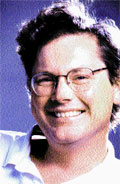
Interview: Bill Joy, Sun's vision guy

As chief scientist of Sun Microsystems Inc., co-founder Bill Joy has spent a quarter of a century designing Unix software.

No one comes to mind.'When you look back on the last 10 years, do you feel Java has taken the world by storm? Yes; look at the Internet. It's becoming clear that the nature of the Java language makes it much easier to produce reliable software. That was a specific area I was involved in, and I'm very pleased about that. For the first time since about 1960, Java is making it possible to do scientific, system and symbolic programming in a single language. Historically, they were done in Fortran, C and Lisp or Smalltalk.I see strong movement toward Java to get the benefits of simplicity and object-oriented programming in a modern language.'Java is maddeningly slow to start up in Web browsers. Is it ever going to get any faster? The alternative is that you download software every time you visit a Web site. You're looking at some artifact of the way Java is used in a particular program today, whereas I'm taking a longer-term view. There's no reason why Java couldn't start in background once you launch the browser. That's just a matter of engineering it better.Of course, Microsoft Corp. has no business interest in making your life easier. The Netscape Communications Corp. browser has been in limbo for a while. Hopefully you'll see that fixed in the next version of Communicator.The truth is, if you want to author Web content around the client, there are not that many choices. That's why the cutting-edge interactive stuff uses Java.'When is Jini coming? If you look around your office, you see a lot of things using electricity, but they don't tend to have software in them. When those things have software and get networked, they can work together. If you have a cell phone in your car and want to make a hands-free call, there's already a speaker in your car radio. But there's no software protocol level at which the phone can talk through the radio.By putting software and networking into electrical devices, we want to create an architecture in which individual devices appear as objects. They can come together to do things in ways that weren't necessarily preplanned but are simple.Objects replace protocols in the sense that you can send objects between machines or devices. The objects themselves implement protocols. In a world with agents, you don't need protocols anymore. The protocol that moves the agents is the protocol to end all protocols.'How will this arrive on the market? The breakthrough place is going to be in cellular handsets. The first one is going to be the iMode phone in Japan, which is the first country to have high-speed Internet access from handsets. We showed Jini in prototype form in some handsets at JavaOne last summer.The first generation mostly will be for wide-area use. Our expectation is that it will start in Japan and go worldwide. The next generation will give the handsets a kind of proximity wireless connection, either with Bluetooth short-range radio technology or with wireless Ethernet. This is all rolling out in the next three to five years. The numbers are staggering.By 2010, the industry expects to have a billion of these handsets in use. There's a 30 percent to 40 percent replacement rate every year. Once the stuff is deployed, it will be adopted quickly'in the same way we've seen digital wireless technology take off in the United States.We think that these will become the PCs of the future for most people. No other consumer appliance is on a trajectory in the next decade to ship anywhere near that number of devices with wireless connectivity. It's a staggeringly large number. More handsets than cars will be built, more handsets than DVD drives or videocassette recorders or televisions. It's off the scale until we have electronic Post-it notes or paper clips, which probably will happen at some point, too'a computer in every piece of paper is possible in the next 20 years.In the 10-year time frame, the center point for most people's computing is going to be a pocket computer that looks like a cell phone.'The battery problem will go away? It isn't like a notebook computer. It'll have the battery life characteristics of a phone. The best battery standby time on a digital network is almost a week now. My Palm VII [from Palm Computing Inc. of Santa Clara, Calif.] that uses similar power management techniques lasts on two alkaline AA batteries for a week to two weeks. My two-way pager lasts a week.We're not talking about running Microsoft Windows CE or the big power pigs. We're running the handset code we already have, maybe a small browser and small Java applets. The Java won't have any start-up time because it's in the read-only memory. The wireless network is probably faster than an Ethernet connection unless you have digital subscriber line or a cable modem. The Palm and pager are instant-on'the batteries last a long time.'Will this play into some telecommunications carriers' plans to give people a single, portable phone number that they carry around in a handset and plug in anywhere? I'd be loath to predict people will have only one phone number. There are good reasons to have more than one. The trend seems to be the other way. Some phone numbers represent places, some represent people.I think it's more likely your handset will have several phone numbers you give to people to cause different things to happen, or at least Caller ID will be so ubiquitous that you effectively have that behavior.'How soon will Sun put up a Wireless Application Protocol site on the Web for such devices? That's a complicated question that the Sun iPlanet people are working on. Another question is, what are the plans for WAP on Solaris? And another one is, are we going to put up our own site accessible by that protocol? I don't know the answers.'Will the Sun Ray do any better than the network computer did? I think the NC will do fine eventually, and the Sun Ray will do fine. It's not something individuals will buy. It's something companies buy.The advantage, even in a small office, is a high-availability server and no single point of failure. If the Sun Ray on my desk breaks, I can go to another one. If the server breaks, it hot-swaps over to another one.When hundreds of people do something against a database, they can't take orders or whatever when their PCs are down. This is a much better architecture for high availability to a lot of seats. Most people do e-mail and the Web and maybe a couple of applications. Those things are becoming services on the Web. It doesn't matter which device you use, it's a question of being at a browser. Sun Ray has a browser, local access to a database you need to do your job, and e-mail.Citrix Systems Inc. of Fort Lauderdale, Fla., has tried to do similar things withWinFrame, but Windows NT isn't reliable enough and doesn't scale enough to capture the bulk of this market.'How many computers and cell phones do you use? I have a screen at the office, a screen at home, a notebook computer, a Palm VII, a pager, a digital cell phone for the United States and one for Europe.'How bad do you think year 2000 will be? As long as the power stays up, we'll be fine. Most systems aren't completely automated. And people are pretty clever. It's a cautionary tale'we shouldn't take people out of the loop on a lot of systems. The problem is when a lot of things break at the same time. There'll probably be a few things that are hard to fix, a cascade of effects.


As chief scientist of Sun Microsystems Inc., co-founder Bill Joy has spent a quarter of a century designing Unix software.

While a graduate student, Joy was principal inventor of Berkeley Unix. He went on to design Sun's Network File System and codesign the Sparc processor architecture. After joining Sun in 1982, he co-authored the Java language and, more recently, conceived Jini distributed computing technology.

He received a bachelor of science degree from the University of Michigan and a master's degree in electrical engineering from the University of California at Berkeley. He is co-chairman of the Presidential Information Technology Advisory Committee.

Joy will deliver a keynote address on Java and Jini at the Software Development Conference this week in Washington. GCN chief technology editor Susan M. Menke interviewed Joy by telephone.


GCN:'Has anyone alive invented more currently used software than yourself?

JOY:


GCN:

JOY:


GCN:

JOY:


GCN:

JOY:


GCN:

JOY:


GCN:

JOY:


GCN:

JOY:


GCN:

JOY:


GCN:

JOY:


GCN:

JOY:


GCN:

JOY:

What's more


  • Age: 44
  • Last book read: For Common Things by Jedediah Purdy
  • Favorite Web site: www.nytimes.com
  • Leisure activities: Skiing, hiking and playing with his kids
  • Worst job: 'Digging sewers as a summer job.'
  • Best job: 'Working for Scott McNealy.'
X
This website uses cookies to enhance user experience and to analyze performance and traffic on our website. We also share information about your use of our site with our social media, advertising and analytics partners. Learn More / Do Not Sell My Personal Information
Accept Cookies
X
Cookie Preferences Cookie List

Do Not Sell My Personal Information

When you visit our website, we store cookies on your browser to collect information. The information collected might relate to you, your preferences or your device, and is mostly used to make the site work as you expect it to and to provide a more personalized web experience. However, you can choose not to allow certain types of cookies, which may impact your experience of the site and the services we are able to offer. Click on the different category headings to find out more and change our default settings according to your preference. You cannot opt-out of our First Party Strictly Necessary Cookies as they are deployed in order to ensure the proper functioning of our website (such as prompting the cookie banner and remembering your settings, to log into your account, to redirect you when you log out, etc.). For more information about the First and Third Party Cookies used please follow this link.

Allow All Cookies

Manage Consent Preferences

Strictly Necessary Cookies - Always Active

We do not allow you to opt-out of our certain cookies, as they are necessary to ensure the proper functioning of our website (such as prompting our cookie banner and remembering your privacy choices) and/or to monitor site performance. These cookies are not used in a way that constitutes a “sale” of your data under the CCPA. You can set your browser to block or alert you about these cookies, but some parts of the site will not work as intended if you do so. You can usually find these settings in the Options or Preferences menu of your browser. Visit www.allaboutcookies.org to learn more.

Sale of Personal Data, Targeting & Social Media Cookies

Under the California Consumer Privacy Act, you have the right to opt-out of the sale of your personal information to third parties. These cookies collect information for analytics and to personalize your experience with targeted ads. You may exercise your right to opt out of the sale of personal information by using this toggle switch. If you opt out we will not be able to offer you personalised ads and will not hand over your personal information to any third parties. Additionally, you may contact our legal department for further clarification about your rights as a California consumer by using this Exercise My Rights link

If you have enabled privacy controls on your browser (such as a plugin), we have to take that as a valid request to opt-out. Therefore we would not be able to track your activity through the web. This may affect our ability to personalize ads according to your preferences.

Targeting cookies may be set through our site by our advertising partners. They may be used by those companies to build a profile of your interests and show you relevant adverts on other sites. They do not store directly personal information, but are based on uniquely identifying your browser and internet device. If you do not allow these cookies, you will experience less targeted advertising.

Social media cookies are set by a range of social media services that we have added to the site to enable you to share our content with your friends and networks. They are capable of tracking your browser across other sites and building up a profile of your interests. This may impact the content and messages you see on other websites you visit. If you do not allow these cookies you may not be able to use or see these sharing tools.

If you want to opt out of all of our lead reports and lists, please submit a privacy request at our Do Not Sell page.

Save Settings
Cookie Preferences Cookie List

Cookie List

A cookie is a small piece of data (text file) that a website – when visited by a user – asks your browser to store on your device in order to remember information about you, such as your language preference or login information. Those cookies are set by us and called first-party cookies. We also use third-party cookies – which are cookies from a domain different than the domain of the website you are visiting – for our advertising and marketing efforts. More specifically, we use cookies and other tracking technologies for the following purposes:

Strictly Necessary Cookies

We do not allow you to opt-out of our certain cookies, as they are necessary to ensure the proper functioning of our website (such as prompting our cookie banner and remembering your privacy choices) and/or to monitor site performance. These cookies are not used in a way that constitutes a “sale” of your data under the CCPA. You can set your browser to block or alert you about these cookies, but some parts of the site will not work as intended if you do so. You can usually find these settings in the Options or Preferences menu of your browser. Visit www.allaboutcookies.org to learn more.

Functional Cookies

We do not allow you to opt-out of our certain cookies, as they are necessary to ensure the proper functioning of our website (such as prompting our cookie banner and remembering your privacy choices) and/or to monitor site performance. These cookies are not used in a way that constitutes a “sale” of your data under the CCPA. You can set your browser to block or alert you about these cookies, but some parts of the site will not work as intended if you do so. You can usually find these settings in the Options or Preferences menu of your browser. Visit www.allaboutcookies.org to learn more.

Performance Cookies

We do not allow you to opt-out of our certain cookies, as they are necessary to ensure the proper functioning of our website (such as prompting our cookie banner and remembering your privacy choices) and/or to monitor site performance. These cookies are not used in a way that constitutes a “sale” of your data under the CCPA. You can set your browser to block or alert you about these cookies, but some parts of the site will not work as intended if you do so. You can usually find these settings in the Options or Preferences menu of your browser. Visit www.allaboutcookies.org to learn more.

Sale of Personal Data

We also use cookies to personalize your experience on our websites, including by determining the most relevant content and advertisements to show you, and to monitor site traffic and performance, so that we may improve our websites and your experience. You may opt out of our use of such cookies (and the associated “sale” of your Personal Information) by using this toggle switch. You will still see some advertising, regardless of your selection. Because we do not track you across different devices, browsers and GEMG properties, your selection will take effect only on this browser, this device and this website.

Social Media Cookies

We also use cookies to personalize your experience on our websites, including by determining the most relevant content and advertisements to show you, and to monitor site traffic and performance, so that we may improve our websites and your experience. You may opt out of our use of such cookies (and the associated “sale” of your Personal Information) by using this toggle switch. You will still see some advertising, regardless of your selection. Because we do not track you across different devices, browsers and GEMG properties, your selection will take effect only on this browser, this device and this website.

Targeting Cookies

We also use cookies to personalize your experience on our websites, including by determining the most relevant content and advertisements to show you, and to monitor site traffic and performance, so that we may improve our websites and your experience. You may opt out of our use of such cookies (and the associated “sale” of your Personal Information) by using this toggle switch. You will still see some advertising, regardless of your selection. Because we do not track you across different devices, browsers and GEMG properties, your selection will take effect only on this browser, this device and this website.