Build bigger bandwidth for your network backbone five ways

Bandwidth, like winning, may not be everything, but to an information services manager looking to buttress a network against the pressures of too much traffic, it can look like the only thing.

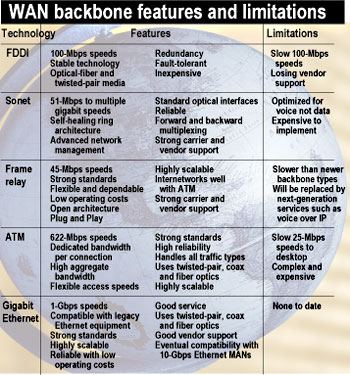
By J.B. MilesSpecial to GCNBandwidth, like winning, may not be everything, but to an information services manager looking to buttress a network against the pressures of too much traffic, it can look like the only thing.Many variables come into play when considering the right LAN or WAN backbone technology for your networks, not the least of which are high connection rates, security and flexible bandwidth management. But for most designers of multiprotocol, multiservice networking environments, the paramount factor is bandwidth.The leading contenders among high-speed, high-bandwidth WAN backbone technologies are Fiber Distributed Data Interface, Synchronous Optical Network, frame relay, asynchronous transfer mode and Gigabit Ethernet. Here are some of the principal features of each technology, along with a view of the viability of each.Fiber Distributed Data Interface backbones have performed very well historically, having arrived well before newer backbone technologies such as ATM and Gigabit Ethernet. FDDI builds 100-Mbps fiber-optic LAN backbones into a counter-rotating token-ring topology that can span up to 200 kilometers. (Twisted-pair copper wiring may also be used for short hops.) FDDI offers great redundancy and can handle up to 170,000 packets per second. FDDI backbones are also extremely fault-tolerant.But FDDI's heyday appears to be over. FDDI's 100-Mbps throughput speed doesn't measure up to the gigabit speeds of Gigabit Ethernet, and, though stable, FDDI doesn't meet the multiservice networking requirements and quality of service that technologies such as 622-Mpbs ATM backbones provide.Sonet is popular among telephone companies and common carriers that use it mainly to aggregate slower-speed T1 and T3 lines into high-speed fiber-optic backbones. The base rate of Sonet is 51.84 Mbps, but this rate can be multiplexed into the multiple gigabit range. Sonet comes in a frame format with two main areas for payload and overhead, and it has built-in intelligence for advanced network management.Sonet supports standardized optical interfaces, so interconnectivity and basic interoperability among different manufacturers' equipment are assured. It allows the multiplexing and de-multiplexing of signals into both high- and low-speed packages, with significant cost savings to users, and it is well-designed for popular private-line services. Its built-in redundancy and self-healing capabilities, especially in the four-fiber bidirectional ring version, make it especially fault-tolerant.Sonet was originally optimized for voice traffic, and this is still where its real strengths lie. Given the rapid growth of data networks, pundits were predicting as late as last fall that Sonet use would decline as buyers migrated to newer transport technologies.But so far the market for Sonet has been resilient. As long as both voice and data networks continue to grow exponentially, the telecommunications industry will continue to support Sonet.Dense wavelength division multiplexing technology, an optical successor to Sonet, is building a following among long-distance carriers, but Sonet will continue to be a viable alternative for enterprise WAN backbones.Frame relay is a popular WAN packet-switching topology offering variable throughput speeds of up to 45 Mbps. It is offered by all the major phone service carriers, including Sprint Corp., which recently halved its government rates under its FTS 2000 bridge contract to the new FTS 2001 contract.Information sent over frame relay WANs is divided into frames or packets that contain the address to which data is sent. Frame relay's underlying technology is efficient because it doesn't process data packets itself. It relies instead on powerful third- and fourth-generation network switches for processing the data packets.Frame relay backbones have become popular as pipelines for remote IP services, and the flexible technology allows for processing other important network protocols such as Systems Network Architecture and TCP/IP.Frame relay backbones are often referred to as clouds because they don't rely on single physical connections between endpoints. Instead they create logical paths, or virtual circuits, that can act as both switched virtual circuits and permanent virtual circuits. Thus, from a user's standpoint, frame relay economically meets the requirements for both switched dial-up lines and dedicated lines.Because frame relay can handle different frame sizes, it is well-suited to handle almost any traffic that passes over it. And because network switches and high-end PCs and workstations now take on many of the burdens of protocol processing, such as error detection and correction from the network itself, frame relay is a good fit for multiprotocol, multiservice networks.Asynchronous transfer mode is a switched technology that provides connections via switches rather than shared buses. Information on ATM backbones is assembled into fixed-length, 53-byte cells broken into 5-byte headers and 48-byte data payloads. Its switched nature allows ATM to offer benefits such as dedicated bandwidth per connection, high aggregate bandwidth, well-defined connection procedures and flexible access speeds.ATM is best known for its high reliability and quality of service for mission-critical applications. Because of its layered architecture, it easily handles multiple services such as voice, data and video. It works equally well over twisted-pair, coaxial or fiber-optic lines.Compared with the 1-Gbps speed of Gigabit Ethernet backbones, the ATM backbone speed of 622 Mbps is relatively slow. And ATM's 25-Mbps speed to desktop PCs hasn't been well-received in the marketplace.To handle Internet protocols successfully, ATM desktop PCs and servers require a specialized format called LAN emulation, a kind of virtual LAN that adds further complexity to ATM installations. Despite its many benefits, ATM can be complex and expensive, and implementation requires a lengthy learning curve for most Ethernet-aware network managers.Until Gigabit Ethernet came along, Ethernet and Fast Ethernet backbones couldn't compete with the speed, flexibility, quality of service and scalability of ATM. But Gigabit Ethernet backbones offer 1-Gbps speed and now can run over Category 5 copper, coaxial and fiber-optic lines.And Gigabit Ethernet's standards are secure, meaning the technology is fully backward-compatible with legacy Ethernet hardware standards and backbones can be scaled back to 10-Mbps Ethernet and 100-Mbps Fast Ethernet speeds as required.Ethernet network management schemes are already well-understood by most managers and users, so no lengthy learning curve is required to get a Gigabit Ethernet backbone up and running.The prices of Gigabit Ethernet gear also are dropping rapidly. Prices for Gigabit Ethernet switches are expected to drop 50 percent, or from about $1,000 per port to $500 per port, over the next six months. Industry watchers note that Gigabit Ethernet offers the same high standards for quality of service and reliability as ATM for a lower cost per port.Gigabit Ethernet appears likely to become the leading multiprotocol, multiservice backbone technology. Reinforcing this trend will be the emergence of 10-Gbps Ethernet systems for metropolitan area networks.
Cost, flexibility and security are factors managers consider when choosing a network technology


FDDI


Sonet


Frame relay


ATM


Gigabit Ethernet


J.B. Miles of Pahoa, Hawaii, writes about communications and computers.
X
This website uses cookies to enhance user experience and to analyze performance and traffic on our website. We also share information about your use of our site with our social media, advertising and analytics partners. Learn More / Do Not Sell My Personal Information
Accept Cookies
X
Cookie Preferences Cookie List

Do Not Sell My Personal Information

When you visit our website, we store cookies on your browser to collect information. The information collected might relate to you, your preferences or your device, and is mostly used to make the site work as you expect it to and to provide a more personalized web experience. However, you can choose not to allow certain types of cookies, which may impact your experience of the site and the services we are able to offer. Click on the different category headings to find out more and change our default settings according to your preference. You cannot opt-out of our First Party Strictly Necessary Cookies as they are deployed in order to ensure the proper functioning of our website (such as prompting the cookie banner and remembering your settings, to log into your account, to redirect you when you log out, etc.). For more information about the First and Third Party Cookies used please follow this link.

Allow All Cookies

Manage Consent Preferences

Strictly Necessary Cookies - Always Active

We do not allow you to opt-out of our certain cookies, as they are necessary to ensure the proper functioning of our website (such as prompting our cookie banner and remembering your privacy choices) and/or to monitor site performance. These cookies are not used in a way that constitutes a “sale” of your data under the CCPA. You can set your browser to block or alert you about these cookies, but some parts of the site will not work as intended if you do so. You can usually find these settings in the Options or Preferences menu of your browser. Visit www.allaboutcookies.org to learn more.

Sale of Personal Data, Targeting & Social Media Cookies

Under the California Consumer Privacy Act, you have the right to opt-out of the sale of your personal information to third parties. These cookies collect information for analytics and to personalize your experience with targeted ads. You may exercise your right to opt out of the sale of personal information by using this toggle switch. If you opt out we will not be able to offer you personalised ads and will not hand over your personal information to any third parties. Additionally, you may contact our legal department for further clarification about your rights as a California consumer by using this Exercise My Rights link

If you have enabled privacy controls on your browser (such as a plugin), we have to take that as a valid request to opt-out. Therefore we would not be able to track your activity through the web. This may affect our ability to personalize ads according to your preferences.

Targeting cookies may be set through our site by our advertising partners. They may be used by those companies to build a profile of your interests and show you relevant adverts on other sites. They do not store directly personal information, but are based on uniquely identifying your browser and internet device. If you do not allow these cookies, you will experience less targeted advertising.

Social media cookies are set by a range of social media services that we have added to the site to enable you to share our content with your friends and networks. They are capable of tracking your browser across other sites and building up a profile of your interests. This may impact the content and messages you see on other websites you visit. If you do not allow these cookies you may not be able to use or see these sharing tools.

If you want to opt out of all of our lead reports and lists, please submit a privacy request at our Do Not Sell page.

Save Settings
Cookie Preferences Cookie List

Cookie List

A cookie is a small piece of data (text file) that a website – when visited by a user – asks your browser to store on your device in order to remember information about you, such as your language preference or login information. Those cookies are set by us and called first-party cookies. We also use third-party cookies – which are cookies from a domain different than the domain of the website you are visiting – for our advertising and marketing efforts. More specifically, we use cookies and other tracking technologies for the following purposes:

Strictly Necessary Cookies

We do not allow you to opt-out of our certain cookies, as they are necessary to ensure the proper functioning of our website (such as prompting our cookie banner and remembering your privacy choices) and/or to monitor site performance. These cookies are not used in a way that constitutes a “sale” of your data under the CCPA. You can set your browser to block or alert you about these cookies, but some parts of the site will not work as intended if you do so. You can usually find these settings in the Options or Preferences menu of your browser. Visit www.allaboutcookies.org to learn more.

Functional Cookies

We do not allow you to opt-out of our certain cookies, as they are necessary to ensure the proper functioning of our website (such as prompting our cookie banner and remembering your privacy choices) and/or to monitor site performance. These cookies are not used in a way that constitutes a “sale” of your data under the CCPA. You can set your browser to block or alert you about these cookies, but some parts of the site will not work as intended if you do so. You can usually find these settings in the Options or Preferences menu of your browser. Visit www.allaboutcookies.org to learn more.

Performance Cookies

We do not allow you to opt-out of our certain cookies, as they are necessary to ensure the proper functioning of our website (such as prompting our cookie banner and remembering your privacy choices) and/or to monitor site performance. These cookies are not used in a way that constitutes a “sale” of your data under the CCPA. You can set your browser to block or alert you about these cookies, but some parts of the site will not work as intended if you do so. You can usually find these settings in the Options or Preferences menu of your browser. Visit www.allaboutcookies.org to learn more.

Sale of Personal Data

We also use cookies to personalize your experience on our websites, including by determining the most relevant content and advertisements to show you, and to monitor site traffic and performance, so that we may improve our websites and your experience. You may opt out of our use of such cookies (and the associated “sale” of your Personal Information) by using this toggle switch. You will still see some advertising, regardless of your selection. Because we do not track you across different devices, browsers and GEMG properties, your selection will take effect only on this browser, this device and this website.

Social Media Cookies

We also use cookies to personalize your experience on our websites, including by determining the most relevant content and advertisements to show you, and to monitor site traffic and performance, so that we may improve our websites and your experience. You may opt out of our use of such cookies (and the associated “sale” of your Personal Information) by using this toggle switch. You will still see some advertising, regardless of your selection. Because we do not track you across different devices, browsers and GEMG properties, your selection will take effect only on this browser, this device and this website.

Targeting Cookies

We also use cookies to personalize your experience on our websites, including by determining the most relevant content and advertisements to show you, and to monitor site traffic and performance, so that we may improve our websites and your experience. You may opt out of our use of such cookies (and the associated “sale” of your Personal Information) by using this toggle switch. You will still see some advertising, regardless of your selection. Because we do not track you across different devices, browsers and GEMG properties, your selection will take effect only on this browser, this device and this website.