Agency IT chiefs say they need to see the money

Information security has been widely heralded as the next big issue for government information technology officials to tackle, but analysts and many agencies are saying, 'Show me the money!'

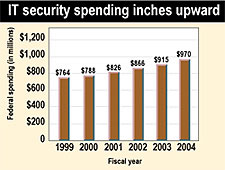
By Christopher J. DorobekGCN StaffInformation security has been widely heralded as the next big issue for government information technology officials to tackle, but analysts and many agencies are saying, 'Show me the money!'Some senior federal IT executives have recommended an emergency appropriation for critical infrastructure protection, following the year 2000 model.'I don't think the budget environment is at a point where we can do the things we want to do,' said Marguerite R. Coffey, chairwoman of the State Department's Critical Infrastructure Protection Governance Board.State chief information officer Fernando Burbano said agencies are working on budgets for fiscal 2002, which makes it difficult to put security measures in place now. Furthermore, he argued, recent denial-of-service attacks and other security breaches have created a window of opportunity in Congress.Yet despite the increased attention given to critical infrastructure protection, a new study conducted by Input Inc., a market research firm in Vienna, Va., predicts only moderate growth in agency IT security spending.The survey, Federal IT Security Market View, indicates that the market for IT security products and services will grow by 5 percent annually. IT security spending is expected to reach almost $1 billion by 2004.Officials from the Office of Management and Budget, speaking at an IT security conference last week, said OMB is generally opposed to centrally controlled funds, preferring that agencies build IT security funding into their budgets. OMB policy analyst Margaret Evans said the year 2000 supplemental fund was difficult to manage.But managing the funds might not be an issue at all, Evans said. Congress has been less than receptive to the administration's funding requests for critical infrastructure protection.Last year, lawmakers rejected outright a request for supplemental funds, and the House this year has given the administration's $9 million request for fiscal 2000 a cold shoulder.'There is not a uniform appreciation to be found,' she said. 'Our position on the criticality of this issue is well-known.'In any case, money cannot be used as a crutch for agencies, OMB officials said. Security has always been a requirement for information systems, and IT security should be a part of budgeted system lifecycle costs, they said.The Computer Security Act has been around for 12 years, OMB policy analyst Glenn Schlarman said at the Critical Infrastructure Protection Day conference sponsored by the CIO Council's Security, Privacy and Critical Infrastructure Committee.IT security should be woven into the program, and budgets must account for the entire lifecycle costs of a system, Schlarman said. But agencies have not done all they can do, Schlarman said. Few agencies have tied performance goals to security, he said.His comments echoed guidance from OMB director Jacob J. Lew, issued late last month, that makes funding for IT projects conditional on adequate security.'The most effective way to protect information and systems is to incorporate security into the architecture of each. This approach ensures that security supports agency business operations'thus facilitating the operations'and that plans to fund and manage security are built into lifecycle budgets for information systems,' Lew said.'In general, OMB will consider new or continued funding only for those system investments that satisfy [the OMB criteria], and will consider funding information technology investments only upon demonstration that existing agency systems meet these criteria,' he said.Many agencies have not given IT security as much attention as they should and have used security funds for other projects, OMB officials acknowledged. Agencies must improve assessments of lifecycle costs, OMB officials said.Part of the problem is the budget process. Evans said OMB has been spearheading a cross-agency effort to fund security projects, but congressional appropriations committees are leery of giving up control.Lawmakers have recognized the possible need for reorganization to track crosscutting concerns such as IT security. The Senate Special Committee on the Year 2000 Technology Problem, in its final report issued last month, noted that funding for critical infrastructure protection is spread over 15 agencies and overseen by nine committees.'This presents numerous challenges to effective congressional oversight and policy initiatives,' the report said. 'The Senate must examine the congressional structure and its efficacy for addressing critical infrastructure protection and future IT issues.'Meanwhile, President Clinton has told agencies to step up efforts to ensure critical infrastructure protection in the wake of several denial-of-service attacks.'The president said he told White House chief of staff John Podesta to coordinate a review of agency vulnerabilities and report back by April 1.'Within legal and administrative limits, attention should also be paid to contractors providing services,' Clinton said.'These Internet disruptions highlight how important computer networks have become in our daily lives, and how vulnerabilities can create risks for all'including the federal government,' Clinton said in a memo.Clinton's memo is online at . For the OMB guidance, go to .



Cold shoulder


Research by Input Inc. shows that federal spending on information security will likely increase moderately for the next five years.


cio.gov/docs/Anti-attacks.htmcio.gov/docs/lews_lessons.htm
X
This website uses cookies to enhance user experience and to analyze performance and traffic on our website. We also share information about your use of our site with our social media, advertising and analytics partners. Learn More / Do Not Sell My Personal Information
Accept Cookies
X
Cookie Preferences Cookie List

Do Not Sell My Personal Information

When you visit our website, we store cookies on your browser to collect information. The information collected might relate to you, your preferences or your device, and is mostly used to make the site work as you expect it to and to provide a more personalized web experience. However, you can choose not to allow certain types of cookies, which may impact your experience of the site and the services we are able to offer. Click on the different category headings to find out more and change our default settings according to your preference. You cannot opt-out of our First Party Strictly Necessary Cookies as they are deployed in order to ensure the proper functioning of our website (such as prompting the cookie banner and remembering your settings, to log into your account, to redirect you when you log out, etc.). For more information about the First and Third Party Cookies used please follow this link.

Allow All Cookies

Manage Consent Preferences

Strictly Necessary Cookies - Always Active

We do not allow you to opt-out of our certain cookies, as they are necessary to ensure the proper functioning of our website (such as prompting our cookie banner and remembering your privacy choices) and/or to monitor site performance. These cookies are not used in a way that constitutes a “sale” of your data under the CCPA. You can set your browser to block or alert you about these cookies, but some parts of the site will not work as intended if you do so. You can usually find these settings in the Options or Preferences menu of your browser. Visit www.allaboutcookies.org to learn more.

Sale of Personal Data, Targeting & Social Media Cookies

Under the California Consumer Privacy Act, you have the right to opt-out of the sale of your personal information to third parties. These cookies collect information for analytics and to personalize your experience with targeted ads. You may exercise your right to opt out of the sale of personal information by using this toggle switch. If you opt out we will not be able to offer you personalised ads and will not hand over your personal information to any third parties. Additionally, you may contact our legal department for further clarification about your rights as a California consumer by using this Exercise My Rights link

If you have enabled privacy controls on your browser (such as a plugin), we have to take that as a valid request to opt-out. Therefore we would not be able to track your activity through the web. This may affect our ability to personalize ads according to your preferences.

Targeting cookies may be set through our site by our advertising partners. They may be used by those companies to build a profile of your interests and show you relevant adverts on other sites. They do not store directly personal information, but are based on uniquely identifying your browser and internet device. If you do not allow these cookies, you will experience less targeted advertising.

Social media cookies are set by a range of social media services that we have added to the site to enable you to share our content with your friends and networks. They are capable of tracking your browser across other sites and building up a profile of your interests. This may impact the content and messages you see on other websites you visit. If you do not allow these cookies you may not be able to use or see these sharing tools.

If you want to opt out of all of our lead reports and lists, please submit a privacy request at our Do Not Sell page.

Save Settings
Cookie Preferences Cookie List

Cookie List

A cookie is a small piece of data (text file) that a website – when visited by a user – asks your browser to store on your device in order to remember information about you, such as your language preference or login information. Those cookies are set by us and called first-party cookies. We also use third-party cookies – which are cookies from a domain different than the domain of the website you are visiting – for our advertising and marketing efforts. More specifically, we use cookies and other tracking technologies for the following purposes:

Strictly Necessary Cookies

We do not allow you to opt-out of our certain cookies, as they are necessary to ensure the proper functioning of our website (such as prompting our cookie banner and remembering your privacy choices) and/or to monitor site performance. These cookies are not used in a way that constitutes a “sale” of your data under the CCPA. You can set your browser to block or alert you about these cookies, but some parts of the site will not work as intended if you do so. You can usually find these settings in the Options or Preferences menu of your browser. Visit www.allaboutcookies.org to learn more.

Functional Cookies

We do not allow you to opt-out of our certain cookies, as they are necessary to ensure the proper functioning of our website (such as prompting our cookie banner and remembering your privacy choices) and/or to monitor site performance. These cookies are not used in a way that constitutes a “sale” of your data under the CCPA. You can set your browser to block or alert you about these cookies, but some parts of the site will not work as intended if you do so. You can usually find these settings in the Options or Preferences menu of your browser. Visit www.allaboutcookies.org to learn more.

Performance Cookies

We do not allow you to opt-out of our certain cookies, as they are necessary to ensure the proper functioning of our website (such as prompting our cookie banner and remembering your privacy choices) and/or to monitor site performance. These cookies are not used in a way that constitutes a “sale” of your data under the CCPA. You can set your browser to block or alert you about these cookies, but some parts of the site will not work as intended if you do so. You can usually find these settings in the Options or Preferences menu of your browser. Visit www.allaboutcookies.org to learn more.

Sale of Personal Data

We also use cookies to personalize your experience on our websites, including by determining the most relevant content and advertisements to show you, and to monitor site traffic and performance, so that we may improve our websites and your experience. You may opt out of our use of such cookies (and the associated “sale” of your Personal Information) by using this toggle switch. You will still see some advertising, regardless of your selection. Because we do not track you across different devices, browsers and GEMG properties, your selection will take effect only on this browser, this device and this website.

Social Media Cookies

We also use cookies to personalize your experience on our websites, including by determining the most relevant content and advertisements to show you, and to monitor site traffic and performance, so that we may improve our websites and your experience. You may opt out of our use of such cookies (and the associated “sale” of your Personal Information) by using this toggle switch. You will still see some advertising, regardless of your selection. Because we do not track you across different devices, browsers and GEMG properties, your selection will take effect only on this browser, this device and this website.

Targeting Cookies

We also use cookies to personalize your experience on our websites, including by determining the most relevant content and advertisements to show you, and to monitor site traffic and performance, so that we may improve our websites and your experience. You may opt out of our use of such cookies (and the associated “sale” of your Personal Information) by using this toggle switch. You will still see some advertising, regardless of your selection. Because we do not track you across different devices, browsers and GEMG properties, your selection will take effect only on this browser, this device and this website.