Do CIOs have enough power to do their jobs?

Most federal agencies have chief information officers, and CIO is a common acronym along Washington's halls of power. But some in government say federal CIOs need more authority. What is needed, several government oversight officials and CIOs have said, is the authority to make top-level decisions'power equivalent to that of their private-sector counterparts.
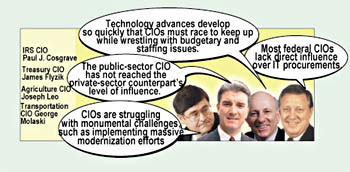
With the exception of the CIOs at the Agriculture and Defense departments, federal CIOs do not have direct influence over IT procurements, Transportation Department CIO George R. Molaski said.Several CIOs and other federal officials testified before Congress recently during a hearing in which lawmakers discussed the roles of CIOs.'Chief information officers in the private sector have provided the technical and managerial expertise that has successfully brought corporate America into an era dominated by high technology,' Rep. Steve Horn (R-Calif.) said at a recent hearing of the House Government Reform Subcommittee on Government Management, Information and Technology, of which he is chairman.Federal CIOs must accomplish similar technical and management feats, but agency leaders have to give them the authority to do so, Horn said.Lawmakers and officials implementing policy said the convergence of empowerment and accountability for CIOs is critical.'As the federal government fully embraces electronic commerce, leadership in the management of the government's information resources becomes of paramount importance,' said Jeffrey C. Steinoff, acting assistant comptroller for the General Accounting Office.That leadership is still lacking, according to GAO officials and some government CIOs.'In the private sector, many CIOs have evolved into chief technology officers working side by side with the chief executive officer,' Treasury Department CIO James Flyzik said. 'The public-sector CIO has not yet reached this level of influence.'Four years after Congress mandated that agencies establish CIOs, many still are trying to make full use of control and evaluation processes and to maintain performance metrics for their IT, testified David L. McClure, GAO's associate director of governmentwide and Defense information systems.And agencies have made inadequate progress in designing and implementing IT architectures before proceeding with massive modernization efforts, McClure said.'More remains to be done to ensure that federal CIOs establish themselves as effective information management leaders,' McClure testified at the hearing.Private-sector leaders agree that federal CIOs face tough challenges.'I believe that the CIO function is one of the most difficult roles today any person has been assigned to in the federal government,' said Lee Cooper, Unisys Corp.'s vice president for business development, at a recent Professional Services Council luncheon in Washington.Federal CIOs face unique structural and cultural hurdles, GAO noted last month in an executive guide, Maximizing the Success of Chief Information Officers: Learning From Leading Organizations.The guide, developed under McClure's direction, looked at three private-sector and three state CIO offices, and presented recommendations to improve federal CIOs' effectiveness. The study looked at the CIO operations of Chase Manhattan Corp., General Motors Corp. and J.C. Penney Co. Inc. and the states of Pennsylvania, Texas and Washington.The CIO position must evolve, Flyzik told the subcommittee.The first challenge: Take advantage of rapidly evolving technology to make government more effective.'It's amazing how fast electronic business is hitting us,' Agriculture Department CIO Joseph Leo said. 'Technology is racing at a tremendous speed.'Public and congressional perceptions are also a challenge, he said. 'There is this perception'right or wrong'that I can turn all of these legacy systems overnight into a user-friendly, interactive, two-way dialogue with the American public at no additional cost.' The uncertain and complex federal appropriations process limits CIOs' ability to take advantage of fleeting technological developments, Leo said. The struggle to find investment money beyond the basic budget is an everyday challenge for federal CIOs, he said.IRS CIO Paul J. Cosgrave said most IT money comes from the agency's base program funding.'If it's new, above the base, it stands out like a sore thumb' and draws attention from lawmakers, he said.Adair Martinez, CIO of the Veterans Benefits Administration, agreed that funding IT projects is a challenge.'One of the biggest differences between the public and private sectors is the budget and planning cycle,' she said. 'The public sector cannot react as quickly to technology. Private-sector CIOs can plan on a shorter cycle to take advantage of it. Public-sector CIOs must think two to five years out.'Funding limitations also hinder the government's efforts to retain skilled IT professionals and attract new blood, Flyzik said.Cosgrave noted that 25 percent of the IRS' work force will be eligible for retirement in the next few years; the average age of the agency's IT officials is 46.'If we don't do something soon, we will be out of business,' Cosgrave said. 'We are not able to attract [IT professionals] because our starting salaries in the government are not competitive.'Leo said his department has lost 22,500 employees since 1993.'What do you do with that?' Leo asked. 'I am concerned with the alignment of IT architecture and human resources. I have to have the human capacity to manage IT.'But the premier challenge noted by lawmakers, GAO and CIOs themselves is finding a way to ensure that federal CIOs have decision-making authority. With enough clout, most said, they could overcome all other challenges.Many CIOs said they have tacit authority and direct interaction with their agency chiefs.In its CIO guide, GAO noted that the government treats IT as a support function rather than a strategic asset, and the CIO as a support officer, not a decision-making executive.Flyzik said he feels lucky to have an 'excellent working relationship with the chief financial officer' at Treasury, so he is involved in every IT investment decision.Cosgrave added: 'I will hold up my relationship with IRS commissioner Charles O. Rossotti as a good one. I am lucky because I am a direct adviser to him. I advise him two to three times a day. It has to be a very open relationship.'Molaski said he also acts as a close IT policy adviser to Transportation Secretary Rodney E. Slater, but he agreed that federal CIOs should control IT decisions.Agency heads should 'position CIOs as change agents with responsibility for applying technology to achieve major improvements in fundamental business processes and operations,' the GAO guide stated.CIOs can retain leadership support by following through on commitments to effectively lead projects, provide needed information management products and services, and train users, GAO concluded.

By Shruti Dat'

GCN Staff

Most federal agencies have chief information officers, and CIO is a common acronym along Washington's halls of power. But some in government say federal CIOs need more authority. What is needed, several government oversight officials and CIOs have said, is the authority to make top-level decisions'power equivalent to that of their private-sector counterparts.


Unique hurdles


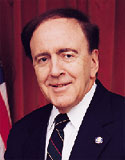
Rep. Steve Horn says government CIOs need authority that is comparable to that of their industry counterparts.


VBA's Adair Martinez says the budget process curtails quick action by CIOs.


Executive treatment


NEXT STORY: Govt.'s greatest hits go online

X
This website uses cookies to enhance user experience and to analyze performance and traffic on our website. We also share information about your use of our site with our social media, advertising and analytics partners. Learn More / Do Not Sell My Personal Information
Accept Cookies
X
Cookie Preferences Cookie List

Do Not Sell My Personal Information

When you visit our website, we store cookies on your browser to collect information. The information collected might relate to you, your preferences or your device, and is mostly used to make the site work as you expect it to and to provide a more personalized web experience. However, you can choose not to allow certain types of cookies, which may impact your experience of the site and the services we are able to offer. Click on the different category headings to find out more and change our default settings according to your preference. You cannot opt-out of our First Party Strictly Necessary Cookies as they are deployed in order to ensure the proper functioning of our website (such as prompting the cookie banner and remembering your settings, to log into your account, to redirect you when you log out, etc.). For more information about the First and Third Party Cookies used please follow this link.

Allow All Cookies

Manage Consent Preferences

Strictly Necessary Cookies - Always Active

We do not allow you to opt-out of our certain cookies, as they are necessary to ensure the proper functioning of our website (such as prompting our cookie banner and remembering your privacy choices) and/or to monitor site performance. These cookies are not used in a way that constitutes a “sale” of your data under the CCPA. You can set your browser to block or alert you about these cookies, but some parts of the site will not work as intended if you do so. You can usually find these settings in the Options or Preferences menu of your browser. Visit www.allaboutcookies.org to learn more.

Sale of Personal Data, Targeting & Social Media Cookies

Under the California Consumer Privacy Act, you have the right to opt-out of the sale of your personal information to third parties. These cookies collect information for analytics and to personalize your experience with targeted ads. You may exercise your right to opt out of the sale of personal information by using this toggle switch. If you opt out we will not be able to offer you personalised ads and will not hand over your personal information to any third parties. Additionally, you may contact our legal department for further clarification about your rights as a California consumer by using this Exercise My Rights link

If you have enabled privacy controls on your browser (such as a plugin), we have to take that as a valid request to opt-out. Therefore we would not be able to track your activity through the web. This may affect our ability to personalize ads according to your preferences.

Targeting cookies may be set through our site by our advertising partners. They may be used by those companies to build a profile of your interests and show you relevant adverts on other sites. They do not store directly personal information, but are based on uniquely identifying your browser and internet device. If you do not allow these cookies, you will experience less targeted advertising.

Social media cookies are set by a range of social media services that we have added to the site to enable you to share our content with your friends and networks. They are capable of tracking your browser across other sites and building up a profile of your interests. This may impact the content and messages you see on other websites you visit. If you do not allow these cookies you may not be able to use or see these sharing tools.

If you want to opt out of all of our lead reports and lists, please submit a privacy request at our Do Not Sell page.

Save Settings
Cookie Preferences Cookie List

Cookie List

A cookie is a small piece of data (text file) that a website – when visited by a user – asks your browser to store on your device in order to remember information about you, such as your language preference or login information. Those cookies are set by us and called first-party cookies. We also use third-party cookies – which are cookies from a domain different than the domain of the website you are visiting – for our advertising and marketing efforts. More specifically, we use cookies and other tracking technologies for the following purposes:

Strictly Necessary Cookies

We do not allow you to opt-out of our certain cookies, as they are necessary to ensure the proper functioning of our website (such as prompting our cookie banner and remembering your privacy choices) and/or to monitor site performance. These cookies are not used in a way that constitutes a “sale” of your data under the CCPA. You can set your browser to block or alert you about these cookies, but some parts of the site will not work as intended if you do so. You can usually find these settings in the Options or Preferences menu of your browser. Visit www.allaboutcookies.org to learn more.

Functional Cookies

We do not allow you to opt-out of our certain cookies, as they are necessary to ensure the proper functioning of our website (such as prompting our cookie banner and remembering your privacy choices) and/or to monitor site performance. These cookies are not used in a way that constitutes a “sale” of your data under the CCPA. You can set your browser to block or alert you about these cookies, but some parts of the site will not work as intended if you do so. You can usually find these settings in the Options or Preferences menu of your browser. Visit www.allaboutcookies.org to learn more.

Performance Cookies

We do not allow you to opt-out of our certain cookies, as they are necessary to ensure the proper functioning of our website (such as prompting our cookie banner and remembering your privacy choices) and/or to monitor site performance. These cookies are not used in a way that constitutes a “sale” of your data under the CCPA. You can set your browser to block or alert you about these cookies, but some parts of the site will not work as intended if you do so. You can usually find these settings in the Options or Preferences menu of your browser. Visit www.allaboutcookies.org to learn more.

Sale of Personal Data

We also use cookies to personalize your experience on our websites, including by determining the most relevant content and advertisements to show you, and to monitor site traffic and performance, so that we may improve our websites and your experience. You may opt out of our use of such cookies (and the associated “sale” of your Personal Information) by using this toggle switch. You will still see some advertising, regardless of your selection. Because we do not track you across different devices, browsers and GEMG properties, your selection will take effect only on this browser, this device and this website.

Social Media Cookies

We also use cookies to personalize your experience on our websites, including by determining the most relevant content and advertisements to show you, and to monitor site traffic and performance, so that we may improve our websites and your experience. You may opt out of our use of such cookies (and the associated “sale” of your Personal Information) by using this toggle switch. You will still see some advertising, regardless of your selection. Because we do not track you across different devices, browsers and GEMG properties, your selection will take effect only on this browser, this device and this website.

Targeting Cookies

We also use cookies to personalize your experience on our websites, including by determining the most relevant content and advertisements to show you, and to monitor site traffic and performance, so that we may improve our websites and your experience. You may opt out of our use of such cookies (and the associated “sale” of your Personal Information) by using this toggle switch. You will still see some advertising, regardless of your selection. Because we do not track you across different devices, browsers and GEMG properties, your selection will take effect only on this browser, this device and this website.