Reno: IT accessibility will challenge agencies

Making government information technology accessible to the disabled will challenge federal agencies, but the effort is necessary because it is the right thing to do, Attorney General Janet Reno said last week.

By Christopher J. DorobekGCN StaffMaking government information technology accessible to the disabled will challenge federal agencies, but the effort is necessary because it is the right thing to do, Attorney General Janet Reno said last week.'The ultimate goal of Section 508 is to make government IT more accessible,' Reno said during a keynote speech at the FOSE trade show in Washington. 'This human resource needs to be included.'Section 508 of the Rehabilitation Act Amendments of 1998 was a dominant topic at FOSE. The draft rules, issued last month by the federal Access Board, require that IT be accessible to the disabled []. The rules, which would likely take effect this year, would apply to agencies when they develop, buy, maintain or use IT.IT vendors say they favor the regulations, but they want more time to develop products that meet the requirements. 'Industry is doing the best it can,' said Dan. C. Heinemeier, president of the Government Electronics and Information Technology Association of Arlington, Va. 'We're trying to em-brace this as an opportunity.'In addition to speeches from Reno and Microsoft Corp. president and chief executive officer Steve Ballmer about making technologies accessible to the disabled, the Education Department and the General Services Administration hosted a booth showcasing technologies for disabled users.'Access doesn't have to cost a lot' when it is built into systems from the beginning and is designed well, Reno said. Video screens, one displaying a transcript of her speech and the other displaying a person signing the speech, flanked the attorney general.The Justice Department last week also issued a much-anticipated report on current federal use of accessible technologies. The report, , said that few agencies are doing enough and that making IT fully accessible would be a challenge for most agencies.For example, revising Web sites to make them more accessible is one of the easiest and least expensive fixes, but few federal sites are designed for disabled users, the report said. 'As more forms and interactive content are put online, agencies will have to maintain their vigilance regarding accessibility.'Reno noted that the Section 508 efforts would have implications for the government's IT work force shortage. 'It is truly ironic that many [IT] jobs may be ideal for people with disabilities, yet most technology in use today was designed without those people in mind,' she said.Across the board, the most serious problem is not technological, according to the Justice report. 'The most significant challenge posed by Section 508 is the need for coordination between those with technological expertise and those with knowledge of disability access issues,' the report said.The rapid pace of innovation only serves to further complicate the issue, the report concluded.Justice made several recommendations:''To foster communication, President Clinton should issue a Technology Access Coordination Directive to revitalize the Interagency Disability Coordinating Council.''Agencies should create universal access working groups to serve as advocates for accessible technology.''Agencies should appoint Section 508 coordinators responsible for making IT accessible.''Agencies should establish voluntary alternative dispute resolution processes to handle disagreements about IT accessibility.''Government programs that test and certify software, such as the Joint Financial Management Improvement Project, should incorporate the requirements into their certification processes.GSA, tapped by the administration to lead Section 508 implementation, is developing educational programs.In demonstrations at FOSE, GSA showcased many products. Zoom Text Xtra from Ai Squared of Manchester Center, Vt., for example, lets users enlarge a portion of the screen, helping those with vision problems.GSA also is working on a Section 508 Web site, .The agency plans to work closely with Education officials and learn from their experience in drafting accessibility requirements for contracts, said Ron Luycx, project manager for the IT Accommodation Division's 508 Project in GSA's Office of Governmentwide Policy.He said the department also is a model for other agencies that want to gauge product accessibility. Education tests products in its own accessibility lab, Luycx said.For vendors, a key issue will be making products interoperable. Many vendors are rallying behind Microsoft Windows' Active Accessibility application programming interfaces. It sets a baseline from which other vendors can design their applications, said Richard Brown, an Adobe Systems Inc. product manager.Justice's report can be found on the Web at . The Access Board's draft rules for Section 508 are posted at .

Making IT accessible will require input from the disabled, Janet Reno says.


GCN, April 17, Page 1


Information Technology and People With Disabilities: The Current State of Federal Accessibility


Help on the way
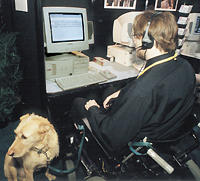

At the GSA'Education booth, a FOSE conference attendee tries out the accessible technologies on display.


www.section508.gov


www.usdoj.gov/crt/508/report/content.htmwww.access-board.gov/RULES/508nprm.htm

NEXT STORY: Flexibility bill passes first test

X
This website uses cookies to enhance user experience and to analyze performance and traffic on our website. We also share information about your use of our site with our social media, advertising and analytics partners. Learn More / Do Not Sell My Personal Information
Accept Cookies
X
Cookie Preferences Cookie List

Do Not Sell My Personal Information

When you visit our website, we store cookies on your browser to collect information. The information collected might relate to you, your preferences or your device, and is mostly used to make the site work as you expect it to and to provide a more personalized web experience. However, you can choose not to allow certain types of cookies, which may impact your experience of the site and the services we are able to offer. Click on the different category headings to find out more and change our default settings according to your preference. You cannot opt-out of our First Party Strictly Necessary Cookies as they are deployed in order to ensure the proper functioning of our website (such as prompting the cookie banner and remembering your settings, to log into your account, to redirect you when you log out, etc.). For more information about the First and Third Party Cookies used please follow this link.

Allow All Cookies

Manage Consent Preferences

Strictly Necessary Cookies - Always Active

We do not allow you to opt-out of our certain cookies, as they are necessary to ensure the proper functioning of our website (such as prompting our cookie banner and remembering your privacy choices) and/or to monitor site performance. These cookies are not used in a way that constitutes a “sale” of your data under the CCPA. You can set your browser to block or alert you about these cookies, but some parts of the site will not work as intended if you do so. You can usually find these settings in the Options or Preferences menu of your browser. Visit www.allaboutcookies.org to learn more.

Sale of Personal Data, Targeting & Social Media Cookies

Under the California Consumer Privacy Act, you have the right to opt-out of the sale of your personal information to third parties. These cookies collect information for analytics and to personalize your experience with targeted ads. You may exercise your right to opt out of the sale of personal information by using this toggle switch. If you opt out we will not be able to offer you personalised ads and will not hand over your personal information to any third parties. Additionally, you may contact our legal department for further clarification about your rights as a California consumer by using this Exercise My Rights link

If you have enabled privacy controls on your browser (such as a plugin), we have to take that as a valid request to opt-out. Therefore we would not be able to track your activity through the web. This may affect our ability to personalize ads according to your preferences.

Targeting cookies may be set through our site by our advertising partners. They may be used by those companies to build a profile of your interests and show you relevant adverts on other sites. They do not store directly personal information, but are based on uniquely identifying your browser and internet device. If you do not allow these cookies, you will experience less targeted advertising.

Social media cookies are set by a range of social media services that we have added to the site to enable you to share our content with your friends and networks. They are capable of tracking your browser across other sites and building up a profile of your interests. This may impact the content and messages you see on other websites you visit. If you do not allow these cookies you may not be able to use or see these sharing tools.

If you want to opt out of all of our lead reports and lists, please submit a privacy request at our Do Not Sell page.

Save Settings
Cookie Preferences Cookie List

Cookie List

A cookie is a small piece of data (text file) that a website – when visited by a user – asks your browser to store on your device in order to remember information about you, such as your language preference or login information. Those cookies are set by us and called first-party cookies. We also use third-party cookies – which are cookies from a domain different than the domain of the website you are visiting – for our advertising and marketing efforts. More specifically, we use cookies and other tracking technologies for the following purposes:

Strictly Necessary Cookies

We do not allow you to opt-out of our certain cookies, as they are necessary to ensure the proper functioning of our website (such as prompting our cookie banner and remembering your privacy choices) and/or to monitor site performance. These cookies are not used in a way that constitutes a “sale” of your data under the CCPA. You can set your browser to block or alert you about these cookies, but some parts of the site will not work as intended if you do so. You can usually find these settings in the Options or Preferences menu of your browser. Visit www.allaboutcookies.org to learn more.

Functional Cookies

We do not allow you to opt-out of our certain cookies, as they are necessary to ensure the proper functioning of our website (such as prompting our cookie banner and remembering your privacy choices) and/or to monitor site performance. These cookies are not used in a way that constitutes a “sale” of your data under the CCPA. You can set your browser to block or alert you about these cookies, but some parts of the site will not work as intended if you do so. You can usually find these settings in the Options or Preferences menu of your browser. Visit www.allaboutcookies.org to learn more.

Performance Cookies

We do not allow you to opt-out of our certain cookies, as they are necessary to ensure the proper functioning of our website (such as prompting our cookie banner and remembering your privacy choices) and/or to monitor site performance. These cookies are not used in a way that constitutes a “sale” of your data under the CCPA. You can set your browser to block or alert you about these cookies, but some parts of the site will not work as intended if you do so. You can usually find these settings in the Options or Preferences menu of your browser. Visit www.allaboutcookies.org to learn more.

Sale of Personal Data

We also use cookies to personalize your experience on our websites, including by determining the most relevant content and advertisements to show you, and to monitor site traffic and performance, so that we may improve our websites and your experience. You may opt out of our use of such cookies (and the associated “sale” of your Personal Information) by using this toggle switch. You will still see some advertising, regardless of your selection. Because we do not track you across different devices, browsers and GEMG properties, your selection will take effect only on this browser, this device and this website.

Social Media Cookies

We also use cookies to personalize your experience on our websites, including by determining the most relevant content and advertisements to show you, and to monitor site traffic and performance, so that we may improve our websites and your experience. You may opt out of our use of such cookies (and the associated “sale” of your Personal Information) by using this toggle switch. You will still see some advertising, regardless of your selection. Because we do not track you across different devices, browsers and GEMG properties, your selection will take effect only on this browser, this device and this website.

Targeting Cookies

We also use cookies to personalize your experience on our websites, including by determining the most relevant content and advertisements to show you, and to monitor site traffic and performance, so that we may improve our websites and your experience. You may opt out of our use of such cookies (and the associated “sale” of your Personal Information) by using this toggle switch. You will still see some advertising, regardless of your selection. Because we do not track you across different devices, browsers and GEMG properties, your selection will take effect only on this browser, this device and this website.