
INTERVIEW: Philip N. Diehl, Mint's former director





Former Mint director Philip N. Diehl in 1998 steered the implementation of the Treasury Department agency's enterprise resource planning system.
DIEHL: A crucial element they have to focus on first is to have a firm grasp on the business case for modernization. That is really where we started at the Mint. By the time we got to the issue of modernizing our information technology systems, we had gone through a three- or four-year process of re-engineering our organization.Throughout virtually the entire organization there was frustration about the lack of capabilities of the legacy systems. Then we had the added jet fuel of year 2000 compliance. So our enterprise resource planning solution was also our Y2K solution.Second, there was broad grassroots support for modernization, which provided an extraordinarily strong business case. I would say obtaining broad formal buy-in is important. The way you get that is by presenting a good business case and involving all the various disciplines, business units, and functional and geographical areas to ensure as many players as possible have a stake in the success of the system implementation.DIEHL: You have to burn the candle at both ends. We started with a task force that did the assessment in the face of knowledge that we would need millions of dollars'at least $12 to $15 million'just to make our legacy systems Y2K-compliant.The task force had representatives from all across the Mint. They looked at a wide range of options, came to the conclusion that an ERP was the best solution and brought it to the executive leadership. You have to have strong top-level sponsorship'not just support'because there are difficult trade-offs in implementing an ERP.DIEHL: You cannot do everything at once. What you discover is the requirements for timely, reliable data in the organization are far greater than you can possibly ever meet, especially over the short to middle term. So you have to make tough choices among manufacturing, financial management, marketing, human resources and procurement demands. All those are competing for dollars, yes, but especially for talent.Then you find as you make some tough business decisions about implementation that there are thousands of lower-level business decisions that have significant business consequences. No one wants to assume the responsibilities of those decisions. One of the things, which is a blessing and curse in ERP systems, is they have been designed with best-in-business practices out in the real world.But government agencies have typically evolved their own business processes. It is shock treatment because agencies have to change these information systems and they have to change their business processes, which are assumed in the ERP. They have to make decisions about how they will conform the business processes to fit the ERP, where they feel like they must change the ERP. That is a very slippery slope.There are unintended consequences to changing the code. You threaten the viability of upgrades to the software.When you customize, the ERP no longer conforms to commercial, off-the-shelf products.DIEHL: I think the threshold issue is whether the agency has the leadership and the internal cultural and financial resources to do an ERP. If it does, then the first threshold is met and the payoff of the ERP is huge.At the Mint, we got much of what we expected and a lot more. If an agency lacks one of the crucial variables from leadership resources in terms of talent or money, I would be cautious in launching an ERP. Assuming that those minimum requirements are there, the great attraction of an ERP is to look at the evolved business practices.It is especially important in government agencies because there is tremendous waste in those processes. They are hardwired into the system because they evolved willy-nilly through situations in which people were not very savvy in business processes or information technology. Those business systems are often 5, 10, 15 or 50 years old, and they cry out for a deep rethink.At the Mint, the ERP implementation was not just a huge IT challenge. It became the most important lever in culture change and business process re-engineering.DIEHL: None whatsoever. The ERP has had a profound impact on our service-delivery functions as well. It includes tremendous power in the area of financial management'an area of reform in all government agencies'in human resource management and procurement processes. There is no basis in making that distinction between the Mint and other agencies.DIEHL: Again, you have to start with a strong, tight business case of why replacing legacy systems with an ERP is crucial to meeting specific demands laid on the agency by its customers, by the oversight agencies such as the Office of Management and Budget, and by Congress. That can be in terms of customer service, product delivery, labor-management relations, and reform in financial management, procurement and human resources management.All those areas represent potential ammunition to build a business case as to why an ERP is appropriate. It is entirely possible to build a case and ask Congress for a limited procurement waiver and receive appropriated funding.DIEHL: Some of them are getting a lot closer. I think the Government Performance and Results Act and financial management reforms, imposed by Congress across government agencies, are building the management infrastructure and capabilities to prepare more agencies to take on this kind of challenge. There are pockets of innovation around the government, so I think there are more agencies coming closer.DIEHL: Well, there are two schools of thought on that. One, don't put all your eggs in one basket. Two, put all your eggs in one basket and watch that basket carefully.The model in the private sector'because no one in the public sector had done it yet'included a client, an ERP software provider and the implementers. The implementers tapped the software and expertise of the software provider and then installed the ERP.At the Mint, we were committed to breaking that mold. We wanted an ERP provider who would also play the role of the implementer.When we did our assessment of what went wrong and what went right in private-sector ERP implementations we found there was a lot of finger-pointing among the three main players, a lot of confusion over who was responsible for what. PeopleSoft Inc. of Pleasanton, Calif., was willing to break that mold and take responsibility for that implementation. So, they were the providers and a core part of the implementation team.The truth of the matter is with an ERP, whether you have one basket, two baskets or 10 baskets, you have to watch them all carefully because an ERP can go wrong in three ways: huge cost overruns, huge time delays and post-implementation chaos.We had customer service problems. We track customer service very closely with 32 metrics, sometimes on an hourly basis or sometimes on a weekly basis. But we saw some of our most important customer service metrics plunge after implementation.There were fewer surprises in the financial management area because they had a less radical transition. We had invested so much in the financial management area, so it was less of a leap for the non-techie people.
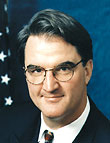 Former Mint director Philip N. Diehl in 1998 steered the implementation of the Treasury Department agency's enterprise resource planning system.
This March, he returned to his native Texas to become president of Zale.com, the online subsidiary of jewelry retailer Zale Corp. of Irving, Texas.
During his six years at the Mint, the agency undertook a systems modernization through a $400 million capital investment plan. Since 1994, the Mint has re-engineered most of its business processes.
A native of Dallas, Diehl earned a master's degree in government from the University of Texas at Austin and a bachelor's degree from Austin College.
GCN staff writer Shruti Dat' interviewed Diehl about challenges federal agencies face in implementing ERP systems and how his public-sector counterparts can overcome these obstacles.
GCN:'On what elements should agencies undertaking systems modernizations concentrate?
GCN:'How did the broad grassroots support mesh with the views of top leadership?
GCN:'What are the trade-offs?
GCN:'Which is better suited for government agencies'a best-of-breed or ERP approach?
GCN:'Some critics claim ERP systems are most suited for manufacturing organizations, such as the Mint. Does that criticism hold weight?
GCN:'How can agencies overcome the procurement hurdles and funding challenges?
GCN:'Are agencies ready to implement ERP systems?
GCN:'Is it wise to select a single private-sector partner when conducting systems modernization?
Philip N. Diehl
This March, he returned to his native Texas to become president of Zale.com, the online subsidiary of jewelry retailer Zale Corp. of Irving, Texas.
During his six years at the Mint, the agency undertook a systems modernization through a $400 million capital investment plan. Since 1994, the Mint has re-engineered most of its business processes.
A native of Dallas, Diehl earned a master's degree in government from the University of Texas at Austin and a bachelor's degree from Austin College.
GCN staff writer Shruti Dat' interviewed Diehl about challenges federal agencies face in implementing ERP systems and how his public-sector counterparts can overcome these obstacles.
GCN:'On what elements should agencies undertaking systems modernizations concentrate?
GCN:'How did the broad grassroots support mesh with the views of top leadership?
GCN:'What are the trade-offs?
GCN:'Which is better suited for government agencies'a best-of-breed or ERP approach?
GCN:'Some critics claim ERP systems are most suited for manufacturing organizations, such as the Mint. Does that criticism hold weight?
GCN:'How can agencies overcome the procurement hurdles and funding challenges?
GCN:'Are agencies ready to implement ERP systems?
GCN:'Is it wise to select a single private-sector partner when conducting systems modernization?
|
NEXT STORY: OMB issues online guidance