Treasury's mining for crooks

The Treasury Department's Financial Crimes Enforcement Network (FinCEN) is pursuing a new data mining strategy to uncover distinctive signatures of money laundering and bank fraud schemes.

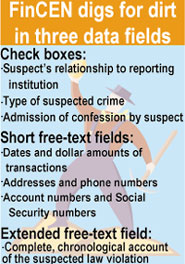
By Patricia DaukantasGCN StaffThe Treasury Department's Financial Crimes Enforcement Network (FinCEN) is pursuing a new data mining strategy to uncover distinctive signatures of money laundering and bank fraud schemes.Meanwhile, FinCEN's production system continues to use artificial intelligence algorithms developed in the 1990s.In a study of three commercial data mining products, FinCEN researchers have detected patterns in a database of suspected crimes. Eventually they might use their results as templates to uncover cases of potential fraud in routine cash transaction reports.Money laundering is a worldwide criminal problem, FinCEN chief scientist Raphael 'Rey' Wong said at a recent Armed Forces Communications and Electronics Association data mining conference.Criminal enterprises transform their ill-gotten proceeds into clean funds in ways that have become more and more difficult to detect because of the increasing sophistication of financial systems. Successful criminals can afford to hire computer experts to assist them.Money laundering transactions might hide within a huge volume of legitimate financial activity, Wong said. The Bank Secrecy Act of 1970 requires banks, casinos and other institutions to report large transactions of U.S. and foreign currency toTreasury.Since 1996, Treasury also has required financial institutions to use a three-page form called the Suspicious Activity Report to describe potential embezzlement, money laundering, check kiting, loan fraud or other crimes.The form has a space for an account of the suspect activity, a category of information not present on other Bank Secrecy Act reporting forms. The free-format data'which can be cryptic, detailed or nearly unintelligible'presents challenges to data miners.Last fall FinCEN completed the first phase of its data mining study. Wong, the project's manager, said it piloted three tools: Darwin from Oracle Corp., Clementine from SPSS Inc. of Chicago and SGI's MineSet. Two contractors, Visual Analytics Inc. of Poolesville, Md., and Nautilus Systems Inc. of Fairfax, Va., worked with FinCEN on the project.Christopher Westphal, Visual Analytics' chief executive officer, said each suspicious activity record contains 70 data fields. Many are fill-in-the-blank responses, but several are yes-or-no or multiple-value check boxes.Westphal said he and his colleagues were not looking to identify those responsible in individual cases of possible fraud. Rather, they wanted to detect general patterns and trends in the nearly 400,000 suspicious-activity forms filed since 1996.'Somebody who is not playing by the rules may be a little bit more erratic,' he said. For example, a customer might deposit unusually large amounts of money into multiple accounts.Cleaning the raw data turned out to be a crucial first step, Westphal said. Not only did the researchers have to fix the usual typographical errors and misspellings, but they also had to resolve data inconsistencies among the free-format text fields.For example, bank officials would describe a suspect's occupation with terms such as 'worked,' 'worker,' 'working at,' 'works on' or 'worked for.' Ultimately, Westphal said, the data mining software must lump the variations under one term, 'employment.'To find data correlations'say, between suspects' job titles and their crimes'the researchers tested several standard mining approaches, Westphal said.A clustering algorithm sought to group data from a given field into natural clusters.Link analysis might reveal, for example, a cluster of persons using the same bank account number.Westphal was reluctant to disclose the exact patterns the researchers found in the database for fear of tipping off criminals.He did say that a combination of conventional data mining methods and link analysis could become a powerful tool for FinCEN's work.Westphal stressed the need for data cleansing procedures that would lessen ambiguities in bank and business names listed on suspicious-activity reports.Ultimately, the broad patterns of criminal activity detected in the forms could help filter the suspicious cases out of Treasury's database of 12 million-plus annual currency transaction reports, he said.In the near future, FinCEN wants to develop a prototype data mining system based on the results of the initial study, Wong said at the AFCEA event.In the next phase the agency would define specific data abstraction routines and train FinCEN analysts, Westphal said.
Sleuths dig through piles of data to unearth clues to financial crime


FinCEN sorts through 70 data fields contained on suspicious-activity forms filed with Treasury.


The mother lode


NEXT STORY: POWER USER

X
This website uses cookies to enhance user experience and to analyze performance and traffic on our website. We also share information about your use of our site with our social media, advertising and analytics partners. Learn More / Do Not Sell My Personal Information
Accept Cookies
X
Cookie Preferences Cookie List

Do Not Sell My Personal Information

When you visit our website, we store cookies on your browser to collect information. The information collected might relate to you, your preferences or your device, and is mostly used to make the site work as you expect it to and to provide a more personalized web experience. However, you can choose not to allow certain types of cookies, which may impact your experience of the site and the services we are able to offer. Click on the different category headings to find out more and change our default settings according to your preference. You cannot opt-out of our First Party Strictly Necessary Cookies as they are deployed in order to ensure the proper functioning of our website (such as prompting the cookie banner and remembering your settings, to log into your account, to redirect you when you log out, etc.). For more information about the First and Third Party Cookies used please follow this link.

Allow All Cookies

Manage Consent Preferences

Strictly Necessary Cookies - Always Active

We do not allow you to opt-out of our certain cookies, as they are necessary to ensure the proper functioning of our website (such as prompting our cookie banner and remembering your privacy choices) and/or to monitor site performance. These cookies are not used in a way that constitutes a “sale” of your data under the CCPA. You can set your browser to block or alert you about these cookies, but some parts of the site will not work as intended if you do so. You can usually find these settings in the Options or Preferences menu of your browser. Visit www.allaboutcookies.org to learn more.

Sale of Personal Data, Targeting & Social Media Cookies

Under the California Consumer Privacy Act, you have the right to opt-out of the sale of your personal information to third parties. These cookies collect information for analytics and to personalize your experience with targeted ads. You may exercise your right to opt out of the sale of personal information by using this toggle switch. If you opt out we will not be able to offer you personalised ads and will not hand over your personal information to any third parties. Additionally, you may contact our legal department for further clarification about your rights as a California consumer by using this Exercise My Rights link

If you have enabled privacy controls on your browser (such as a plugin), we have to take that as a valid request to opt-out. Therefore we would not be able to track your activity through the web. This may affect our ability to personalize ads according to your preferences.

Targeting cookies may be set through our site by our advertising partners. They may be used by those companies to build a profile of your interests and show you relevant adverts on other sites. They do not store directly personal information, but are based on uniquely identifying your browser and internet device. If you do not allow these cookies, you will experience less targeted advertising.

Social media cookies are set by a range of social media services that we have added to the site to enable you to share our content with your friends and networks. They are capable of tracking your browser across other sites and building up a profile of your interests. This may impact the content and messages you see on other websites you visit. If you do not allow these cookies you may not be able to use or see these sharing tools.

If you want to opt out of all of our lead reports and lists, please submit a privacy request at our Do Not Sell page.

Save Settings
Cookie Preferences Cookie List

Cookie List

A cookie is a small piece of data (text file) that a website – when visited by a user – asks your browser to store on your device in order to remember information about you, such as your language preference or login information. Those cookies are set by us and called first-party cookies. We also use third-party cookies – which are cookies from a domain different than the domain of the website you are visiting – for our advertising and marketing efforts. More specifically, we use cookies and other tracking technologies for the following purposes:

Strictly Necessary Cookies

We do not allow you to opt-out of our certain cookies, as they are necessary to ensure the proper functioning of our website (such as prompting our cookie banner and remembering your privacy choices) and/or to monitor site performance. These cookies are not used in a way that constitutes a “sale” of your data under the CCPA. You can set your browser to block or alert you about these cookies, but some parts of the site will not work as intended if you do so. You can usually find these settings in the Options or Preferences menu of your browser. Visit www.allaboutcookies.org to learn more.

Functional Cookies

We do not allow you to opt-out of our certain cookies, as they are necessary to ensure the proper functioning of our website (such as prompting our cookie banner and remembering your privacy choices) and/or to monitor site performance. These cookies are not used in a way that constitutes a “sale” of your data under the CCPA. You can set your browser to block or alert you about these cookies, but some parts of the site will not work as intended if you do so. You can usually find these settings in the Options or Preferences menu of your browser. Visit www.allaboutcookies.org to learn more.

Performance Cookies

We do not allow you to opt-out of our certain cookies, as they are necessary to ensure the proper functioning of our website (such as prompting our cookie banner and remembering your privacy choices) and/or to monitor site performance. These cookies are not used in a way that constitutes a “sale” of your data under the CCPA. You can set your browser to block or alert you about these cookies, but some parts of the site will not work as intended if you do so. You can usually find these settings in the Options or Preferences menu of your browser. Visit www.allaboutcookies.org to learn more.

Sale of Personal Data

We also use cookies to personalize your experience on our websites, including by determining the most relevant content and advertisements to show you, and to monitor site traffic and performance, so that we may improve our websites and your experience. You may opt out of our use of such cookies (and the associated “sale” of your Personal Information) by using this toggle switch. You will still see some advertising, regardless of your selection. Because we do not track you across different devices, browsers and GEMG properties, your selection will take effect only on this browser, this device and this website.

Social Media Cookies

We also use cookies to personalize your experience on our websites, including by determining the most relevant content and advertisements to show you, and to monitor site traffic and performance, so that we may improve our websites and your experience. You may opt out of our use of such cookies (and the associated “sale” of your Personal Information) by using this toggle switch. You will still see some advertising, regardless of your selection. Because we do not track you across different devices, browsers and GEMG properties, your selection will take effect only on this browser, this device and this website.

Targeting Cookies

We also use cookies to personalize your experience on our websites, including by determining the most relevant content and advertisements to show you, and to monitor site traffic and performance, so that we may improve our websites and your experience. You may opt out of our use of such cookies (and the associated “sale” of your Personal Information) by using this toggle switch. You will still see some advertising, regardless of your selection. Because we do not track you across different devices, browsers and GEMG properties, your selection will take effect only on this browser, this device and this website.