CDC posts mortality statistics

How many California women aged 50 or over died in house fires between 1990 and 1997? Did more young Maine men die by suicide than by cancer in 1981?

By Patricia DaukantasGCN StaffHow many California women aged 50 or over died in house fires between 1990 and 1997? Did more young Maine men die by suicide than by cancer in 1981?A new Web site at the National Center for Injury Prevention and Control (NCIPC) answers such questions for medical researchers and the public.The Web-based Injury Statistics Query and Reporting System, or WISQARS, pronounced whiskers, supplies information about U.S. injury-related deaths from 1981 to 1997, said Steve James, a computer specialist in NCIPC's Office of Statistics and Programming. NCIPC is part of the Centers for Disease Control and Prevention in Atlanta.WISQARS, at , handles two types of mortality data queries. Visitors can look up statistics on deaths from specific injuries such as drowning or adverse drug reactions. They can also search based on the manner or intent of the fatal injuries'accident, suicide or homicide.In the second type of query, users can request lists of the leading causes of death, both injury-related and disease-related.The resulting lists let users drill down to find out more specifically the types of injuries lumped under 'suicide,' 'homicide and legal intervention' or 'unintentional injuries and adverse effects.' Other causes such as heart disease and cancer are not broken down further in WISQARS.That's because 'this system is very injury-centric,' said Lee Annest, director of the Office of Statistics and Programming. NCIPC officials wanted to provide the lists of leading causes of death only to show how injuries compare with diseases, he said.The National Center for Health Statistics, another branch of CDC, collects the mortality data from death certificates filed with the 50 states and the District of Columbia.'We just take their data and provide a method to access it,' James said.WISQARS users can specify whether they want death statistics for the entire United States, individual states or multiple-state regions defined by the Census Bureau.The Web site doesn't break down the data in geographic areas smaller than states because of confidentiality concerns, James said. For example, a sparsely populated county might have had only one death by a particular method in a given year, and residents might know the identity of the deceased.WISQARS went public on March 1, but NCIPC employees used it internally for about eight months prior to the debut, James said. They wanted to make sure the application was stable and all firewall problems had been solved.NCIPC programmers used software from SAS Institute Inc. of Cary, N.C., especially the SAS/IntrNet package, to create the WISQARS site.The data already existed in the SAS format, said Kevin Webb, team leader for programming in NCIPC's Office of Statistics and Programming, because SAS is the main statistical programming language used at the center.James said the decision to use SAS tools was 'kind of a no-brainer' because he has 15 years of experience in SAS programming. He said he spent 12 to 18 months on the WISQARS application development effort.'Learning SAS/IntrNet was the big learning curve,' Webb said. Now that NCIPC has finished developing the main site, WISQARS updates will progress quickly as each new data set is received. In the extensive WISQARS help pages is a cautionary note indicating that it takes about 18 months to compile each year's worth of death statistics. Information about deaths during 1998 is not slated to appear on WISQARS until late summer or early fall.NCIPC will not add pre-1981 data to WISQARS because of differences in the international classification system for mortality statistics, Webb said.Other than SAS/IntrNet, WISQARS uses only standard Hypertext Markup Language. Webb said the team wanted the site to be accessible to the 'lowest level of [browser] technology.'The effort started out as 'a way to automate the continual barrage of requests' for statistical reports from the NCIPC information technology staff, Webb said.In the past, when Congress or high-level officials wanted data about accidents or homicides, the workers had to drop everything and generate a report, Webb said. 'Basically, [WISQARS] got us out of the ad hoc request cycle,' he said.Before the public launch, the WISQARS team had no idea how many hits per day their application would draw. 'That's the problem with a Web application'it's like having a party and not knowing how many people are going to come,' James said.For the launch, the WISQARS team put the application on an old, borrowed server that could not handle more than 1,000 hits per day. The NCIPC team soon had to have WISQARS temporarily removed from the spotlight feature on the CDC home page.WISQARS has been averaging about 900 hits per day, Annest said.The team recently acquired a more powerful server from Dell Computer Corp. and will transfer the application to it once installation of SAS Version 8 is completed.
Medical researchers and the public can access injury-related death data


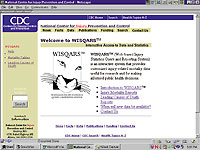
The WISQARS opening page provides access to two types of queries, plus links to other CDC Web sites. Visitors can find statistics on deaths from specific injuries such as drowning.


www.cdc.gov/ncipc/wisqars


SAS software


State sizes


NEXT STORY: POWER USER

X
This website uses cookies to enhance user experience and to analyze performance and traffic on our website. We also share information about your use of our site with our social media, advertising and analytics partners. Learn More / Do Not Sell My Personal Information
Accept Cookies
X
Cookie Preferences Cookie List

Do Not Sell My Personal Information

When you visit our website, we store cookies on your browser to collect information. The information collected might relate to you, your preferences or your device, and is mostly used to make the site work as you expect it to and to provide a more personalized web experience. However, you can choose not to allow certain types of cookies, which may impact your experience of the site and the services we are able to offer. Click on the different category headings to find out more and change our default settings according to your preference. You cannot opt-out of our First Party Strictly Necessary Cookies as they are deployed in order to ensure the proper functioning of our website (such as prompting the cookie banner and remembering your settings, to log into your account, to redirect you when you log out, etc.). For more information about the First and Third Party Cookies used please follow this link.

Allow All Cookies

Manage Consent Preferences

Strictly Necessary Cookies - Always Active

We do not allow you to opt-out of our certain cookies, as they are necessary to ensure the proper functioning of our website (such as prompting our cookie banner and remembering your privacy choices) and/or to monitor site performance. These cookies are not used in a way that constitutes a “sale” of your data under the CCPA. You can set your browser to block or alert you about these cookies, but some parts of the site will not work as intended if you do so. You can usually find these settings in the Options or Preferences menu of your browser. Visit www.allaboutcookies.org to learn more.

Sale of Personal Data, Targeting & Social Media Cookies

Under the California Consumer Privacy Act, you have the right to opt-out of the sale of your personal information to third parties. These cookies collect information for analytics and to personalize your experience with targeted ads. You may exercise your right to opt out of the sale of personal information by using this toggle switch. If you opt out we will not be able to offer you personalised ads and will not hand over your personal information to any third parties. Additionally, you may contact our legal department for further clarification about your rights as a California consumer by using this Exercise My Rights link

If you have enabled privacy controls on your browser (such as a plugin), we have to take that as a valid request to opt-out. Therefore we would not be able to track your activity through the web. This may affect our ability to personalize ads according to your preferences.

Targeting cookies may be set through our site by our advertising partners. They may be used by those companies to build a profile of your interests and show you relevant adverts on other sites. They do not store directly personal information, but are based on uniquely identifying your browser and internet device. If you do not allow these cookies, you will experience less targeted advertising.

Social media cookies are set by a range of social media services that we have added to the site to enable you to share our content with your friends and networks. They are capable of tracking your browser across other sites and building up a profile of your interests. This may impact the content and messages you see on other websites you visit. If you do not allow these cookies you may not be able to use or see these sharing tools.

If you want to opt out of all of our lead reports and lists, please submit a privacy request at our Do Not Sell page.

Save Settings
Cookie Preferences Cookie List

Cookie List

A cookie is a small piece of data (text file) that a website – when visited by a user – asks your browser to store on your device in order to remember information about you, such as your language preference or login information. Those cookies are set by us and called first-party cookies. We also use third-party cookies – which are cookies from a domain different than the domain of the website you are visiting – for our advertising and marketing efforts. More specifically, we use cookies and other tracking technologies for the following purposes:

Strictly Necessary Cookies

We do not allow you to opt-out of our certain cookies, as they are necessary to ensure the proper functioning of our website (such as prompting our cookie banner and remembering your privacy choices) and/or to monitor site performance. These cookies are not used in a way that constitutes a “sale” of your data under the CCPA. You can set your browser to block or alert you about these cookies, but some parts of the site will not work as intended if you do so. You can usually find these settings in the Options or Preferences menu of your browser. Visit www.allaboutcookies.org to learn more.

Functional Cookies

We do not allow you to opt-out of our certain cookies, as they are necessary to ensure the proper functioning of our website (such as prompting our cookie banner and remembering your privacy choices) and/or to monitor site performance. These cookies are not used in a way that constitutes a “sale” of your data under the CCPA. You can set your browser to block or alert you about these cookies, but some parts of the site will not work as intended if you do so. You can usually find these settings in the Options or Preferences menu of your browser. Visit www.allaboutcookies.org to learn more.

Performance Cookies

We do not allow you to opt-out of our certain cookies, as they are necessary to ensure the proper functioning of our website (such as prompting our cookie banner and remembering your privacy choices) and/or to monitor site performance. These cookies are not used in a way that constitutes a “sale” of your data under the CCPA. You can set your browser to block or alert you about these cookies, but some parts of the site will not work as intended if you do so. You can usually find these settings in the Options or Preferences menu of your browser. Visit www.allaboutcookies.org to learn more.

Sale of Personal Data

We also use cookies to personalize your experience on our websites, including by determining the most relevant content and advertisements to show you, and to monitor site traffic and performance, so that we may improve our websites and your experience. You may opt out of our use of such cookies (and the associated “sale” of your Personal Information) by using this toggle switch. You will still see some advertising, regardless of your selection. Because we do not track you across different devices, browsers and GEMG properties, your selection will take effect only on this browser, this device and this website.

Social Media Cookies

We also use cookies to personalize your experience on our websites, including by determining the most relevant content and advertisements to show you, and to monitor site traffic and performance, so that we may improve our websites and your experience. You may opt out of our use of such cookies (and the associated “sale” of your Personal Information) by using this toggle switch. You will still see some advertising, regardless of your selection. Because we do not track you across different devices, browsers and GEMG properties, your selection will take effect only on this browser, this device and this website.

Targeting Cookies

We also use cookies to personalize your experience on our websites, including by determining the most relevant content and advertisements to show you, and to monitor site traffic and performance, so that we may improve our websites and your experience. You may opt out of our use of such cookies (and the associated “sale” of your Personal Information) by using this toggle switch. You will still see some advertising, regardless of your selection. Because we do not track you across different devices, browsers and GEMG properties, your selection will take effect only on this browser, this device and this website.