
Interview: Bureau focuses on data sharing





Mark A. Tanner, the FBI's information resources manager since April 1997, juggles day-to-day systems management at the bureau.
TANNER: Major initiatives and accomplishments over the past few years have included the Integrated Automated Fingerprint Identification System. That was a $640 million project that the bureau overhauled in 1995 and implemented in July 1999. Over a five-year period, it was developed on schedule and on budget, and it delivered all of the functionality originally intended.Another major initiative was the National Crime Information Center 2000 program, also implemented in July 1999 on budget and on schedule.Another initiative, the Combined DNA Index System, lets us share DNA information with state and local law enforcement agencies.We now are working on the eFBI initiative to transform the way the FBI does business. It will take us from mainframe-centric technology to Web-enabled technologies.We will need to overcome the state of our infrastructure. We have in excess of 13,000 computers'representing 50 percent of our desktop computer inventory'which are 133-MHz or slower PCs. And, they are five years or older. You cannot put current desktop applications on them. Our network infrastructure is equally old, which limits bandwidth.Congress is reviewing eFBI. We will issue task orders off of governmentwide contracts, blanket purchasing agreements and schedule contracts.The Information Sharing Initiative was the name of eFBI's predecessor. The reduced scope of eFBI will mean reduced capability. We don't intend to connect our classified networks to unclassified networks.We are going to pilot new technologies in a limited number of field offices to enhance our infrastructure from token ring to Ethernet. Implementing it in a limited geographical area will help us implement it in other subsequent areas.The concern I have is that there is virtually no investigation we conduct that is contained to a specific geographical area. Whether it is a drug-trafficking, fugitive or counterterrorism case, typically there are leads that require communication with other field offices or international offices. We need a computing infrastructure that will enable communication across our organization.In the long run, eFBI will address this. We will have a complete in-house capability to communicate with all of our locations. Because eFBI is reduced in scope and dollars, there won't be a secure communications capability between state and local agencies as we had envisioned with the Information Sharing Initiative. Out of our Criminal Justice Information Service Division and Laboratory Division, we already share information with state and local, federal and international partners on fingerprint and forensics technologies.The most significant challenge is transforming culture to take advantage of technology rather than applying technology to the way we currently do our jobs. Another challenge will be acquiring and retaining information technology professionals with the skills in current technologies or personnel who can manage contractors.There will be a challenge for us to sustain an adequate IT budget so we can refresh the technologies we put in place. But the reliance on technology means there will be more expenditure on technology.
 Mark A. Tanner, the FBI's information resources manager since April 1997, juggles day-to-day systems management at the bureau.
Tanner began his FBI career in May 1983 as a special agent and worked as an investigator in the Charlotte, N.C., Jacksonville, Fla., and New York field offices.
From there, he moved to the Information Management Division at headquarters, where he helped define systems requirements. He next became supervisor of the Joint Drug Intelligence Group in Phoenix and later took over the Phoenix division office as assistant special agent in charge.
He recently spoke with GCN about the FBI's information technology plans.
Graying PCs
Mark A. Tanner
Tanner began his FBI career in May 1983 as a special agent and worked as an investigator in the Charlotte, N.C., Jacksonville, Fla., and New York field offices.
From there, he moved to the Information Management Division at headquarters, where he helped define systems requirements. He next became supervisor of the Joint Drug Intelligence Group in Phoenix and later took over the Phoenix division office as assistant special agent in charge.
He recently spoke with GCN about the FBI's information technology plans.
 Eugene J. O'Leary Acting Assistant Director, Information Resources Division Richard Garcia Acting Deputy Assistant Director, Information Resources Division Mark A. Tanner Information Resources Manager, Information Resources Division Sanjeev 'Sonny' Bhagowalia Chief of Major Projects Section, Information Resources Division Edward Allen Deputy Assistant Director of the Lab Division's Engineering Resource Facility Dave Walchak Deputy Assistant Director, Criminal Justice Information Services Division James Jasinski Program Manager, Integrated Automated Fingerprint Identification System Michael Vatis Director, National Infrastructure Protection Center Gregory Jones Chief of Information Technology Management Section, Criminal'Justice Information Services Division (in millions)
|
Graying PCs
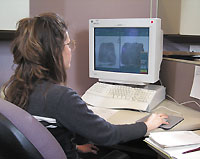 | A fingerprint analyst at the FBI Criminal Justice Information Services Division in Clarksburg, W.Va., taps the Integrated Automated Fingerprint Identification System to process criminal history queries from around the country. The year-old IAFIS provides10-print, latent-print and subject searches for federal, state and local law enforcement officers. The system also has links to the National Instant Criminal Background Check System, National Criminal Information Center 2000 and National Law Enforcement Telecommunications System. |
| Major programs |
National Instant Criminal Background Check System'Congress mandated the creation of NICS in 1994. The FBI worked with the Bureau of Alcohol, Tobacco and Firearms, and state and local law enforcement agencies to develop the system. The computerized background check module responds within 30 seconds on most inquiries from federally licensed firearms sellers. Each NICS background check searches 3 million criminal records. Integrated Automated Fingerprint Identification System'IAFIS helps officers conduct criminal background history searches and fingerprint and crime scene information checks. Federal, state and local law enforcement users also submit fingerprint and case information for inclusion in the system. The $640 million IAFIS has three subsystems: the Automated Fingerprint Identification System, the Interstate Identification Index, and the Identification, Tasking and Networking module. National Crime Information Center 2000'NCIC 2000, the FBI's year-old crime-fighting information network, replaced the 30-year-old NCIC. It shares interfaces with NICS and systems run by seven federal agencies and by law enforcement agencies in all 50 states. NCIC 2000, essentially a crime data processing center, handles more than 2.4 million transactions a day and stores 39 million records in 17 databases. Combined DNA Index System'CODIS houses DNA profiles of felons convicted of sex and other violent crimes. The FBI created the database to provide leads to unsolved crimes. |