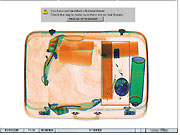
Is that a gun or just a security test?

Security teams at airport checkpoints will soon be subjected to a computer's vivid imagination.

The Threat Image Projection (TIP) system, part of the Federal Aviation Administration's new airport baggage scanning technology, randomly displays fictional images of items such as guns to make security workers more adept at detecting threats, FAA officials said.Previous technology only used X-ray systems to scan carry-on baggage and other items as travelers and their companions moved through checkpoints into secure areas. TIP will add a training function that FAA officials hope will increase screeners' diligence by inserting fictional threats throughout the duty cycle and keeping a record of responses.When screeners spot dangerous items, such as guns or knives, in the X-ray images, they must punch a button and TIP reveals whether the image is fictional. If the training application did not create the image, the security team treats the finding as a real threat.Travelers won't notice much difference between the new systems and the X-ray systems they've become accustomed to pushing their bags through. A conveyer belt moves the bags through the same metal scanning device that captures X-ray images and displays them on a monitor just as it always has.The X-ray machine captures a series of X-ray images that an on-board analog converter changes to digital data for display, said Michael Ellenbogen, vice president of new business development at PerkinElmer Inc. of Boston, one of the three companies that FAA has approved to provide TIP equipment.As the images appear on-screen, the custom TIP software randomly inserts ghost images based on the number of bags going through the machine to test the screener's reaction and awareness.FAA plans to deploy 1,200 of the new systems at 454 airports nationwide by the end of 2002.The agency, which last month began rolling out the new system at large airports, will pay for the equipment and installation, said Jan Brecht-Clark, FAA's director of security, policy and planning.Each airport will pick a TIP setup from one of the three vendors and pay for maintenance and upkeep. FAA will pick up the cost of repairs made under warranty.By the end of next year, FAA expects to install 800 units at a price of $40,000 to $50,000 per unit, Brecht-Clark said. The cost for upgrading all airport security scanning systems could run as high as $80 million, she said. Each unit includes a package of X-ray machines, viewer terminals and TIP software.A small airport might need only one unit; a large airport such as JFK International in New York might install as many as 40.Besides PerkinElmer, FAA has approved Rapiscan Computer Products Inc. of Hawthorne, Calif., and Heimann Systems Corp., a German company with American offices in Pine Brook, N.J., to provide TIP systems.For the initial test of TIP, FAA last summer signed agreements to lease 10 units from each vendor.It recently bought those systems. The Heimann contract was for $76,550, PerkinElmer's $47,750 and Rapiscan's $98,330.PerkinElmer and Rapiscan began developing the TIP library of images under a cooperative R&D agreement with FAA's Human Factors Research Lab in Atlantic City, N.J. The agency issued a list of specifications for the proposed system, said Armen Sahagian, FAA's integrated program manager for checkpoints. Heimann joined the effort later.Other companies could qualify to supply TIP systems with FAA's approval, Sahagian said.Much of TIP's design was left to the companies. But to be included on the TIP qualified-vendor list, vendors had to meet a set of minimum requirements:''The custom TIP software must contain at least 350 X-ray images in specified categories of threats defined by FAA.''To host the TIP library of images, each system must have at least a 2.1G hard drive that can be expanded.''The system must allow the addition of new images via scanning, through electronic upload from a Zip drive from Iomega Corp. of Roy, Utah, or via a network link.''The system must support report generation in a Microsoft Excel or Excel-compatible format.''Files must be downloadable to floppy disks or Zip cartridges with the capacity to store a month's worth of data.''Airport users must have read-only access privileges to data, and the units must be password-protected.All three vendors will supply systems that use Pentium PCs for the screening terminals. PerkinElmer and Rapiscan plan to use off-the-shelf PCs from a variety of makers.The PerkinElmer systems will run TIP under Microsoft Windows 95, Rapiscan under Windows NT.Heimann will supply 600-MHz Pentium III PCs designed in its German laboratory running Linux to host TIP, said Mark Loustra, the company's managing director of aviation.Besides inserting fake images into X-ray images, the software can also create a ghost image of a bag containing a fictional threat in a cluster of existing bags, officials said.The system will keep track of each screener's responses to projected images, giving FAA officials information by which to judge the performance of airport security teams.User responses will be stored and downloaded every three months to a Zip disk. FAA will upload the data to a Microsoft Access 97 database. Eventually, FAA wants to create a network link between the TIP units at the airports and an agency data center to handle the data transfers.If a screener fails to identify a projected threat image, the program stops the system's conveyer belt and sends a message to the user. 'You have not identified a fictional threat,' the program notifies the security worker and then directs the user to search the bag.The threat image library contains nearly 2,400 images of items such as guns, knives and bombs that security teams are trained to watch for, PerkinElmer's Ellenbogen said.As recently as April, the General Accounting Office slammed FAA for its poor screening performance.At a March hearing of the Senate Commerce, Science and Transportation Subcommittee on Aviation, GAO officials noted that delays in FAA's development and deployment of new screening systems had impeded efforts to certify security companies hired to run checkpoints.The delays stymied efforts to improve employee performance, said Gerald L. Dillingham, associate director for transportation issues in GAO's Resources, Community and Economic Development Division.FAA had planned to use data from the TIP system to guide it in setting performance standards, Dillingham said. Now the agency will likely be forced to look to other information, he said.But Lyle Malotky, FAA's chief scientific and technical adviser for civil aviation security, said that although the concept of threat imaging was conceived roughly a decade ago, only recently have PCs had the crunching power to make the system a reality.

By Tony Lee Orrd

GCN Staff

Security teams at airport checkpoints will soon be subjected to a computer's vivid imagination.
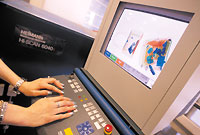

FAA is exposing airport baggage screeners to fake images of security threats. At left, the TIP system inserts an image of a gun; at right, it superimposes a ghost image of an explosive near the suitcase's top edge.


Sweeping rollout


Ghostly luggage


NEXT STORY: PACKET RAT

X
This website uses cookies to enhance user experience and to analyze performance and traffic on our website. We also share information about your use of our site with our social media, advertising and analytics partners. Learn More / Do Not Sell My Personal Information
Accept Cookies
X
Cookie Preferences Cookie List

Do Not Sell My Personal Information

When you visit our website, we store cookies on your browser to collect information. The information collected might relate to you, your preferences or your device, and is mostly used to make the site work as you expect it to and to provide a more personalized web experience. However, you can choose not to allow certain types of cookies, which may impact your experience of the site and the services we are able to offer. Click on the different category headings to find out more and change our default settings according to your preference. You cannot opt-out of our First Party Strictly Necessary Cookies as they are deployed in order to ensure the proper functioning of our website (such as prompting the cookie banner and remembering your settings, to log into your account, to redirect you when you log out, etc.). For more information about the First and Third Party Cookies used please follow this link.

Allow All Cookies

Manage Consent Preferences

Strictly Necessary Cookies - Always Active

We do not allow you to opt-out of our certain cookies, as they are necessary to ensure the proper functioning of our website (such as prompting our cookie banner and remembering your privacy choices) and/or to monitor site performance. These cookies are not used in a way that constitutes a “sale” of your data under the CCPA. You can set your browser to block or alert you about these cookies, but some parts of the site will not work as intended if you do so. You can usually find these settings in the Options or Preferences menu of your browser. Visit www.allaboutcookies.org to learn more.

Sale of Personal Data, Targeting & Social Media Cookies

Under the California Consumer Privacy Act, you have the right to opt-out of the sale of your personal information to third parties. These cookies collect information for analytics and to personalize your experience with targeted ads. You may exercise your right to opt out of the sale of personal information by using this toggle switch. If you opt out we will not be able to offer you personalised ads and will not hand over your personal information to any third parties. Additionally, you may contact our legal department for further clarification about your rights as a California consumer by using this Exercise My Rights link

If you have enabled privacy controls on your browser (such as a plugin), we have to take that as a valid request to opt-out. Therefore we would not be able to track your activity through the web. This may affect our ability to personalize ads according to your preferences.

Targeting cookies may be set through our site by our advertising partners. They may be used by those companies to build a profile of your interests and show you relevant adverts on other sites. They do not store directly personal information, but are based on uniquely identifying your browser and internet device. If you do not allow these cookies, you will experience less targeted advertising.

Social media cookies are set by a range of social media services that we have added to the site to enable you to share our content with your friends and networks. They are capable of tracking your browser across other sites and building up a profile of your interests. This may impact the content and messages you see on other websites you visit. If you do not allow these cookies you may not be able to use or see these sharing tools.

If you want to opt out of all of our lead reports and lists, please submit a privacy request at our Do Not Sell page.

Save Settings
Cookie Preferences Cookie List

Cookie List

A cookie is a small piece of data (text file) that a website – when visited by a user – asks your browser to store on your device in order to remember information about you, such as your language preference or login information. Those cookies are set by us and called first-party cookies. We also use third-party cookies – which are cookies from a domain different than the domain of the website you are visiting – for our advertising and marketing efforts. More specifically, we use cookies and other tracking technologies for the following purposes:

Strictly Necessary Cookies

We do not allow you to opt-out of our certain cookies, as they are necessary to ensure the proper functioning of our website (such as prompting our cookie banner and remembering your privacy choices) and/or to monitor site performance. These cookies are not used in a way that constitutes a “sale” of your data under the CCPA. You can set your browser to block or alert you about these cookies, but some parts of the site will not work as intended if you do so. You can usually find these settings in the Options or Preferences menu of your browser. Visit www.allaboutcookies.org to learn more.

Functional Cookies

We do not allow you to opt-out of our certain cookies, as they are necessary to ensure the proper functioning of our website (such as prompting our cookie banner and remembering your privacy choices) and/or to monitor site performance. These cookies are not used in a way that constitutes a “sale” of your data under the CCPA. You can set your browser to block or alert you about these cookies, but some parts of the site will not work as intended if you do so. You can usually find these settings in the Options or Preferences menu of your browser. Visit www.allaboutcookies.org to learn more.

Performance Cookies

We do not allow you to opt-out of our certain cookies, as they are necessary to ensure the proper functioning of our website (such as prompting our cookie banner and remembering your privacy choices) and/or to monitor site performance. These cookies are not used in a way that constitutes a “sale” of your data under the CCPA. You can set your browser to block or alert you about these cookies, but some parts of the site will not work as intended if you do so. You can usually find these settings in the Options or Preferences menu of your browser. Visit www.allaboutcookies.org to learn more.

Sale of Personal Data

We also use cookies to personalize your experience on our websites, including by determining the most relevant content and advertisements to show you, and to monitor site traffic and performance, so that we may improve our websites and your experience. You may opt out of our use of such cookies (and the associated “sale” of your Personal Information) by using this toggle switch. You will still see some advertising, regardless of your selection. Because we do not track you across different devices, browsers and GEMG properties, your selection will take effect only on this browser, this device and this website.

Social Media Cookies

We also use cookies to personalize your experience on our websites, including by determining the most relevant content and advertisements to show you, and to monitor site traffic and performance, so that we may improve our websites and your experience. You may opt out of our use of such cookies (and the associated “sale” of your Personal Information) by using this toggle switch. You will still see some advertising, regardless of your selection. Because we do not track you across different devices, browsers and GEMG properties, your selection will take effect only on this browser, this device and this website.

Targeting Cookies

We also use cookies to personalize your experience on our websites, including by determining the most relevant content and advertisements to show you, and to monitor site traffic and performance, so that we may improve our websites and your experience. You may opt out of our use of such cookies (and the associated “sale” of your Personal Information) by using this toggle switch. You will still see some advertising, regardless of your selection. Because we do not track you across different devices, browsers and GEMG properties, your selection will take effect only on this browser, this device and this website.