NLM tool does finger-pointing

'Fifty percent of networking is finger-pointing,' according to Michael Gill, an electronics engineer in the National Library of Medicine's Communications Engineering branch.

By William JacksonGCN Staff'Fifty percent of networking is finger-pointing,' according to Michael Gill, an electronics engineer in the National Library of Medicine's Communications Engineering branch.Gill has found a tool to help him point his finger more accurately when a newly installed application does not perform up to expectations. Before rolling out an application, he baselines network performance with simulated traffic to identify choke points and help the systems staff determine whether any future slowdown comes from the pipe or elsewhere.Gill began using the Pegasus network-monitoring program about six months ago before installing an automated indexing system developed at NLM. He wanted to make sure the network connection would be adequate. It was, and knowing in advance saved NLM's parent, the National Institutes of Health, the expense of installing new lines.'We were having serious discussions about T3s' that turned out to be unnecessary, Gill said.NLM is now working with NASA to test a series of links to connect an anatomist in Japan with large graphics files at the library in Bethesda, Md. The final circuit will extend 100,000 miles one way with two satellite hops.The monitoring tool is 'for an operational environment, not for stress-testing a network,' he said of Pegasus from Ganymede Software Inc. of Research Triangle Park, N.C.The Pegasus server software, which runs under Microsoft Windows NT, gathers performance data from clients installed on desktop systems or other servers. The endpoint clients work under 19 operating systems, including common versions of Windows, Unix and Linux.The endpoint clients execute scripts to simulate application traffic and create realistic loads across a network. The Pegasus server measures real-time performance at the application layer and can provide historical trend reports. The server has 40 scripts that simulate common application types. An application scanner can create a script for other applications, or scripts can be edited and customized.Adding applications at NLM is tricky because the library's files run as large as 20M apiece.'The main product is bibliographical databases,' Gill said. The library developed a system to automate some of the identification and indexing of data from scholarly publications. During development and testing, the indexing system resided in a building with its own 100-Mbps connections.'They were humming away in-house,' Gill said.But the new system will go into production in a building several miles from the NIH campus. An IP over an asynchronous transfer mode connection will serve the remote site, although there is only a 10Base-T connection inward from the router.Gill said he wondered 'how to characterize the performance between us and them.' He did it by installing a Pegasus client on a desktop system at the remote site that executed a File Transfer Protocol 'get' command every 15 minutes, 24 hours a day.Under that load, the connection between client and server was just adequate, Gill said. That does not guarantee the new application will work perfectly when installed, but if it doesn't, he will be reasonably sure the problem is not in the network.Pegasus is helping assess connections that will move large graphics files between Bethesda and Sapporo, Japan, for NLM's Visible Human project. The Visible Human is a series of cross-section images of male and female cadavers that were scanned and digitized. The male images amount to 15G of data, and the female images 40G'more because those sections were thinner.NLM staff has classified and indexed many of the flat-file data sets, but some work remains to be done. A Japanese anatomist volunteered to help finish up the job on a system that can manipulate sectional graphics. Transferring the images will take a big pipe.'These are big images, anywhere from 5M to 10M' each, Gill said.With NASA's help, NLM has set up a test circuit to see how practical such large file transfers are. A NASA research network with a node at the library takes them as far as Star Tap, the National Science Foundation's high-performance network connection point in Chicago. From there a Canadian research network carries them to Vancouver, where they cross the Pacific to Japan.Pegasus clients on a desktop system in Sapporo and a server in Bethesda simulated the file transfers 24 hours a day for several weeks and came up with a baseline bandwidth of 1.3 Mbps. The choke point was a T1 line in Japan.'Things work, but they are very slow,' Gill said. 'From a user perspective, it's not worth doing.'The library expects to open up a bigger route that will have T3 or faster links and will use an American and a Japanese satellite to carry the data. Pegasus also will test that circuit which, if all goes well, should provide a baseline 45 Mbps.

NLM's Michael Gill says test tools help in finding network choke points.

Network monitoring program zeros in on applications that cause problems


Instant payoff


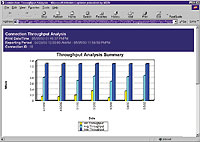
Pegasus provides throughput summaries via the network manager's browser, based on endpoint client reports. The clients realistically simulate traffic.


NEXT STORY: INTERNAUT

X
This website uses cookies to enhance user experience and to analyze performance and traffic on our website. We also share information about your use of our site with our social media, advertising and analytics partners. Learn More / Do Not Sell My Personal Information
Accept Cookies
X
Cookie Preferences Cookie List

Do Not Sell My Personal Information

When you visit our website, we store cookies on your browser to collect information. The information collected might relate to you, your preferences or your device, and is mostly used to make the site work as you expect it to and to provide a more personalized web experience. However, you can choose not to allow certain types of cookies, which may impact your experience of the site and the services we are able to offer. Click on the different category headings to find out more and change our default settings according to your preference. You cannot opt-out of our First Party Strictly Necessary Cookies as they are deployed in order to ensure the proper functioning of our website (such as prompting the cookie banner and remembering your settings, to log into your account, to redirect you when you log out, etc.). For more information about the First and Third Party Cookies used please follow this link.

Allow All Cookies

Manage Consent Preferences

Strictly Necessary Cookies - Always Active

We do not allow you to opt-out of our certain cookies, as they are necessary to ensure the proper functioning of our website (such as prompting our cookie banner and remembering your privacy choices) and/or to monitor site performance. These cookies are not used in a way that constitutes a “sale” of your data under the CCPA. You can set your browser to block or alert you about these cookies, but some parts of the site will not work as intended if you do so. You can usually find these settings in the Options or Preferences menu of your browser. Visit www.allaboutcookies.org to learn more.

Sale of Personal Data, Targeting & Social Media Cookies

Under the California Consumer Privacy Act, you have the right to opt-out of the sale of your personal information to third parties. These cookies collect information for analytics and to personalize your experience with targeted ads. You may exercise your right to opt out of the sale of personal information by using this toggle switch. If you opt out we will not be able to offer you personalised ads and will not hand over your personal information to any third parties. Additionally, you may contact our legal department for further clarification about your rights as a California consumer by using this Exercise My Rights link

If you have enabled privacy controls on your browser (such as a plugin), we have to take that as a valid request to opt-out. Therefore we would not be able to track your activity through the web. This may affect our ability to personalize ads according to your preferences.

Targeting cookies may be set through our site by our advertising partners. They may be used by those companies to build a profile of your interests and show you relevant adverts on other sites. They do not store directly personal information, but are based on uniquely identifying your browser and internet device. If you do not allow these cookies, you will experience less targeted advertising.

Social media cookies are set by a range of social media services that we have added to the site to enable you to share our content with your friends and networks. They are capable of tracking your browser across other sites and building up a profile of your interests. This may impact the content and messages you see on other websites you visit. If you do not allow these cookies you may not be able to use or see these sharing tools.

If you want to opt out of all of our lead reports and lists, please submit a privacy request at our Do Not Sell page.

Save Settings
Cookie Preferences Cookie List

Cookie List

A cookie is a small piece of data (text file) that a website – when visited by a user – asks your browser to store on your device in order to remember information about you, such as your language preference or login information. Those cookies are set by us and called first-party cookies. We also use third-party cookies – which are cookies from a domain different than the domain of the website you are visiting – for our advertising and marketing efforts. More specifically, we use cookies and other tracking technologies for the following purposes:

Strictly Necessary Cookies

We do not allow you to opt-out of our certain cookies, as they are necessary to ensure the proper functioning of our website (such as prompting our cookie banner and remembering your privacy choices) and/or to monitor site performance. These cookies are not used in a way that constitutes a “sale” of your data under the CCPA. You can set your browser to block or alert you about these cookies, but some parts of the site will not work as intended if you do so. You can usually find these settings in the Options or Preferences menu of your browser. Visit www.allaboutcookies.org to learn more.

Functional Cookies

We do not allow you to opt-out of our certain cookies, as they are necessary to ensure the proper functioning of our website (such as prompting our cookie banner and remembering your privacy choices) and/or to monitor site performance. These cookies are not used in a way that constitutes a “sale” of your data under the CCPA. You can set your browser to block or alert you about these cookies, but some parts of the site will not work as intended if you do so. You can usually find these settings in the Options or Preferences menu of your browser. Visit www.allaboutcookies.org to learn more.

Performance Cookies

We do not allow you to opt-out of our certain cookies, as they are necessary to ensure the proper functioning of our website (such as prompting our cookie banner and remembering your privacy choices) and/or to monitor site performance. These cookies are not used in a way that constitutes a “sale” of your data under the CCPA. You can set your browser to block or alert you about these cookies, but some parts of the site will not work as intended if you do so. You can usually find these settings in the Options or Preferences menu of your browser. Visit www.allaboutcookies.org to learn more.

Sale of Personal Data

We also use cookies to personalize your experience on our websites, including by determining the most relevant content and advertisements to show you, and to monitor site traffic and performance, so that we may improve our websites and your experience. You may opt out of our use of such cookies (and the associated “sale” of your Personal Information) by using this toggle switch. You will still see some advertising, regardless of your selection. Because we do not track you across different devices, browsers and GEMG properties, your selection will take effect only on this browser, this device and this website.

Social Media Cookies

We also use cookies to personalize your experience on our websites, including by determining the most relevant content and advertisements to show you, and to monitor site traffic and performance, so that we may improve our websites and your experience. You may opt out of our use of such cookies (and the associated “sale” of your Personal Information) by using this toggle switch. You will still see some advertising, regardless of your selection. Because we do not track you across different devices, browsers and GEMG properties, your selection will take effect only on this browser, this device and this website.

Targeting Cookies

We also use cookies to personalize your experience on our websites, including by determining the most relevant content and advertisements to show you, and to monitor site traffic and performance, so that we may improve our websites and your experience. You may opt out of our use of such cookies (and the associated “sale” of your Personal Information) by using this toggle switch. You will still see some advertising, regardless of your selection. Because we do not track you across different devices, browsers and GEMG properties, your selection will take effect only on this browser, this device and this website.