Army debuts IT crime unit

In a converted computer room at Fort Belvoir, Va., six Army chief warrant officers and a legal adviser are working in the Wild West of law enforcement: investigating network intrusions.

By Bill MurrayGCN StaffIn a converted computer room at Fort Belvoir, Va., six Army chief warrant officers and a legal adviser are working in the Wild West of law enforcement: investigating network intrusions.The Army Criminal Investigation Command's Computer Crime Investigative Unit had its formal debut on the new frontier of police work in early spring, and unit officials recently celebrated a big conviction. Army Pfc. Aaron J. Eden pleaded guilty on May 11 to four charges, including intentional damage to a government computer and intentional access to a government computer without permission.Army officials apprehended Eden in November for installing the hacker tool BackOrifice 2000 on computers at the Army Enlisted Records and Evaluation Center at Fort Benjamin Harrison, Ind., said Chief Warrant Officer James S. Smith, commander of the computer crime unit.Eden, who worked at the records center, had altered or deleted 58,000 personnel files, Smith said. The private also tried to copy office software and sell it illegally, Smith said.Because the center makes tape backups of the 185 computers connected to its LAN servers, no data was lost, Smith said. Eden had gained access to many systems by using BackOrifice 2000 in stealth mode to determine the passwords of other users, he said.The computer crime unit built its case against Eden by showing that he had logged on as the network's systems administrator and deleted personnel files during times when the sysadmin was not in the building, said Chief Warrant Officer Dave Shaver, one of the unit's special agents.The Staff Judge Advocate's office prosecuted Eden in a court-martial, Smith said. In addition to a dishonorable discharge, Eden received a four-month prison sentence and had to forfeit outstanding pay.When the computer crime unit's agents collect evidence, they use special portable Pentium III computers developed jointly by the Army and NASA. These PCs come loaded with forensic software that lets the agents gain read-only access to computers, Smith said. The agents also carry their own SCSI devices and peripherals, and they can burn CD-ROMs on-site to collect evidence.Agents must be prepared to retrieve data from whatever source they can, from internal harddrives to digital linear tape storage subsystems.The agents use EnCase, a law enforcement application from Guidance Software Inc. of Pasadena, Calif., to scan hard drives. When used on systems running Apple Mac OS, Microsoft Windows, Linux and other operating systems, EnCase searches for keywords and analyzes file structures. The agents' portable systems each have a RAID storage subsystem of eight drives.On an isolated LAN at the unit's forensics laboratory, agents use 333-MHz Pentium II PCs from eMachines Inc. of Irvine, Calif., as well as Sun Microsystems Ultrasparc 10 workstations.The LAN runs multiple OSes, including Windows 98, Windows NT Server 4.0 and SunSoft Solaris.The unit tries to figure out how an attack proceeded by launching controlled attacks on its own LAN to see what happens.Although the unit is concerned about insider threats, its agents have spent most of their time investigating outside hackers since 1998, when the Criminal Investigation Command assigned two agents to look into computer crimes, Shaver said.In June 1999, the first two agents helped secure Chad Davis' conviction for hacking into and defacing the main Army Web site, at www.army.mil. The 19-year-old from Green Bay, Wis., made the mistake of storing e-mail logs from a month-long period when he planned the attack, Shaver said.After pleading guilty to fraud and malicious mischief, Davis paid more than $8,000 in restitution to the Army and served a six-month prison sentence. During his probation, all computer and telephone access is being supervised for three years.Currently, the computer crime unit has more than 30 open investigations into intrusions, Smith said. 'These cases go on for a long time,' which is partly why agents get so excited when a suspect is convicted, he said.This year, the unit has filed 12 reports detailing its investigations.To conduct investigations, Shaver said, the unit often must work with Internet service providers. Gaining access to the providers' customer data generally requires subpoenas. The subpoenas let agencies check subscriber names and connection logs for suspect IP addresses, he said.'It's a real rat race, actually,' Shaver said of the crime unit's efforts to get subpoenas and to gain the aid of Internet service providers.Using IP addresses, agents can sometimes determine the geographic origin of an attack.Agents are still investigating a February distributed denial-of-service attack that made use of six Army computers as hosts, said Chief Warrant Officer Brent Pack, the unit's technical support team chief. The attack used at least 255 computers to flood several commercial online sites.The hacker installed a sniffer program on one computer to ferret out passwords and eventually gained supervisor access to the six PCs, which let the hacker install files on the systems remotely, Smith said.The unit has a couple of ways to follow up on an attack. When an Army organization reports a system breach, the service can either immediately repair the system and lock it down against further intrusion or it can opt to leave the system vulnerable so the computer crime unit can try to snare the offender, Smith said. The choice often depends on the nature of the system, the data it contains and the programs it supports. Leaving a system open to further hacking attempts can help agents get subpoenas, install network intrusion devices and track any system ports that have been invaded, Smith said.
Investigative agents use special PCs to gather evidence, build their cases


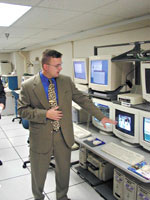
Chief Warrant Officer Dave Shaver says one way that Army investigators study malicious code is by using it to attack systems on the crime unit's own network at Fort Belvoir.


Book 'em


Case studies


NEXT STORY: BRIEFING BOOK

X
This website uses cookies to enhance user experience and to analyze performance and traffic on our website. We also share information about your use of our site with our social media, advertising and analytics partners. Learn More / Do Not Sell My Personal Information
Accept Cookies
X
Cookie Preferences Cookie List

Do Not Sell My Personal Information

When you visit our website, we store cookies on your browser to collect information. The information collected might relate to you, your preferences or your device, and is mostly used to make the site work as you expect it to and to provide a more personalized web experience. However, you can choose not to allow certain types of cookies, which may impact your experience of the site and the services we are able to offer. Click on the different category headings to find out more and change our default settings according to your preference. You cannot opt-out of our First Party Strictly Necessary Cookies as they are deployed in order to ensure the proper functioning of our website (such as prompting the cookie banner and remembering your settings, to log into your account, to redirect you when you log out, etc.). For more information about the First and Third Party Cookies used please follow this link.

Allow All Cookies

Manage Consent Preferences

Strictly Necessary Cookies - Always Active

We do not allow you to opt-out of our certain cookies, as they are necessary to ensure the proper functioning of our website (such as prompting our cookie banner and remembering your privacy choices) and/or to monitor site performance. These cookies are not used in a way that constitutes a “sale” of your data under the CCPA. You can set your browser to block or alert you about these cookies, but some parts of the site will not work as intended if you do so. You can usually find these settings in the Options or Preferences menu of your browser. Visit www.allaboutcookies.org to learn more.

Sale of Personal Data, Targeting & Social Media Cookies

Under the California Consumer Privacy Act, you have the right to opt-out of the sale of your personal information to third parties. These cookies collect information for analytics and to personalize your experience with targeted ads. You may exercise your right to opt out of the sale of personal information by using this toggle switch. If you opt out we will not be able to offer you personalised ads and will not hand over your personal information to any third parties. Additionally, you may contact our legal department for further clarification about your rights as a California consumer by using this Exercise My Rights link

If you have enabled privacy controls on your browser (such as a plugin), we have to take that as a valid request to opt-out. Therefore we would not be able to track your activity through the web. This may affect our ability to personalize ads according to your preferences.

Targeting cookies may be set through our site by our advertising partners. They may be used by those companies to build a profile of your interests and show you relevant adverts on other sites. They do not store directly personal information, but are based on uniquely identifying your browser and internet device. If you do not allow these cookies, you will experience less targeted advertising.

Social media cookies are set by a range of social media services that we have added to the site to enable you to share our content with your friends and networks. They are capable of tracking your browser across other sites and building up a profile of your interests. This may impact the content and messages you see on other websites you visit. If you do not allow these cookies you may not be able to use or see these sharing tools.

If you want to opt out of all of our lead reports and lists, please submit a privacy request at our Do Not Sell page.

Save Settings
Cookie Preferences Cookie List

Cookie List

A cookie is a small piece of data (text file) that a website – when visited by a user – asks your browser to store on your device in order to remember information about you, such as your language preference or login information. Those cookies are set by us and called first-party cookies. We also use third-party cookies – which are cookies from a domain different than the domain of the website you are visiting – for our advertising and marketing efforts. More specifically, we use cookies and other tracking technologies for the following purposes:

Strictly Necessary Cookies

We do not allow you to opt-out of our certain cookies, as they are necessary to ensure the proper functioning of our website (such as prompting our cookie banner and remembering your privacy choices) and/or to monitor site performance. These cookies are not used in a way that constitutes a “sale” of your data under the CCPA. You can set your browser to block or alert you about these cookies, but some parts of the site will not work as intended if you do so. You can usually find these settings in the Options or Preferences menu of your browser. Visit www.allaboutcookies.org to learn more.

Functional Cookies

We do not allow you to opt-out of our certain cookies, as they are necessary to ensure the proper functioning of our website (such as prompting our cookie banner and remembering your privacy choices) and/or to monitor site performance. These cookies are not used in a way that constitutes a “sale” of your data under the CCPA. You can set your browser to block or alert you about these cookies, but some parts of the site will not work as intended if you do so. You can usually find these settings in the Options or Preferences menu of your browser. Visit www.allaboutcookies.org to learn more.

Performance Cookies

We do not allow you to opt-out of our certain cookies, as they are necessary to ensure the proper functioning of our website (such as prompting our cookie banner and remembering your privacy choices) and/or to monitor site performance. These cookies are not used in a way that constitutes a “sale” of your data under the CCPA. You can set your browser to block or alert you about these cookies, but some parts of the site will not work as intended if you do so. You can usually find these settings in the Options or Preferences menu of your browser. Visit www.allaboutcookies.org to learn more.

Sale of Personal Data

We also use cookies to personalize your experience on our websites, including by determining the most relevant content and advertisements to show you, and to monitor site traffic and performance, so that we may improve our websites and your experience. You may opt out of our use of such cookies (and the associated “sale” of your Personal Information) by using this toggle switch. You will still see some advertising, regardless of your selection. Because we do not track you across different devices, browsers and GEMG properties, your selection will take effect only on this browser, this device and this website.

Social Media Cookies

We also use cookies to personalize your experience on our websites, including by determining the most relevant content and advertisements to show you, and to monitor site traffic and performance, so that we may improve our websites and your experience. You may opt out of our use of such cookies (and the associated “sale” of your Personal Information) by using this toggle switch. You will still see some advertising, regardless of your selection. Because we do not track you across different devices, browsers and GEMG properties, your selection will take effect only on this browser, this device and this website.

Targeting Cookies

We also use cookies to personalize your experience on our websites, including by determining the most relevant content and advertisements to show you, and to monitor site traffic and performance, so that we may improve our websites and your experience. You may opt out of our use of such cookies (and the associated “sale” of your Personal Information) by using this toggle switch. You will still see some advertising, regardless of your selection. Because we do not track you across different devices, browsers and GEMG properties, your selection will take effect only on this browser, this device and this website.