
Gigabit copper zips data at super speed





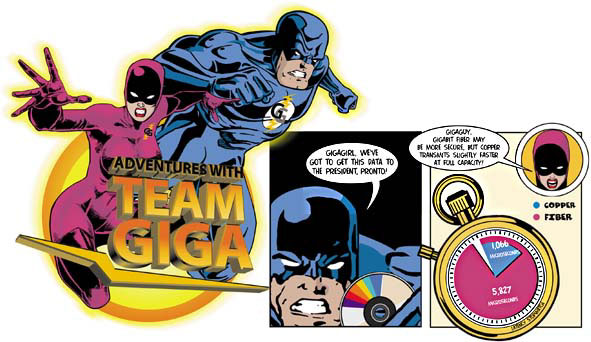
Faster than Fast Ethernet. More powerful than a Pentium III. Able to leap a minitower in a single bound. TeamGiga stands for truth, justice and administrators everywhere. They're dedicated to superfast processors and high-bandwidth communications.
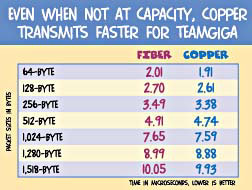
By Michael Cheek andWilliam JacksonGCN StaffIn the battle of the gigabit titans, neither fiber nor copper comes out a clear winner. Fiber-optic cabling is more secure against sniffing. Copper Category 5 twisted-pair cabling is a little cheaper.Fiber provides a future path for upgrading bandwidth. But at gigabit speeds on office networks, copper delivers the data slightly faster.That's right. Copper just barely edges out fiber.The GCN Lab conducted a variety of bandwidth tests over both types of cabling with the Hewlett-Packard Co. ProCurve 4000M switch []. The ProCurve had two 1000Base-SX fiber ports and two 1000Base-TX copper ports.We gave all the ports a workout with the SmartBits 2000 communications testing device from Netcom Systems Inc. of Calabasas, Calif.At top bandwidth, sending packets at 100 percent of capacity, both types of ports performed exceptionally well. Their throughput was equal. Both types sent and received all packets without losing a single byte.Latency, or how long it takes data to travel from source to destination, proved to be the only differentiating factor. The difference was so slight that only a device as sensitive as SmartBits could detect it.Switches send packets in two different modes: store-and-forward or cut-through. In cut-through mode, packets are sent off as soon as data begins to arrive. Store-and-forward mode waits until the end of a packet arrives before directing it to its destination.Cut-through generally is considered less reliable, generating more errors and dropping more packets than store-and-forward. The price of reliability for store-and-forward mode is slightly higher latency.Regardless of whether the ports were set to cut-through or store-and-forward, the slight performance delta remained between fiber and copper. After some research into why fiber was slightly slower, the lab staff concluded the reason has to do with the make-up of packets.We're not talking bytes or bits but the properties of what physically moves via copper or fiber.Fiber carries light. Copper carries electric current. The light is photons; the electrical pulses are electrons.All the wiring inside computers, network interface cards and most standard switches must carry data as electrical pulses. In other words, the communication within these devices occurs only via electrons.Because fiber carries only photons, the delay we measured came from the necessary conversions between electrons and photons at either end. The nature of the testing meant that conversion had to occur four times in each run.SmartBits generated a standard Ethernet packet'a series of electrons. At the fiber interface, it had to be converted to photons before it could travel over the fiber. The HP switch received the photons, converting them back to electrons to travel along its 3.2-Gbps backplane. The same thing happened in the reverse direction.The lab staff set SmartBits to generate Ethernet packets of seven standard byte sizes: 64, 128, 256, 512, 1,024, 1,280 and 1,518. We used the User Datagram Protocol, as specified by the Internet Engineering Task Force's Benchmarking Methodology Working Group. RFC 1242 is a standards document for measuring Ethernet performance.To put the two connection types to the ultimate torture test, we flooded the switch for three minutes at capacities between 90 percent and 100 percent, in 1 percent increments.With network traffic at less than 97 percent of capacity, the disparity between fiber and copper was minuscule'only about 3 percent. Averaging out the time duration, it came to about 0.11 microseconds. A microsecond is one-millionth of a second.But operating at capacity'100 percent of the theoretical bandwidth'the latency jumped. Over copper, the delay was around 1,066 microseconds; over fiber, it came to 5,827 microseconds. We averaged results from all packet sizes, and there was no significant difference in latency based on packet size.Although all the packets arrived at their destinations, latency jumped by four orders of magnitude. We were testing a rare scenario in which packets ran back-to-back. The difference of almost six-thousandths of a second vs. one-thousandth of a second was imperceptible to human senses.Our fiber and copper cables were of similar lengths'fiber at 10 feet and copper at 14 feet. We did not have extra optical fiber for testing, but we did test a 50-foot Category 5 twisted-pair cable. Copper is a good conductor, and our tests showed only a very slight difference in latency between the two lengths. The 50-foot copper performed with the same latency as the 10-foot fiber, or slightly less.Our gigabit tests were across distances common for small enterprise or office networks, not site-to-site or WAN transmissions. We wanted to determine which connection type worked best for common LANs.Although copper did perform slightly faster, both types of cabling have compelling pros and cons that are worth considering before deployment decisions are made:' Fiber is more secure. Electrical impulses can bleed outside the shielding of copper cable and be detected by sensor equipment that is sufficiently sensitive. Fiber cannot bleed electrical signals.' In many cases, networks already wired for standard 10-Mbps Ethernet or 100-Mbps Fast Ethernet can upgrade to copper Gigabit Ethernet if their Category 5 cabling is good. That saves the cost of rewiring with fiber, which can be substantial for room-to-room or floor-to-floor connections.' Industry trends are setting a 1-Gbps limit for copper. The trend is toward fiber, and the fiber infrastructure is just beginning to grow. Current standard fiber backbones can transmit 2.5 Gbps; close behind is 10 Gbps. Some types of fiber have been tested to 89 Gbps and beyond.' Although copper in categories 5 and 6 can adequately handle current enterprise needs, which top out in the gigabit range, fiber might be necessary to take advantage of higher rates reaching down the LAN from big pipes on the backbones. Some government users already have gigabit service at the desk, and higher LAN speeds cannot be far behind.Maybe rewiring with fiber now could save a few extra bucks later. All these factors, taken together, make fiber attractive for future-proofing networks, especially new installations.Copper's price advantage over fiber also is shrinking. Improved connection systems are bringing down the fiber cost premium, and smaller form factors for connectors are boosting switches' port density, saving real estate in the wiring closet.Furthermore, the longer distances possible with fiber mean wiring plans can be centralized to eliminate some wiring closets and equipment. That also brings down the overall cost of a fiber network.Your mileage may vary due to your network requirements. The cost of replacing existing copper could eat up much of the potential savings. But for a new installation, fiber is becoming competitive enough to warrant a look.
Fiber is more secure and easier to upgrade, but for bandwidth and economy, copper gets lab's nod
Faster than Fast Ethernet. More powerful than a Pentium III. Able to leap a minitower in a single bound. TeamGiga stands for truth, justice and administrators everywhere. They're dedicated to superfast processors and high-bandwidth communications.
The saga continues this week when our heroes receive detailed data about a cyberattack on the GigaLair. The data must be transmitted, but how'over copper or fiber Gigabit Ethernet cabling?

GCN, July 3, Page 25
You torturous fiends!
Lay of the LAN
Senior reviews editor John Breeden II and GCN Lab assistant Arthur Moser contributed to this report.
Faster than Fast Ethernet. More powerful than a Pentium III. Able to leap a minitower in a single bound. TeamGiga stands for truth, justice and administrators everywhere. They're dedicated to superfast processors and high-bandwidth communications.
EPISODE 2: PUSHING PACKETS |
The saga continues this week when our heroes receive detailed data about a cyberattack on the GigaLair. The data must be transmitted, but how'over copper or fiber Gigabit Ethernet cabling?
GCN, July 3, Page 25
You torturous fiends!
Lay of the LAN
Senior reviews editor John Breeden II and GCN Lab assistant Arthur Moser contributed to this report.
NEXT STORY: Distributor Caldera acquires part of Unix vendor