
INTERVIEW: Rear Adm. Keith W. Lippert, Navy's master logistician
Featured eBooks





Whether it's running an enterprise resource planning pilot to replace 1960s-era Cobol applications, conducting a reverse auction or weathering the uncertainty of A-76 outsourcing studies, the Naval Supply Systems Command is at the center of Navy efforts to reduce costs and improve fleet support.
LIPPERT: About 7 percent of our sales are through direct vendor delivery contracts, which don't require the command to store the parts. Out goal is to get to 10 percent this year, and to eventually make it 25 to 30 percent of our sales.Our vision is that the contractor would manage the materiel, warranties and the performance of parts. Direct delivery contracts tend to be long-term in nature.With warranties, we never had a capability to analyze the mean time between failure. In October, we will start doing serial-number tracking so we can monitor in-transit times and mean times between failure. We'll also know where the carcass is when a part fails.We are gathering data for high-cost, depot-level repairables. It can tell us how long we've had a part, how many times it's been repaired and other information. We are starting in the aviation world, and then we plan to go to surface ships and then submarines.LIPPERT: We have a strategic plan that dates back to 1995 that One Touch Support is part of. The best way to view it is that it allows a customer to access the Navy supply system from around the world and initiate an order with one action that sets off a chain of events through a global set of networks. Users can place orders using IMPAC credit cards.Two or two and a half years ago, civilians at the Pearl Harbor Fleet Industrial Supply Center created the One Touch Support network to enable customers in that region to access the center's products. The center worked with Oracle Corp. to create the system.Once it was done, we exported it throughout the Navy to all fleet industrial supply centers. We went from a regional to a national approach that enabled customers to go anywhere in our supply system to order parts.LIPPERT: We're working on Version 3.0. It will use a public-key infrastructure for identification and will include the ability to make a requisition. It will also give us total asset visibility, so that customers can find out the status of their orders.In addition to the requisitioning capability, users at places like Pearl Harbor will be able to arrange schedules for a contractor to arrive at a ship to perform work and other tasks.On June 30, we awarded a $2.8 million contract to IBM Corp., which will work with Ariba Inc. [of Mountain View, Calif.], to give us access to Ariba's global network. It includes over 20,000 suppliers, as well as Defense Logistics Agency and General Services Administration contractors. Navy buyers will be able to review supplier offerings through the Internet and make price comparisons.The initial use of Version 3.0 will begin this month, with full rollout in the fall. The IBM contract covers this fiscal year. We expect to award a follow-on contract for implementation that will be worth $5 million to $6 million over 18 months.LIPPERT: We've taken a three-phased approach. Last fall, as part of Phase 1, we hired Electronic Data Systems Corp. as a contractor for our supply maintenance system to replace two 1960s-era Cobol mainframe programs that have about 3 million lines of code.EDS recommended SAP America Inc. [of Newton Square, Pa.] as the ERP provider.The second phase, which started July 24, will last 18 months. During that time, EDS will develop a prototype SAP system to see if it can work in an operational environment. We plan to evaluate the prototype in 18 months.Our original vision was to deploy it first at the fleet industrial supply centers and Navy inventory control points and then aboard ships.But the bill to take it to the ship level was too much. The center and control point implementation will cost about $200 million through 2005. If we had extended it to the ship level, it would have cost about $400 million. The pilot itself will cost about $36 million.LIPPERT: We have a three-month contract with FreeMarkets Inc.[of Pittsburgh] to do reverse auctions. We have done two so far. One resulted in a 28 percent savings; the other resulted in a 22 percent savings.Our intention is to do several more and then award a long-term contract to a reverse-auction supplier. In the future, we would like to conduct reverse auctions involving the Navy Exchange.When we use reverse auctions, contracting officers evaluate all bidders' offers to ensure that we get the best value.LIPPERT: We've been working on total-asset visibility and reducing response times for several years. We've made a big improvement since operations Desert Storm and Desert Shield. We have well over 90 percent total-asset visibility in Navy systems, and we're improving our visibility of repair items that are in transit.Particularly in a coalition environment, however, it's difficult because there are many different logistics systems, and some of them don't work well together. I don't think we're at the stage yet where total-asset visibility is possible in a joint operation.Funding is always a problem. It's just something that we try to handle on a year-by-year basis.LIPPERT: The inventory control points'primarily the facility in Philadelphia'provides a lot of support for Marine Corps users. We do have interfaces with their systems.'The service's systems, however, are unique systems. So, where you have independent systems, you're going to have problems.LIPPERT: Until 2005, we're expected to achieve hundreds of millions in savings through our budget from outsourcing, re-engineering and contractor efficiencies.So far, we've done 13 Office of Management and Budget Circular A-76 studies out of a total of 36 we want to do. Government teams have won nine competitions; industry has won four.LIPPERT: FMSO is the central design agency for our organic systems, which include logistics, transportation, finance, accounting and inventory math modeling. About 750 people work there.There will always be some residual systems that we maintain. We think that ERP systems will probably provide 70 percent of the functionality that we need, and organic systems will probably provide the remaining 30 percent.
 Whether it's running an enterprise resource planning pilot to replace 1960s-era Cobol applications, conducting a reverse auction or weathering the uncertainty of A-76 outsourcing studies, the Naval Supply Systems Command is at the center of Navy efforts to reduce costs and improve fleet support.
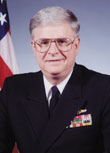
Rear Adm. Keith W. Lippert has been Naval Supply Systems commander since August of last year. Before taking over the command, he had been its vice commander for two years.
Lippert entered the Navy in 1968 through the Reserve Officers Training Corps Program at Miami University, where he received a bachelor's degree in mathematics.
In August 1995, Lippert became the first commander of a naval inventory control point.
He previously had been NAVSUP's deputy commander for financial management.
Besides his math degree, Lippert has a master's in management and operations research from the Naval Postgraduate School.
Lippert received the Defense Superior Service Medal, two Legion of Merit awards, four Meritorious Service Medals, two Navy Commendation Medals and a Navy Achievement Medal.
Lippert received the Society of Logistics Engineers 1992 International Award for outstanding performance in financial management and inventory control.
GCN staff writer Bill Murray interviewed Lippert by telephone.
GCN:'How far along is the Naval Supply Systems Command in getting out of the warehousing business?
GCN:'How did the Navy's One Touch Support program come about?
GCN:'So what's the next step?
GCN:'Meanwhile, the command is also working on enterprise resource planning system. How extensive will it be?
GCN:'The Navy is one of the first agencies to jump on the reverse-auction bandwagon. How will reverse auctions reduce the Navy's procurement costs?
GCN:'The Defense Department's Joint Vision 2020 calls for logistics organizations to make use of the Web for tracking assets so that commanders can get information easily during joint operations. Will you meet the plan's milestones?
GCN:'Do your systems work well with the Marine Corps' systems?
GCN:'What's the status of your outsourcing studies?
GCN:'What's the future of the Fleet Material Support Office in providing systems support?
Rear Adm. Keith W. Lippert
Rear Adm. Keith W. Lippert has been Naval Supply Systems commander since August of last year. Before taking over the command, he had been its vice commander for two years.
Lippert entered the Navy in 1968 through the Reserve Officers Training Corps Program at Miami University, where he received a bachelor's degree in mathematics.
In August 1995, Lippert became the first commander of a naval inventory control point.
He previously had been NAVSUP's deputy commander for financial management.
Besides his math degree, Lippert has a master's in management and operations research from the Naval Postgraduate School.
Lippert received the Defense Superior Service Medal, two Legion of Merit awards, four Meritorious Service Medals, two Navy Commendation Medals and a Navy Achievement Medal.
Lippert received the Society of Logistics Engineers 1992 International Award for outstanding performance in financial management and inventory control.
GCN staff writer Bill Murray interviewed Lippert by telephone.
GCN:'How far along is the Naval Supply Systems Command in getting out of the warehousing business?
GCN:'How did the Navy's One Touch Support program come about?
GCN:'So what's the next step?
GCN:'Meanwhile, the command is also working on enterprise resource planning system. How extensive will it be?
GCN:'The Navy is one of the first agencies to jump on the reverse-auction bandwagon. How will reverse auctions reduce the Navy's procurement costs?
GCN:'The Defense Department's Joint Vision 2020 calls for logistics organizations to make use of the Web for tracking assets so that commanders can get information easily during joint operations. Will you meet the plan's milestones?
GCN:'Do your systems work well with the Marine Corps' systems?
WHAT'S MORE
|
GCN:'What's the status of your outsourcing studies?
GCN:'What's the future of the Fleet Material Support Office in providing systems support?