FCC takes payments online

The Federal Communications Commission now accepts credit card payments for many of its license applications, renewals and routine regulatory fees.

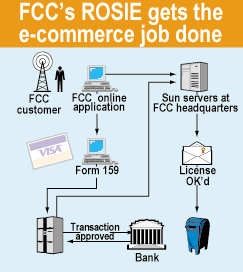
By Patricia DaukantasGCN StaffThe Federal Communications Commission now accepts credit card payments for many of its license applications, renewals and routine regulatory fees.Behind the scenes, the credit card transactions flow through systems at the Treasury Department and a Washington electronic commerce company without FCC's servers ever seeing a card number.The year-old system known as ROSIE'for Remittance over Secure Internet E-commerce'accepts payments by MasterCard or Visa for any transaction that can be paid via FCC's remittance Form 159, FCC chief financial officer Mark Reger said.'No matter what you're paying the FCC, it's the common form,' Reger said.Form 159 users also can choose to pay by bank automated clearinghouse (ACH) electronic funds transfer, or they can simply print out the form and mail it with a check. But credit cards are most convenient for people paying relatively small fees of a few dollars up to a few thousand dollars.'You really want to do large payments with ACH,' Reger said.The commission started accepting credit cards online in August of last year, said Brian Donnelly, a project manager for contractor Computech Inc. of Bethesda, Md. He worked on setting up ROSIE.ROSIE has no individual entry point or home page, Donnelly said. To see the electronic version of Form 159 and choose the 'charge it' option, prospective users must first register online for a license.Through Aug. 22, FCC racked up 8,964 Form 159 credit card payments totaling about $1 million, Reger said.''That's a drop in the bucket for the commission, which annually takes in $185 million in regulatory fees, $28 million in application fees and potentially billions from auctioning chunks of the electromagnetic spectrum. Over the past year, however, the money that comes in through ROSIE has been doubling almost every month, Reger said.Growth has slowed now that the system has been online for a year, and most people who are inclined to make electronic payments are doing so, Donnelly said.For the largest transactions involving six- or seven-figure sums, FCC requires payment by bank wire transfers, Donnelly said.Through an agreement with Treasury, Govolution of Washington administers the server that handles the MasterCard and Visa numbers for FCC's ROSIE and several other agencies. Govolution is a spinoff of the e-commerce unit of Bixler Inc., another Washington company that started developing the system in 1997.FCC and Computech were trying to develop their own e-payment system at the time and sought guidance from Treasury, which has oversight of all government e-payment systems, Donnelly said. Treasury officials informed them of the work being done with Bixler.'We were very concerned about the risks associated with credit card numbers being processed through several hands,' Donnelly said.For security reasons, credit card numbers never come into the FCC system, Reger said. Even the paper Form 159 has a separate section for credit card information, and the bank tears off and keeps that portion so the commission never receives the number or expiration date.When FCC's online filers choose to pay by credit card, ROSIE invisibly transfers them over to a secure, 128-bit-encrypted site on Govolution's servers, Govolution chief executive officer Jonathan M. Prince said. The site replicates the look and feel of FCC's other license-related Web pages.'When you go to the payments page, the graphics look the same, and the citizens or businesses still think they're completely within the realm of the government agency,' Prince said.After the financial institution authorizes the credit card transaction, Govolution generates a transaction confirmation number to send to the customer and to FCC. That number identifies the transaction in case the customer needs to contact FCC about it later.Credit card numbers pass from the Govolution environment to the financial institution, then are deleted from the Govolution site.'It's an innovative approach to security,' Donnelly said.Govolution's system is based on the Extensible Markup Language and the company's proprietary technology, Govolution chief technical officer Joshua E. Bixler said.Treasury has designated two financial institutions, Bank of America and Mellon Bank, to clear the credit card transactions, said Brett Smith, a program manager in the electronic money group within Treasury's Financial Management Service.When agencies approach FMS to set up e-payment systems, Treasury officials point them toward the Govolution system because of its economies of scale, Smith said.Currently 24 agencies use the e-commerce system and another 30 are in various stages of development, Smith said.'In terms of trying to implement e-business, this is the right architecture,' Smith said.Before the Web, many routine licensing processes were paper-intensive, and payment processing contributed to delays, Reger said.The law requires all FCC bureaus and offices to confirm payment before processing a license application or renewal form. Instead of waiting for a check to clear, they receive credit card authorization within seconds, and the application can start the review process faster.'If you mail a check, occasionally it gets lost,' Reger said. But people using credit cards get notified of approval right away, 'so it's good for both parties.'For several years FCC has been retraining workers whose jobs have been eliminated by such technological changes. Some employees who used to process paperwork now work at the agency's call center, Reger said.ROSIE has had one glitch so far, he said. Early on, when a few impatient users hit the 'charge' button and didn't get a response, they pressed the button multiple times'and got charged multiple fees.Fortunately for the 30 or so people to whom this happened, agency officials immediately sent letters and credited the excess fees to their accounts, Reger said.'They probably got our letter before they got their bill,' he said.For the first time this month, FCC will accept credit card payments during its annual regulatory fee filing period, Donnelly said.In the past, payments have been via paper or downloadable software.The window for paying regulatory fees starts today and runs through Sept. 20. FCC officials expect ROSIE to be heavily used, Donnelly said, especially as the deadline draws near.'The FCC's keen on providing the license holder with as much flexibility as possible in making payments to FCC,' he said. 'This is just another step in that direction.'
System accepts credit card transactions via remittance form, CFO says


FCC's online payment system keeps credit card transactions separate from the rest of the system's license applications.


Slow to grow


One slight problem


NEXT STORY: POWER USER

X
This website uses cookies to enhance user experience and to analyze performance and traffic on our website. We also share information about your use of our site with our social media, advertising and analytics partners. Learn More / Do Not Sell My Personal Information
Accept Cookies
X
Cookie Preferences Cookie List

Do Not Sell My Personal Information

When you visit our website, we store cookies on your browser to collect information. The information collected might relate to you, your preferences or your device, and is mostly used to make the site work as you expect it to and to provide a more personalized web experience. However, you can choose not to allow certain types of cookies, which may impact your experience of the site and the services we are able to offer. Click on the different category headings to find out more and change our default settings according to your preference. You cannot opt-out of our First Party Strictly Necessary Cookies as they are deployed in order to ensure the proper functioning of our website (such as prompting the cookie banner and remembering your settings, to log into your account, to redirect you when you log out, etc.). For more information about the First and Third Party Cookies used please follow this link.

Allow All Cookies

Manage Consent Preferences

Strictly Necessary Cookies - Always Active

We do not allow you to opt-out of our certain cookies, as they are necessary to ensure the proper functioning of our website (such as prompting our cookie banner and remembering your privacy choices) and/or to monitor site performance. These cookies are not used in a way that constitutes a “sale” of your data under the CCPA. You can set your browser to block or alert you about these cookies, but some parts of the site will not work as intended if you do so. You can usually find these settings in the Options or Preferences menu of your browser. Visit www.allaboutcookies.org to learn more.

Sale of Personal Data, Targeting & Social Media Cookies

Under the California Consumer Privacy Act, you have the right to opt-out of the sale of your personal information to third parties. These cookies collect information for analytics and to personalize your experience with targeted ads. You may exercise your right to opt out of the sale of personal information by using this toggle switch. If you opt out we will not be able to offer you personalised ads and will not hand over your personal information to any third parties. Additionally, you may contact our legal department for further clarification about your rights as a California consumer by using this Exercise My Rights link

If you have enabled privacy controls on your browser (such as a plugin), we have to take that as a valid request to opt-out. Therefore we would not be able to track your activity through the web. This may affect our ability to personalize ads according to your preferences.

Targeting cookies may be set through our site by our advertising partners. They may be used by those companies to build a profile of your interests and show you relevant adverts on other sites. They do not store directly personal information, but are based on uniquely identifying your browser and internet device. If you do not allow these cookies, you will experience less targeted advertising.

Social media cookies are set by a range of social media services that we have added to the site to enable you to share our content with your friends and networks. They are capable of tracking your browser across other sites and building up a profile of your interests. This may impact the content and messages you see on other websites you visit. If you do not allow these cookies you may not be able to use or see these sharing tools.

If you want to opt out of all of our lead reports and lists, please submit a privacy request at our Do Not Sell page.

Save Settings
Cookie Preferences Cookie List

Cookie List

A cookie is a small piece of data (text file) that a website – when visited by a user – asks your browser to store on your device in order to remember information about you, such as your language preference or login information. Those cookies are set by us and called first-party cookies. We also use third-party cookies – which are cookies from a domain different than the domain of the website you are visiting – for our advertising and marketing efforts. More specifically, we use cookies and other tracking technologies for the following purposes:

Strictly Necessary Cookies

We do not allow you to opt-out of our certain cookies, as they are necessary to ensure the proper functioning of our website (such as prompting our cookie banner and remembering your privacy choices) and/or to monitor site performance. These cookies are not used in a way that constitutes a “sale” of your data under the CCPA. You can set your browser to block or alert you about these cookies, but some parts of the site will not work as intended if you do so. You can usually find these settings in the Options or Preferences menu of your browser. Visit www.allaboutcookies.org to learn more.

Functional Cookies

We do not allow you to opt-out of our certain cookies, as they are necessary to ensure the proper functioning of our website (such as prompting our cookie banner and remembering your privacy choices) and/or to monitor site performance. These cookies are not used in a way that constitutes a “sale” of your data under the CCPA. You can set your browser to block or alert you about these cookies, but some parts of the site will not work as intended if you do so. You can usually find these settings in the Options or Preferences menu of your browser. Visit www.allaboutcookies.org to learn more.

Performance Cookies

We do not allow you to opt-out of our certain cookies, as they are necessary to ensure the proper functioning of our website (such as prompting our cookie banner and remembering your privacy choices) and/or to monitor site performance. These cookies are not used in a way that constitutes a “sale” of your data under the CCPA. You can set your browser to block or alert you about these cookies, but some parts of the site will not work as intended if you do so. You can usually find these settings in the Options or Preferences menu of your browser. Visit www.allaboutcookies.org to learn more.

Sale of Personal Data

We also use cookies to personalize your experience on our websites, including by determining the most relevant content and advertisements to show you, and to monitor site traffic and performance, so that we may improve our websites and your experience. You may opt out of our use of such cookies (and the associated “sale” of your Personal Information) by using this toggle switch. You will still see some advertising, regardless of your selection. Because we do not track you across different devices, browsers and GEMG properties, your selection will take effect only on this browser, this device and this website.

Social Media Cookies

We also use cookies to personalize your experience on our websites, including by determining the most relevant content and advertisements to show you, and to monitor site traffic and performance, so that we may improve our websites and your experience. You may opt out of our use of such cookies (and the associated “sale” of your Personal Information) by using this toggle switch. You will still see some advertising, regardless of your selection. Because we do not track you across different devices, browsers and GEMG properties, your selection will take effect only on this browser, this device and this website.

Targeting Cookies

We also use cookies to personalize your experience on our websites, including by determining the most relevant content and advertisements to show you, and to monitor site traffic and performance, so that we may improve our websites and your experience. You may opt out of our use of such cookies (and the associated “sale” of your Personal Information) by using this toggle switch. You will still see some advertising, regardless of your selection. Because we do not track you across different devices, browsers and GEMG properties, your selection will take effect only on this browser, this device and this website.