Scientists have high hopes for fusion simulation

The Energy Department wants to push commercial software companies to develop supersoftware, just as it has pushed hardware developers and manufacturers to develop supercomputers.

By Merry MayerSpecial to GCNThe Energy Department wants to push commercial software companies to develop supersoftware, just as it has pushed hardware developers and manufacturers to develop supercomputers.Scientists at Energy's Lawrence Livermore National Laboratory in Livermore, Calif., are hoping for improved visualization software that could provide detailed imaging of fusion reactions that occur in just three-billionths of a second.Until the private sector catches up with its special needs, however, Energy must support its own software, MeshTV. It allows visualization and analysis of data using 2-D and 3-D images. It also provides different ways of viewing the data, including both orthogonal and arbitrary slicing, and is virtually hardware and vendor independent, said Terri Quinn, assistant head of the Scientific Computing and Communications Department at Lawrence Livermore.The lab's National Ignition Facility is using the homegrown software for experiments in which scientists simulate fusion reactions on a small scale to test their instabilities.For physicists, instability is the degree of mixing of elements, which, depending on the circumstances, can be a good or bad thing. The more elements mix, the higher the instability.Lack of instability is why smog hangs over much of Los Angeles, said Andrew Cook, an NIF physicist. There isn't enough mixing of the air, so the air gets trapped in the valley.Instability is also a good thing when it comes to jet engines, which need lots of mixing of air for combustion and takeoff, Cook said.But instability is not good when it comes to nuclear weapons, he said. Mixing of elements can cause the capsules' shells to break up and prevent ignition.Scientists replicate the fusion environment in the lab by shooting a powerful laser at a fusion capsule the size of a BB, causing it to implode and create a tiny star.Such simulations could someday let Energy determine whether a nuclear weapon works without testing it. The simulations also could give astrophysicists new insight into the formation of stars and possibly provide a new source of energy, officials said.But to get a computerized visual of a complex reaction occurring in just three-billionths of a second would require software capable of processing millions of data elements quickly.Energy's Accelerated Strategic Computing Initiative has five large contracts with universities to develop some aspect of visualization computing, said Derrol Hammer, high-performance computing procurement group leader at Lawrence Livermore.The institutions are Stanford University, California Institute of Technology, University of Chicago, University of Illinois at Urbana-Champaign and University of Utah.ASCI is collaborating with Computational Engineering International of Morrisville, N.C., to make its Ensight graphics software scalable for the lab's purposes, Quinn said.Ensight software lets scientists slice the action into planes and actually see what is going on in different sections of the capsule as it implodes, she said. Scientists can also do a particle trace, following it through the capsule as the action occurs.'Unfortunately, it isn't scalable for our purposes at this time,' Quinn said.Late last year, Lawrence Livermore successfully completed the first 3-D simulation of a nuclear weapon primary explosion using its ASCI Blue Pacific supercomputer, one of the most powerful computers in the world, and MeshTV software.Nuclear weapons consist of two main components: the primary or trigger and the secondary, which produces most of the energy.To simulate a primary explosion on a computer required 300G of RAM and some 20 days to complete the calculation. DOE estimated that such a calculation on a regular desktop computer would have taken 30 years to complete.The Blue Pacific is a greatly expanded version of IBM's RS/6000 SP Scalable PowerParallel supercomputer. The ASCI Blue Pacific has 5,856 processors, 1,464 nodes and takes up 8,000 square feet of space. It can perform 3.88 trillion floating-point operations per second and has 75T of space, enough to store the contents of all the books in the Library of Congress.Scientists analyze the visualizations on workstations from SGI. The workstations are connected to the lab's supercomputer by a high-speed HIPPI/OC-12 network. The servers employ switched video and remote rendering to the analysts' workstations, providing multiple levels of graphics capabilities, officials said.Although the main goal of NIF is to ensure the safety and reliability of the nation's nuclear weapons, Energy is also looking beyond this to possible contributions to basic science and its commercial applications.If NIF can achieve fusion ignition and a net engery gain, it will have demonstrated that fusion reactions can be controlled and used as an energy source. Nuclear fusion is much cleaner, with no hazardous byproducts as with nuclear fission, and there is an unlimited supply of fuel, Cook said.Such simulations should also give insight into how stars behave under various circumstances, he said.
Energy calls on software companies to develop programs that will help in high-level research


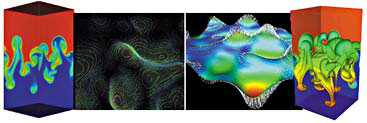
Lawrence Livermore National Laboratory's homegrown visualization software, MeshTV, lets Energy scientists see and analyze fusion data using both 2-D and 3-D images for high-end simulations.


Friend or foe?


One, two, boom


X
This website uses cookies to enhance user experience and to analyze performance and traffic on our website. We also share information about your use of our site with our social media, advertising and analytics partners. Learn More / Do Not Sell My Personal Information
Accept Cookies
X
Cookie Preferences Cookie List

Do Not Sell My Personal Information

When you visit our website, we store cookies on your browser to collect information. The information collected might relate to you, your preferences or your device, and is mostly used to make the site work as you expect it to and to provide a more personalized web experience. However, you can choose not to allow certain types of cookies, which may impact your experience of the site and the services we are able to offer. Click on the different category headings to find out more and change our default settings according to your preference. You cannot opt-out of our First Party Strictly Necessary Cookies as they are deployed in order to ensure the proper functioning of our website (such as prompting the cookie banner and remembering your settings, to log into your account, to redirect you when you log out, etc.). For more information about the First and Third Party Cookies used please follow this link.

Allow All Cookies

Manage Consent Preferences

Strictly Necessary Cookies - Always Active

We do not allow you to opt-out of our certain cookies, as they are necessary to ensure the proper functioning of our website (such as prompting our cookie banner and remembering your privacy choices) and/or to monitor site performance. These cookies are not used in a way that constitutes a “sale” of your data under the CCPA. You can set your browser to block or alert you about these cookies, but some parts of the site will not work as intended if you do so. You can usually find these settings in the Options or Preferences menu of your browser. Visit www.allaboutcookies.org to learn more.

Sale of Personal Data, Targeting & Social Media Cookies

Under the California Consumer Privacy Act, you have the right to opt-out of the sale of your personal information to third parties. These cookies collect information for analytics and to personalize your experience with targeted ads. You may exercise your right to opt out of the sale of personal information by using this toggle switch. If you opt out we will not be able to offer you personalised ads and will not hand over your personal information to any third parties. Additionally, you may contact our legal department for further clarification about your rights as a California consumer by using this Exercise My Rights link

If you have enabled privacy controls on your browser (such as a plugin), we have to take that as a valid request to opt-out. Therefore we would not be able to track your activity through the web. This may affect our ability to personalize ads according to your preferences.

Targeting cookies may be set through our site by our advertising partners. They may be used by those companies to build a profile of your interests and show you relevant adverts on other sites. They do not store directly personal information, but are based on uniquely identifying your browser and internet device. If you do not allow these cookies, you will experience less targeted advertising.

Social media cookies are set by a range of social media services that we have added to the site to enable you to share our content with your friends and networks. They are capable of tracking your browser across other sites and building up a profile of your interests. This may impact the content and messages you see on other websites you visit. If you do not allow these cookies you may not be able to use or see these sharing tools.

If you want to opt out of all of our lead reports and lists, please submit a privacy request at our Do Not Sell page.

Save Settings
Cookie Preferences Cookie List

Cookie List

A cookie is a small piece of data (text file) that a website – when visited by a user – asks your browser to store on your device in order to remember information about you, such as your language preference or login information. Those cookies are set by us and called first-party cookies. We also use third-party cookies – which are cookies from a domain different than the domain of the website you are visiting – for our advertising and marketing efforts. More specifically, we use cookies and other tracking technologies for the following purposes:

Strictly Necessary Cookies

We do not allow you to opt-out of our certain cookies, as they are necessary to ensure the proper functioning of our website (such as prompting our cookie banner and remembering your privacy choices) and/or to monitor site performance. These cookies are not used in a way that constitutes a “sale” of your data under the CCPA. You can set your browser to block or alert you about these cookies, but some parts of the site will not work as intended if you do so. You can usually find these settings in the Options or Preferences menu of your browser. Visit www.allaboutcookies.org to learn more.

Functional Cookies

We do not allow you to opt-out of our certain cookies, as they are necessary to ensure the proper functioning of our website (such as prompting our cookie banner and remembering your privacy choices) and/or to monitor site performance. These cookies are not used in a way that constitutes a “sale” of your data under the CCPA. You can set your browser to block or alert you about these cookies, but some parts of the site will not work as intended if you do so. You can usually find these settings in the Options or Preferences menu of your browser. Visit www.allaboutcookies.org to learn more.

Performance Cookies

We do not allow you to opt-out of our certain cookies, as they are necessary to ensure the proper functioning of our website (such as prompting our cookie banner and remembering your privacy choices) and/or to monitor site performance. These cookies are not used in a way that constitutes a “sale” of your data under the CCPA. You can set your browser to block or alert you about these cookies, but some parts of the site will not work as intended if you do so. You can usually find these settings in the Options or Preferences menu of your browser. Visit www.allaboutcookies.org to learn more.

Sale of Personal Data

We also use cookies to personalize your experience on our websites, including by determining the most relevant content and advertisements to show you, and to monitor site traffic and performance, so that we may improve our websites and your experience. You may opt out of our use of such cookies (and the associated “sale” of your Personal Information) by using this toggle switch. You will still see some advertising, regardless of your selection. Because we do not track you across different devices, browsers and GEMG properties, your selection will take effect only on this browser, this device and this website.

Social Media Cookies

We also use cookies to personalize your experience on our websites, including by determining the most relevant content and advertisements to show you, and to monitor site traffic and performance, so that we may improve our websites and your experience. You may opt out of our use of such cookies (and the associated “sale” of your Personal Information) by using this toggle switch. You will still see some advertising, regardless of your selection. Because we do not track you across different devices, browsers and GEMG properties, your selection will take effect only on this browser, this device and this website.

Targeting Cookies

We also use cookies to personalize your experience on our websites, including by determining the most relevant content and advertisements to show you, and to monitor site traffic and performance, so that we may improve our websites and your experience. You may opt out of our use of such cookies (and the associated “sale” of your Personal Information) by using this toggle switch. You will still see some advertising, regardless of your selection. Because we do not track you across different devices, browsers and GEMG properties, your selection will take effect only on this browser, this device and this website.