
VIEW FROM THE FRONT





When Col. Robert Kirsch arrived at the Pentagon two years ago to manage the building's information management and telecommunications renovation, he knew it would be a monumental undertaking.
By Richard W. WalkerGCN StaffWhen Col. Robert Kirsch arrived at the Pentagon two years ago to manage the building's information management and telecommunications renovation, he knew it would be a monumental undertaking.One of his tasks was to replace the communications infrastructure in each of the five wedges that make up the five sides of the building with a sleek, new system.How monumental it would be became clear when workers began to rip out the decades-old accumulation of communications wiring from the first wedge of the structure.A massive tangle of cabling, both old and new, ran throughout the building'above ceilings, through floor conduits and inside walls. There were about 100,000 miles of wiring in all.'When we actually went in and began to demolish the wedge, we found bundles of cable'fiber-optic, twisted pair and coaxial'all laid in on top of each other,' Kirsch said. 'It was a rat's nest.'When the Pentagon was completed almost six decades ago, its communications network was crude and rudimentary.'Close your eyes and imagine the building when it was opened in 1943,' he said. 'There was one telephone for every three people. In the intervening 57 years, we've added new technology on top of old technology. In most cases, the old [wiring] was abandoned in place.'In the Pentagon today there are 42,000 phone lines. 'Every desk has at least one telephone, if not two or more,' he said. 'I have two'a classified phone and an unclassified phone.'Then there are the data systems, a conglomeration of service-unique LANs and network management centers.'Everybody has at least one PC on their desk,' Kirsch said. 'And if they have videoconferencing capability they probably have an [Integrated Services Digital Network] line.'When the Pentagon was completed in 1943, it was a shining model of architectural ingenuity. It was more like a small city than an office building, with some 25,000 employees navigating its 17 miles of corridors.But the building's major systems have deteriorated to the point where repairs are no longer effective.Moreover, the presence of asbestos in the ceiling plaster, ventilating ducts, pipes and floor coverings represents a serious hazard.So, the Pentagon is undergoing a massive, $1.2 billion reconstruction, managed by the Army Corps of Engineers. The job is expected to take about 14 years.The building will be renovated in five, 1-million-square-foot wedges, reflecting the way the five-sided structure was originally built.Each wedge houses about 5,000 employees.The plan includes the removal of all outdated systems'mechanical, electrical and plumbing'down to the base structures and the construction of all new systems.'There are two pieces to the renovation,' Kirsch said. 'There's construction side'the demolition, abatement of hazardous materials and then the build-out of the wedge.' The second part occurs when 'the facilities are turned over to us and we do the information technology implementation,' he saidFor the communications infrastructure component of the renovation, there is a grand vision for a new, state-of-the-art information system.Planners have designed a high-speed, fiber-optic backbone with almost 500 telecommunications closets, 47 communications equipment rooms and 15 wedge rooms that will provide classified and unclassified network connectivity for the Pentagon's 25,000 users.'Our goal is eventually to converge voice, data and video over a common backbone,' Kirsch said.General Dynamics Corp., which holds the primary contract for the above-ground telecommunications backbone, will install the switches, routers and cables to support present and future voice, data and video communications needs of the Pentagon.The first wedge is now in the build-out phase, and General Dynamics personnel are installing the communications infrastructure using both twisted-pair wiring and fiber optic cable.'We take voice out over copper because it's currently the least expensive implementation,' Kirsch said. 'The data side of it goes out over fiber to the telecommunications closets. From there to the workstations, we take both twisted pair and fiber'one set of twisted pair for voice and another for data'with the fiber as a backup for future growth.'The renovation of the first wedge is expected to be completed in about a year, he said.For Kirsch, the challenges of the Pentagon project are matched by the rewards.For example, Kirsch draws great satisfaction from making certain that there are no disruptions in communications service during the renovation.When the reconstruction of the first wedge got under way, Kirsch and his team had to move about 5,000 employees and their PCs, phones and other IT equipment into a swing space, where workers are housed during reconstruction.'I like that part about it,' he said. 'We do what's called decertification and certification of [employees'] IT assets. We verify that it works at its old location, deinstall it, pack up and move it to the new location. Then we hook it back up, re-install it and recertify it. For the greatest percentage of the tenants we have moved, everything worked the day they walked in and sat down at their new workstations.'Kirsch's job demands that he concentrate on both the present and the future.'We have to keep one eye on today's [IT] implementation because when the user shows up at his desk, he's got to have dial tone, data tone and video if he has it, and it's got to work first time, every time,' he said.'And then we have to keep the other eye on the changes and improvements in technology to ensure that we're anticipating where industry is going. We don't want to find ourselves in a situation where we've implemented something that's going to be abandoned. So far I think we've done a pretty good job of that.'Kirsch's biggest challenge is building the infrastructure system to meet future, yet-to-be-defined requirements, especially those of classified systems.'We have to make sure we've designed a system that is robust enough to allow us to add [more bandwidth] as either technology or requirements dictate,' Kirsch said. 'We always need to keep an eye on future technology changes to ensure that our architecture is very robust and not based on a given piece of hardware or a given technology.'To guarantee such scalability, the team is putting in a cabling system from Sumitomo Electric Lightwave Corp. of Research Triangle Park, N.C., that will allow the future installation of fiber with no muss or fuss.Replacing the conventional conduit, Sumitomo's Futureflex air-blown fiber-optic cabling system uses a tough, flexible outer jacket containing up to 19 individual tubes that carry fiber-optic bundles.When network changes become necessary, additional fiber can simply be blown through a tube on a stream of air or nitrogen gas using a cable-blowing head at a speed of up to 150 feet per minute.'For future requirements, we'll be able to take fiber from a telecom closet directly to the column box adjacent to the user without having to go into the ceiling and pull anything,' Kirsch said. 'That will make it much easier to expand the classified requirements should the need present itself.'Kirsch is now looking at Gigabit Ethernet as the common transport protocol. It was originally planned as an asynchronous transfer mode backbone.'We're currently looking at changing the Layer 2 protocol from ATM to Gigabit Ethernet,' he said. 'We're in the final stages of evaluating the potential. I've tasked General Dynamics to evaluate potential Gigabit solutions and determine if in fact Gigabit Layer 2 implementation can provide us with the same robust solution that we were looking at in ATM.'Keeping an eye on what's over the technology horizon should be straightforward for Kirsch.He's done everything from network management to software engineering, spending 18 of his 22 years on active duty in one field of automation or another.Before taking on the Pentagon renovation job, Kirsch, who has a master's degree in information systems from the Naval Postgraduate School, was director of the Army Information Systems Engineering Command's office at Fort Belvoir, Va.'I did that for a year waiting for [the Pentagon] job to come available,' he said.Before that, Kirsch was for three years product manager for Army network management systems at Army Communications-Electronics Command at Fort Monmouth, N.J..As project manager of Pentagon systems renovations, Kirsch is back under CECOM's umbrella, managing a staff of about 28.He also gets support from the 27 technical specialists in Pentagon Engineering Office, part of the Army Information Systems Engineering Command, headquartered in Fort Huachuca, Ariz.He also oversees the hundreds of contractors on the project from General Dynamics and elsewhere.True, it's early on in a huge undertaking, but Kirsch feels that his team is getting it done.''It speaks highly of the people I have working with me on the job,' he said.
 Kirsch takes on wall-to-wall upgrade of Pentagon's aging infrastructure
Way back when
The first wedge
Extra help
 | 'Our goal is eventually to converge voice, data and video over a common backbone.' 'Col. Robert Kirsch |
Way back when
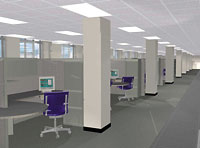 | The Pentagon's shift to fiber-optic networking will be accomplished by an open working environment depicted in this rendering of renovations to the building's first wedge. |
The first wedge
Extra help
NEXT STORY: DOD networks