

Message Mania

Two years ago, as President Clinton's impeachment proceedings took center stage, floods of impassioned messages slowed congressional e-mail systems to a crawl.

| GCN STAFFTwo years ago, as President Clinton's impeachment proceedings took center stage, floods of impassioned messages slowed congressional e-mail systems to a crawl.Now the Senate is readying separate systems for its public e-mail and its internal business e-mail so that staffs will not lose messaging capability during future controversies.Routing constituent e-mail through a separate system could avoid future network jams and server crashes, said Lynden Armstrong, administrative and systems director for the Washington office of Sen. Pete V. Domenici (R-N.M.).At times during the proceedings, Congress received so much e-mail that Capitol Hill staff could not use their Lotus cc:Mail, said Jody Reeves, systems administrator for the Washington office of Sen. Dianne Feinstein (D-Calif.).'Right after the whole impeachment e-mail deluge, the Senate began casting about for a new e-mail system to handle the volumes that we're getting from constituents,' Reeves said.In mid-1999, Senate officials announced they would use EchoMail message routing software from EchoMail Inc. of Cambridge, Mass. Over the past year, Senate and company officials have been working to convert the software 'from a private-industry product to a public-sector product,' Reeves said. For example, a batch-printing function had to be added, Armstrong said.Feinstein's office is one of two in the Senate that have run EchoMail as a pilot since last January, Reeves said. Between now and April, it will be rolled out to the rest of the Senate.As a senator from the nation's most populous state, Feinstein receives about 2,500 outside messages per day, reaching 5,000 to 7,000 in the days before a Senate vote on major legislation.Feinstein's policy is to send personalized responses only to her constituents. E-mail correspondents must include a postal address to get an answer.Reeves said she has set up the senator's EchoMail account to recognize the keyword California and its abbreviations, plus ZIP codes that begin with 9. Out-of-state e-mail messages get an automated EchoMail answer stating Feinstein's response policy.Most Hill offices have a similar policy for constituent e-mail, Reeves said.'If a Senate office is small enough that they can handle other people, that's great'I envy them,' she said.Reeves said her account has filters for common spam and viruses, and she never even sees such messages.About 70 percent of the e-mail from Californians can be answered by stock replies that explain Feinstein's position on issues, Reeves said.E-mails that need special attention'requests for tour tickets, flags or other materials'are printed out and answered by postal mail, Reeves said.Because Feinstein was up for re-election this year, Senate policies forbade sending out unsolicited e-mail to voters.Reeves said the California senator's office would not do that anyway. 'People might think of that as spam, and it can get a little annoying,' she said.Most congressional offices have a constituent management system (CMS) specifically designed to log all letters, phone calls, faxes and e-mail from voters, Armstrong said. Senate offices generally use one of two products: Quorum Power from Intelligent Solutions Inc. of Falls Church, Va., and Capitol Correspond from InterAmerica Technologies Inc. of McLean, Va.The EchoMail system is not designed to replace the CMS products, which can track constituent concerns in greater detail, Armstrong said. For example, EchoMail could tell a staff member whether a constituent has sent a message every week, but not whether that person has written only about agricultural issues.In many Senate offices, workers print out constituent e-mail and log them into the CMS by hand, Armstrong said. He does not expect that to change right away, because EchoMail initially will not have an electronic connection to the existing databases.CMS vendors are developing bridge programs that would transfer messages sorted by EchoMail into the database systems, Armstrong said.Feinstein's office uses Quorum Power, which holds correspondence records dating back to the start of her Senate service in 1993, Reeves said. EchoMail archives e-mail for six months.Generally, nothing about senators' e-mail will look different to the public, Armstrong said. Existing public e-mail addresses, such as , will remain the same.To discourage spam, some Senate offices, including Domenici's, collect e-mail from constituents only through a Web form, such as the one at . Once Domenici's staff tries the new system, its members may consider setting up a public e-mail address and filtering responses through EchoMail, Armstrong said.The number of e-mails to Domenici's office varies widely, depending on whether the Senate is in session and whether senators are debating hot-button issues. On average, the office gets about 500 outside e-mails per day, up to 70 percent from New Mexico residents, Armstrong said.Senators get plenty of correspondence from activists outside their home states. The volume of nonconstituent messages 'probably depends on how much national exposure your boss gets,' Armstrong said.Based on a survey of Senate offices, EchoMail set up about 30 basic e-mail categories for broad issues such as defense, the environment and agriculture. During training on the new system, Senate staff will learn how to personalize EchoMail to reflect specific state concerns.Individual senators' offices will get the new system by seniority. Domenici entered the Senate in 1973, and his office will probably be an early adopter, Armstrong said.Senators' offices don't have to take on EchoMail if they don't feel they are ready for it, but Armstrong said he has not heard of anyone rejecting it.The turnover from this month's elections should not affect the rollout, Armstrong said. The system won't be installed in the offices of retiring or defeated senators, and new senators will get the system close to the start of their six-year terms.The office of the Senate sergeant at arms hosts the EchoMail system in the Senate's main data center, located in the Postal Square building near Capitol Hill.The software runs on two Sun Microsystems Enterprise 450 servers, and two additional Enterprise 450 machines host an Oracle8 Release 8.06 database for EchoMail.
After Senate members find themselves adrift in a sea of e-mail, they decide they must set a new systems course

BY PATRICIA DAUKANTAS


The deluge


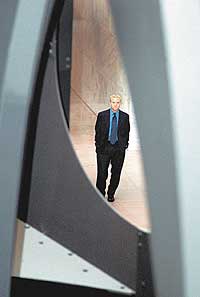
Systems tech Lynden Armstrong says senators need separate public and internal mail services.


Special requests


senator@feinstein.senate.gov

Spam? No thanks

www.senate.gov/~domenici/contactme/contactme.htm"


Keep it moving


NEXT STORY: Cosgrave departs IRS

X
This website uses cookies to enhance user experience and to analyze performance and traffic on our website. We also share information about your use of our site with our social media, advertising and analytics partners. Learn More / Do Not Sell My Personal Information
Accept Cookies
X
Cookie Preferences Cookie List

Do Not Sell My Personal Information

When you visit our website, we store cookies on your browser to collect information. The information collected might relate to you, your preferences or your device, and is mostly used to make the site work as you expect it to and to provide a more personalized web experience. However, you can choose not to allow certain types of cookies, which may impact your experience of the site and the services we are able to offer. Click on the different category headings to find out more and change our default settings according to your preference. You cannot opt-out of our First Party Strictly Necessary Cookies as they are deployed in order to ensure the proper functioning of our website (such as prompting the cookie banner and remembering your settings, to log into your account, to redirect you when you log out, etc.). For more information about the First and Third Party Cookies used please follow this link.

Allow All Cookies

Manage Consent Preferences

Strictly Necessary Cookies - Always Active

We do not allow you to opt-out of our certain cookies, as they are necessary to ensure the proper functioning of our website (such as prompting our cookie banner and remembering your privacy choices) and/or to monitor site performance. These cookies are not used in a way that constitutes a “sale” of your data under the CCPA. You can set your browser to block or alert you about these cookies, but some parts of the site will not work as intended if you do so. You can usually find these settings in the Options or Preferences menu of your browser. Visit www.allaboutcookies.org to learn more.

Sale of Personal Data, Targeting & Social Media Cookies

Under the California Consumer Privacy Act, you have the right to opt-out of the sale of your personal information to third parties. These cookies collect information for analytics and to personalize your experience with targeted ads. You may exercise your right to opt out of the sale of personal information by using this toggle switch. If you opt out we will not be able to offer you personalised ads and will not hand over your personal information to any third parties. Additionally, you may contact our legal department for further clarification about your rights as a California consumer by using this Exercise My Rights link

If you have enabled privacy controls on your browser (such as a plugin), we have to take that as a valid request to opt-out. Therefore we would not be able to track your activity through the web. This may affect our ability to personalize ads according to your preferences.

Targeting cookies may be set through our site by our advertising partners. They may be used by those companies to build a profile of your interests and show you relevant adverts on other sites. They do not store directly personal information, but are based on uniquely identifying your browser and internet device. If you do not allow these cookies, you will experience less targeted advertising.

Social media cookies are set by a range of social media services that we have added to the site to enable you to share our content with your friends and networks. They are capable of tracking your browser across other sites and building up a profile of your interests. This may impact the content and messages you see on other websites you visit. If you do not allow these cookies you may not be able to use or see these sharing tools.

If you want to opt out of all of our lead reports and lists, please submit a privacy request at our Do Not Sell page.

Save Settings
Cookie Preferences Cookie List

Cookie List

A cookie is a small piece of data (text file) that a website – when visited by a user – asks your browser to store on your device in order to remember information about you, such as your language preference or login information. Those cookies are set by us and called first-party cookies. We also use third-party cookies – which are cookies from a domain different than the domain of the website you are visiting – for our advertising and marketing efforts. More specifically, we use cookies and other tracking technologies for the following purposes:

Strictly Necessary Cookies

We do not allow you to opt-out of our certain cookies, as they are necessary to ensure the proper functioning of our website (such as prompting our cookie banner and remembering your privacy choices) and/or to monitor site performance. These cookies are not used in a way that constitutes a “sale” of your data under the CCPA. You can set your browser to block or alert you about these cookies, but some parts of the site will not work as intended if you do so. You can usually find these settings in the Options or Preferences menu of your browser. Visit www.allaboutcookies.org to learn more.

Functional Cookies

We do not allow you to opt-out of our certain cookies, as they are necessary to ensure the proper functioning of our website (such as prompting our cookie banner and remembering your privacy choices) and/or to monitor site performance. These cookies are not used in a way that constitutes a “sale” of your data under the CCPA. You can set your browser to block or alert you about these cookies, but some parts of the site will not work as intended if you do so. You can usually find these settings in the Options or Preferences menu of your browser. Visit www.allaboutcookies.org to learn more.

Performance Cookies

We do not allow you to opt-out of our certain cookies, as they are necessary to ensure the proper functioning of our website (such as prompting our cookie banner and remembering your privacy choices) and/or to monitor site performance. These cookies are not used in a way that constitutes a “sale” of your data under the CCPA. You can set your browser to block or alert you about these cookies, but some parts of the site will not work as intended if you do so. You can usually find these settings in the Options or Preferences menu of your browser. Visit www.allaboutcookies.org to learn more.

Sale of Personal Data

We also use cookies to personalize your experience on our websites, including by determining the most relevant content and advertisements to show you, and to monitor site traffic and performance, so that we may improve our websites and your experience. You may opt out of our use of such cookies (and the associated “sale” of your Personal Information) by using this toggle switch. You will still see some advertising, regardless of your selection. Because we do not track you across different devices, browsers and GEMG properties, your selection will take effect only on this browser, this device and this website.

Social Media Cookies

We also use cookies to personalize your experience on our websites, including by determining the most relevant content and advertisements to show you, and to monitor site traffic and performance, so that we may improve our websites and your experience. You may opt out of our use of such cookies (and the associated “sale” of your Personal Information) by using this toggle switch. You will still see some advertising, regardless of your selection. Because we do not track you across different devices, browsers and GEMG properties, your selection will take effect only on this browser, this device and this website.

Targeting Cookies

We also use cookies to personalize your experience on our websites, including by determining the most relevant content and advertisements to show you, and to monitor site traffic and performance, so that we may improve our websites and your experience. You may opt out of our use of such cookies (and the associated “sale” of your Personal Information) by using this toggle switch. You will still see some advertising, regardless of your selection. Because we do not track you across different devices, browsers and GEMG properties, your selection will take effect only on this browser, this device and this website.