
The Mint cashes in on its COINS project





Confident in the hand its systems team has dealt so far, the Mint is preparing to up the ante on its enterprise resource planning system.
| SPECIAL TO GCNConfident in the hand its systems team has dealt so far, the Mint is preparing to up the ante on its enterprise resource planning system.Already responsible for managing a ninefold revenue increase over the past three years, the Consolidated Information System this year will gain human resources and payroll modules. These new modules, to be implemented with COINS Version 2.5, will add to the ERP system's repertoire of administration, production management and marketing tools.In 1998, the Mint recorded a profit of $400 million. Last year, the Mint posted $3.6 billion in revenue and $2.6 billion in profit.COINS, one of the first federal ERP projects, consists of integrated systems for manufacturing, supply chain execution, financial management, plant and equipment maintenance, a mail-order system and customer database. Begun in 1998, the Mint chose a phased approach to COINS, implementing several applications at a time rather than all at once [].'Our point of view was that we needed to create a Fortune 500 company in the Mint,' deputy director John Mitchell said.align="right" width="160">The Mint has more than 2,800 employees, with branches in Denver; Philadelphia; San Francisco; West Point, N.Y.; Fort Knox, Ky.; and three locations in Washington. It is one of the few government agencies that not only provides services but also manufactures products'producing 16 billion to 20 billion circulating coins annually, as well as manufacturing and selling collectible coins, and safeguarding more than $1 billion in national assets.Until recently, however, the Mint had only a few independent automated systems. None was integrated, and the majority were not year 2000-ready.The limitations of systems and databases that could not communicate with each other, combined with manual processes that required rekeying or reformatting data, made reporting difficult. According to Mitchell, annual financial reporting took up to a year to close, and quarterly closeouts were released 90 days after the fact. Monthly closeouts were not even attempted.Conditions were little better on the service front. The measure of acceptable service until recently was to fill at least 50 percent of orders within eight weeks.'All of the barriers to efficiency were self-imposed. We were our own worst enemies,' Mitchell said. 'We knew that if we wanted to turn our 207-year-old government bureaucracy into a self-funded, customer-focused business, we needed to move our systems into the 21st century.'COINS replaced three mainframe systems entirely, primarily using software from PeopleSoft Inc. of Pleasanton, Calif. The PeopleSoft 7.5 ERP suite superseded two aging financial systems, and the Mail Order Cataloging System from Smith-Gardner & Associates Inc. of Delray Beach, Fla., took over from the homegrown Numismatic Coin Ordering System.Linked to both the ERP suite and the mail-order system, COINS has two other elements: a customer database management tool, Marketing Customer Service Reinvention, developed in-house for the Mint by DiaLogos Inc. of Boston; and Maximo, a plant maintenance and equipment optimization scheduling system from PSDI of Bedford, Mass. Litton PRC acted as the systems integrator.The COINS project evolved in several stages. COINS-1 gave the Mint its first automated ERP system, encompassing all facilities, focusing on manufacturing, financials, and sales and distribution functions. It went live in October 1998, taking 12 months to implement. Mitchell attributes the fast pace to a preference for off-the-shelf products that required minimal customization.COINS-1 moved the Mint from an early-1980s mainframe environment to Sun Microsystems Inc. servers running SunSoft Solaris, an Oracle database and PeopleSoft ERP. End-users tap the system from 1,800 PCs running Microsoft Windows NT and 98. An upgrade to Windows 2000 is scheduled this year.align="right" width="110">'Before, we had very little prediction'it was like managing through a rearview mirror,' said Mitchell. 'Now we can see our costs, price points, where profits are and drill down through to over 400 product lines to see the details.'The ERP backbone also provided the information-sharing platform the Mint needed to build a Web site that has grown into one of the top 20 in the country. The site, at , generated $156 million for fiscal 2000.'Any user who needs access to decision-support data can get it from a unified database,' Mitchell said. 'On the financial side, we've cut our closing time from 45 to 60 days to one day, and we can get products out much faster.'COINS-1 provided vast improvements in reporting and an enhanced ability to project the need for raw materials with accuracy, as well as a more streamlined manufacturing system.'Change is not a big enough word to describe what the Mint has gone through,' said Augie MacCurrach, director of data engineering at DiaLogos. 'They're becoming customer- and market-driven, can analyze how well their executed programs are doing in comparison with their planned programs and do campaign management.'According to Mitchell, the complete cost for the first phase of the system was $40 million, with a projected return on investment of $80 million.To improve the reporting capabilities available in COINS-1, Version 2 implementation began in June. COINS-2 adds an automated data capture system from HighJump Software of Eden Prairie, Minn., to enhance and simplify data collection, and minimize manual data entry. Version 2 upgraded each item of COINS-1 to keep the software current.The designing, coding and testing for COINS-2 was recently completed.'We are now in change management and training phase,' Mitchell said. 'We are giving the employees the opportunity to learn the system.'The Version 2.5 rollout is part of a Treasury Department-wide effort to standardize HR and payroll services. The Bureau of Alcohol, Tobacco and Firearms, and the IRS are already live. By December of this year, the Mint will join them. In the interim, the Mint is piloting the PeopleSoft payroll system for Treasury.'We staged it like this to make it a smooth transition and to take our time with the modules we were unfamiliar with,' Mitchell said.The ERP system played a major part in the Mint's expansion, but it is far from the only element. Management and legislative changes have reshaped the agency in recent years.'There have been about 15 bills passed in the last seven years that helped us reach this stage and become self-funding and compete more like a private-sector business,' Mitchell said.From the management perspective, new programs such as the issuance of state quarters and aggressive promotion within the collector community have served to boost Mint revenues. Millions of Americans are actively collecting quarters, with more than one-third of collectors amassing 25 or more quarters from each state.As a result, sales of quarters surged from $1 billion to $6 billion in a year, Mint officials said.Because of improved customer service and increased sales, John Kamensky, the deputy director of the National Partnership for Reinventing Government, in August presented Vice President Gore's Hammer Award to a 66-member COINS team for developing the system and setting a new standard for management practices and infrastructure.
BY DREW ROBB
GCN, June 19, 2000, Page 1
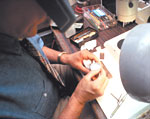
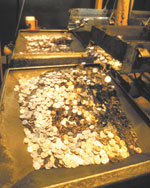
size="2" color="#FF0000">Mint sculptor and engraver Al Maletsky, top, designs coins at his work bench. meanwhile, new dimes await counting and bagging.
Separate data processing

size="2" color="#FF0000">"We knew that if we wanted to run our 207-year-old government bureaucracy into a self-funded, customer-focues business, we needed to move our systems into the 21st century.
size="1" color="#FF0000">-Deputy Director John Mitchell
www.usmint.gov
Pinpointing needs
GCN, June 19, 2000, Page 1
size="2" color="#FF0000">Mint sculptor and engraver Al Maletsky, top, designs coins at his work bench. meanwhile, new dimes await counting and bagging.
Separate data processing
size="2" color="#FF0000">"We knew that if we wanted to run our 207-year-old government bureaucracy into a self-funded, customer-focues business, we needed to move our systems into the 21st century.
size="1" color="#FF0000">-Deputy Director John Mitchell
www.usmint.gov
Pinpointing needs
NEXT STORY: State uses incentives to rebuild IT staff