On the trail of cybersmugglers

Federal agents helped rout an alleged Internet child pornography ring last month when four suspects in the United States and five in Russia were arrested.

| GCN STAFFFederal agents helped rout an alleged Internet child pornography ring last month when four suspects in the United States and five in Russia were arrested.For the Customs Service's CyberSmuggling Center in Fairfax, Va., the investigation, dubbed Operation Blue Orchid, was just another case cleared.Last May, Moscow police requested the assistance of the U.S. Customs attach' to investigate individuals running a Web site, hosted at , that distributed pornographic videos of children.The Customs attach' contacted the center, which conducted an undercover purchase of a video, resulting in the arrests and closure of the site.Battling child pornography on the Net is just one of the center's jobs.Envisioned in 1997 and dedicated in 2000, the CyberSmuggling Center fights crime via the Internet, including money laundering, drug trafficking, intellectual property theft and illegal arms trading.'We have not found any new crimes as a result of the Internet,' center director Kevin Delli-Colli said. Criminals 'are just finding new ways to commit old crimes.'Customs first came across computers being used for child pornography in 1989 by monitoring online bulletin boards. But the advent of the Web intensified the problem.The CyberSmuggling Center was Customs' answer to keep pace, and child pornography remains the center's main focus.It has partnered with the National Center for Missing and Exploited Children in Alexandria, Va., which operates a toll-free hotline through which people can pass on information about child porn on the Internet. The tips are made available daily to law enforcement agencies, specifically Customs, the FBI and the Postal Service.The CyberSmuggling Center has an annual budget of $4 million and 37 employees, including agents and criminal investigators, some with training in computer forensics.'Any time you have an Internet-related crime, you have computers at both ends, and you need people who can examine that for evidential purposes,' Delli-Colli said.Besides the director, there are three assistant directors who head the Child Exploitation, Computer Forensic and Cybercrimes units.The Computer Forensic Unit examines computers used in other crimes and trains field agents. It also works with the Bureau of Alcohol, Tobacco and Firearms, IRS and Secret Service to standardize forensic software, methods and training techniques.The training, called the Computer Investigative Specialist Program, involves two weeks of studying major PC operating systems and hardware components through a Computer Technology Industry Association certification program. Examiners also take two and a half weeks of advanced computer evidence recovery training, targeting network OSes.The agents use souped-up PCs they've dubbed forensic media analysis desktops to conduct laboratory-like examinations in the office. The PCs are customized for the center.'To go out and buy a computer that just has our needs and our forensic tools is somewhat different from a standard commercial box,' said James Thomas, a Customs senior special agent. 'We want swappability of hard drives and components. We'll take this drive out and put another one in. We use different operating systems.'To build these systems, Customs hired Skytech Inc. of Alexandria, Va. The 800-MHz Pentium III PCs can support as many as seven hard drives and run Microsoft Windows 98, Windows 2000 or Linux, Skytech president Cat Crosby said.'They are made in such a way that the agents can hook up any hardware device to the desktop PCs,' she said.The computers are designed to extract data from any media: hard drives, floppy disks, tapes, magneto-optical disks, CD-ROMs, CD-RWs, DVDs, flash disks, and Zip and Jaz drives. The PCs also are equipped with specialized software for field exams of suspects' computers.Forensic tools for the preservation, recovery and analysis of digital evidence include SafeBack from New Technologies Inc. of Gresham, Ore.; EnCase from Guidance Software of Pasadena, Calif.; and Norton Utilities from Symantec Corp. of Cupertino, Calif.Agents will soon be able to access a dedicated server via a virtual private network. The server will host a Web site that lets agents communicate, get technical support and download upgrades to their field software.Because the Internet is boundless, agents sometimes find themselves working outside of their jurisdictions.'On the Internet, you don't know where your criminal is,' Delli-Colli said. 'It could be someone across the street or [across] the country.'Usually, law enforcement agencies assign agents to a case depending on the jurisdiction or area in which the case falls, he said. But often, cooperation from other countries becomes critical.According to Thomas, laws in the United States have not caught up with technology. 'All laws refer back to documentary evidence,' he said. 'Some of them do not apply to the digital evidence.'Once assigned to a case, the agents find the computer that was used in the crime and make forensic images of the machine's guts.'Forensics image is the bit-by-bit transfer of the machine, and then with the image we try and find the information that is relative to the offense,' Thomas said.The trouble is that some judicial districts have not agreed on whether original evidence or its exact image is the best evidence, he said.
Customs center hunts criminals on the Internet

BY PREETI VASISHTHA


'To go out and buy a computer that just has our needs and our forensic tools is somewhat different from a standard commercial box,' says James Thomas, senior special agent at the Customs Service's CyberSmuggling Center.
www.geocities.com


Cyber skill set


Tech cramming


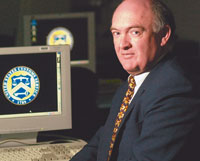
'We have not found any new crimes as a result of the Internet,' says Kevin Delli-Colli, director of Customs' CyberSmuggling Center. Criminals 'are just finding new ways to commit old crimes.'


X
This website uses cookies to enhance user experience and to analyze performance and traffic on our website. We also share information about your use of our site with our social media, advertising and analytics partners. Learn More / Do Not Sell My Personal Information
Accept Cookies
X
Cookie Preferences Cookie List

Do Not Sell My Personal Information

When you visit our website, we store cookies on your browser to collect information. The information collected might relate to you, your preferences or your device, and is mostly used to make the site work as you expect it to and to provide a more personalized web experience. However, you can choose not to allow certain types of cookies, which may impact your experience of the site and the services we are able to offer. Click on the different category headings to find out more and change our default settings according to your preference. You cannot opt-out of our First Party Strictly Necessary Cookies as they are deployed in order to ensure the proper functioning of our website (such as prompting the cookie banner and remembering your settings, to log into your account, to redirect you when you log out, etc.). For more information about the First and Third Party Cookies used please follow this link.

Allow All Cookies

Manage Consent Preferences

Strictly Necessary Cookies - Always Active

We do not allow you to opt-out of our certain cookies, as they are necessary to ensure the proper functioning of our website (such as prompting our cookie banner and remembering your privacy choices) and/or to monitor site performance. These cookies are not used in a way that constitutes a “sale” of your data under the CCPA. You can set your browser to block or alert you about these cookies, but some parts of the site will not work as intended if you do so. You can usually find these settings in the Options or Preferences menu of your browser. Visit www.allaboutcookies.org to learn more.

Sale of Personal Data, Targeting & Social Media Cookies

Under the California Consumer Privacy Act, you have the right to opt-out of the sale of your personal information to third parties. These cookies collect information for analytics and to personalize your experience with targeted ads. You may exercise your right to opt out of the sale of personal information by using this toggle switch. If you opt out we will not be able to offer you personalised ads and will not hand over your personal information to any third parties. Additionally, you may contact our legal department for further clarification about your rights as a California consumer by using this Exercise My Rights link

If you have enabled privacy controls on your browser (such as a plugin), we have to take that as a valid request to opt-out. Therefore we would not be able to track your activity through the web. This may affect our ability to personalize ads according to your preferences.

Targeting cookies may be set through our site by our advertising partners. They may be used by those companies to build a profile of your interests and show you relevant adverts on other sites. They do not store directly personal information, but are based on uniquely identifying your browser and internet device. If you do not allow these cookies, you will experience less targeted advertising.

Social media cookies are set by a range of social media services that we have added to the site to enable you to share our content with your friends and networks. They are capable of tracking your browser across other sites and building up a profile of your interests. This may impact the content and messages you see on other websites you visit. If you do not allow these cookies you may not be able to use or see these sharing tools.

If you want to opt out of all of our lead reports and lists, please submit a privacy request at our Do Not Sell page.

Save Settings
Cookie Preferences Cookie List

Cookie List

A cookie is a small piece of data (text file) that a website – when visited by a user – asks your browser to store on your device in order to remember information about you, such as your language preference or login information. Those cookies are set by us and called first-party cookies. We also use third-party cookies – which are cookies from a domain different than the domain of the website you are visiting – for our advertising and marketing efforts. More specifically, we use cookies and other tracking technologies for the following purposes:

Strictly Necessary Cookies

We do not allow you to opt-out of our certain cookies, as they are necessary to ensure the proper functioning of our website (such as prompting our cookie banner and remembering your privacy choices) and/or to monitor site performance. These cookies are not used in a way that constitutes a “sale” of your data under the CCPA. You can set your browser to block or alert you about these cookies, but some parts of the site will not work as intended if you do so. You can usually find these settings in the Options or Preferences menu of your browser. Visit www.allaboutcookies.org to learn more.

Functional Cookies

We do not allow you to opt-out of our certain cookies, as they are necessary to ensure the proper functioning of our website (such as prompting our cookie banner and remembering your privacy choices) and/or to monitor site performance. These cookies are not used in a way that constitutes a “sale” of your data under the CCPA. You can set your browser to block or alert you about these cookies, but some parts of the site will not work as intended if you do so. You can usually find these settings in the Options or Preferences menu of your browser. Visit www.allaboutcookies.org to learn more.

Performance Cookies

We do not allow you to opt-out of our certain cookies, as they are necessary to ensure the proper functioning of our website (such as prompting our cookie banner and remembering your privacy choices) and/or to monitor site performance. These cookies are not used in a way that constitutes a “sale” of your data under the CCPA. You can set your browser to block or alert you about these cookies, but some parts of the site will not work as intended if you do so. You can usually find these settings in the Options or Preferences menu of your browser. Visit www.allaboutcookies.org to learn more.

Sale of Personal Data

We also use cookies to personalize your experience on our websites, including by determining the most relevant content and advertisements to show you, and to monitor site traffic and performance, so that we may improve our websites and your experience. You may opt out of our use of such cookies (and the associated “sale” of your Personal Information) by using this toggle switch. You will still see some advertising, regardless of your selection. Because we do not track you across different devices, browsers and GEMG properties, your selection will take effect only on this browser, this device and this website.

Social Media Cookies

We also use cookies to personalize your experience on our websites, including by determining the most relevant content and advertisements to show you, and to monitor site traffic and performance, so that we may improve our websites and your experience. You may opt out of our use of such cookies (and the associated “sale” of your Personal Information) by using this toggle switch. You will still see some advertising, regardless of your selection. Because we do not track you across different devices, browsers and GEMG properties, your selection will take effect only on this browser, this device and this website.

Targeting Cookies

We also use cookies to personalize your experience on our websites, including by determining the most relevant content and advertisements to show you, and to monitor site traffic and performance, so that we may improve our websites and your experience. You may opt out of our use of such cookies (and the associated “sale” of your Personal Information) by using this toggle switch. You will still see some advertising, regardless of your selection. Because we do not track you across different devices, browsers and GEMG properties, your selection will take effect only on this browser, this device and this website.