The road warrior's beltful of computer devices is headed into history. The two most popular portables, the cell phone and the personal digital assistant, have been merging for the last couple of years.In this review, the GCN Lab tested six devices that have already merged. It's easy to tell what their developers started from'some devices are basically PDAs with wireless calling added, whereas others are phones with PDA functions thrown in.[IMGCAP(2)] We tested each PDA-phone for ease of use, price, reliability and extra features such as Web access. We also considered battery life, robustness and reliability of the wireless service provided with each test phone. That's a big consideration in places with lots of hills and tall buildings, such as the Washington area where we tested.According to the Reuters news service, Britain's Society for Psychical Research has announced that cell phones operate on the same frequency as paranormal activity. The society believes that wireless signals keep ghosts away.The opposite seems to hold true in Washington. Ghosts might be the only explanation for the many spotty or dead signal areas we found here.The Sony Ericsson T68i combined good features of phones and PDAs but was more like a phone with easy-to-use PDA elements added. A tiny joystick above the dial pad moved the selection cursor around the screen.Without reading the instructions, several volunteers could use most of the functions immediately, and they found the joystick accurate for paging through menus. The joystick also could be depressed as a selection button.Sony obviously had a big influence over the design because earlier Ericsson phones were boxy and low on features. The T68i's color screen was high quality, though photos appeared a bit fuzzy even at maximum resolution. But color in menus and icons made selections easier.The test unit had VoiceStream'now T-Mobile'wireless service. Of the various services we tested, it was far and away the best in the Washington area. There were almost no dropped calls when roaming, and no problems in outlying areas. We did find a few dead zones, but where other providers had no signal at all, T-Mobile could eke out a bar. Connected calls sounded clear and static-free about 98 percent of the time.[IMGCAP(3)] Only the Samsung SPH-A460 was more compact than the lightweight little T68i, which fit into the palm of a hand. New users might worry that because the phone barely covered an ear, they were talking into space. But the directive microphone did a good job of capturing voices except in loud backgrounds.The T68i did not have full PDA features. It could store contacts and a schedule and make short voice recordings, but it lacked basic word processing or handwriting recognition.There were some interesting extras, however. An optional tiny CommuniCam camera snapped onto the base, drawing power from the phone battery. The camera had its own memory, which could store 14 high-resolution photos or about 200 low-res ones that looked pretty bad. The high-res ones were passable and could be e-mailed right from the phone as attachments.The Motorola A388 was the most practical PDA-phone we've come across in the lab. The clamshell design weighed only 4.6 ounces and measured a mere 3.8 by 2.2 by 0.9 inches. It had the longest standby battery life in the review: six days. We measured four hours of talk time.The A388 worked on all three Global Standard for Mobile (GSM) frequencies, 900 MHz, 1,800 MHz and 1,900 MHz, making it ideal for someone who travels the world. Different subscriber identity modules would have to be inserted to match the destinations.Nextel e-mail, enhanced messaging and short messaging services were included. At $479, the phone was a bit on the high side but worth it for simple PDA functions combined with worldwide calling ability.[IMGCAP(4)]Poor handwriting recognition software and a meager 2M of memory were the only drawbacks we found to Motorola's A388.The Samsung SPH-A460 had the best design: a silver flip-phone complete with external clock, signal strength meter and battery life indicator.With the phone flipped open, the monochrome screen looked crisp and easy to read. Buttons were color-coded and lit up. Most were blue, whereas the talk button was green and the end button red. A circular directional pad made for easy menu navigation.The inside of the phone looked great, but the half-circle buttons on a nearly flat surface were difficult to distinguish by touch. Dialing accuracy with strings of numbers was poor'it was too easy to slip from one number to the next, or to apply too much pressure and hit several adjacent buttons.Like the T68i, the SPH-A460 was a phone first and a PDA second. It had basic calendar functions and rudimentary games with some of the most amazing sounds we have ever heard on a phone. For example, it could play John Philip Sousa's 'Stars and Stripes Forever' as a ring signal. Most songs sounded like good Musical Instrument Digital Interface files.The Sprint wireless service had its good and bad days. Sometimes we could put through perfect calls when other phones could not, such as on a ferry between Leesburg, Va., and Poolesville, Md. But inside Washington, completing a five-minute conversation took up to four calls because of service cutouts.The Motorola i95cl was the 256-color color version of the i90c, which earned good marks in a recent review. The new display and Java 3-D animation engine drastically shortened battery life, however.We had to charge the phone an average of twice a day. On the plus side, the buttons were easy to use, and navigation remained the same as in the earlier version.For $400, the i95cl was a little pricey. Its Nextel service seemed excellent in Washington but chancy outside it. Within the city we experienced no dropped calls out of 20 during peak hours, but many calls dropped out on Maryland's Eastern Shore.[IMGCAP(5)]We judged the i95cl, like the Nextel service, average. Despite new capability to send and receive pictures, we did not consider the color screen worth the cost in battery life.The Samsung SPH-I300 was the most PDA-like device in the review. Except for an antenna, the SPH-1300 looked like a color Palm OS device. Palm users would have an easy time adjusting to the controls, and anything that could be synchronized with a Palm device would work on the SPH-I300.The Sprint service had the same advantages and disadvantages discussed above. The SPH-I300's color screen served as the dial pad, by either finger touches or stylus. Placing a call was surprisingly easy.Short battery life was aggravated by the difficulty of telling whether the phone was turned off, even after we held down the button and the screen went completely dark. That led to some unexpected low-power warnings.A second problem was lack of integrated screen protection. You can buy a leather case for about $35, but a $500 device with a fragile, three-inch sheet of exposed glass should not be sold without even a belt clip. Carry this device in a briefcase, pocket or your hand.The Nokia 9290 Communicator was by far the most intriguing PDA-phone in the roundup'for engineers. With more than a dozen navigation buttons and soft keys, the Nokia was quite a handful to learn. Its 322-page user guide read like a flight manual and did not always correspond with actual functions.The phone was in fact more like a notebook computer than a PDA. The cover opened up to a large color LCD and a full, though minuscule, keyboard capable of handling wireless e-mail, Web browsing, and organizer and calculator functions.[IMGCAP(6)]It took us a while to figure out that once we created a document, we could only open it again through the file manager and not the office application that created it.Typing was a challenge because the small keys were so sensitive and close together. One tester could press the buttons accurately only by using a pencil eraser tip.Surprisingly, the biggest challenge with using the Communicator was talking on the phone. The voice mike and earpiece were on the back of the case, far from the dial pad and LCD. Checking voice mail, for example, required turning the phone around to the back to listen, then turning it to the front again to push the required button, and so on. Our testers soon resorted to opening up the PDA and using the speakerphone, which was functional but sounded rather tinny at the other end.With the Communicator's T-Mobile service, we lost three out of 20 calls'more than with T-Mobile and the Sony Ericsson phone above.The $600 device had a useful voice recorder and surprisingly long battery life: eight hours' talk time and nine hours' standby. That's not bad considering that the 640- by 200-pixel color screen could display thousands of colors.Web scraping features were also good, and we could easily download news or weather. But the bulky, 8.6-ounce unit wasn't suited to carrying in a pocket or on a belt.
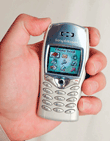
The top-ranked Sony Ericsson T68i fit into a palm and had easy-to-use, colorful navigation functions.
Henrik G. DeGyor
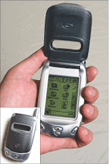
The Motorola A388 had a robust design and the longest standby time in the review.
Henrik G. DeGyor
Motorola has given the i95cl a color screen, but that feature comes at a substantial cost in battery life.
Henrik G. DeGyor
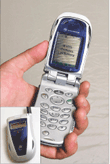
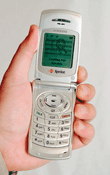
The Samsung SPH-A460's design was judged the best in the review, but dialing it seemed difficult with almost-flat buttons. Overall, testers found the devices handy but subject to environmental factors that made some connections spotty.
Henrik G. DeGyor
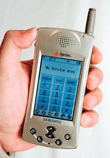
The PDA-like Samsung SPH-I300 was inclined to stay turned on when testers thought it was off.
Henrik G. DeGyor
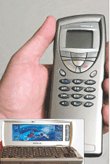
Several users found the Nokia 9290 Communicator's voice functions workable only by speakerphone.