Tag Team: Materiel tracking system supports military

In the first Gulf War, the Army's approach to logistics could perhaps best be described as brute-force.

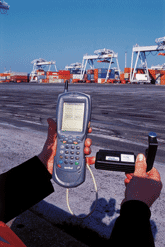
In the first Gulf War, the Army's approach to logistics could perhaps best be described as brute-force.'In 1991, there were thousands of cargo containers flooding the ports of Southwest Asia,' said Ann F. Scotti, manager of the Army's Product Manager-Automatic Identification Technology office.Because of the difficulty of matching paper manifests with shipping containers, tens of thousands of containers had to be opened to find out what they held, and a lot of time and materiel was wasted. According to the General Accounting Office, $2.7 billion worth of spare parts shipped to the Gulf theater in 1991 went unused.To prevent a recurrence, the Defense Department developed a worldwide radio-frequency ID network to track tagged cargo from its origin through the transportation system to its final destination, Scotti said.The Army began moving toward just-in-time logistics in the summer of 2002, when Central Command chief Gen. Tommy Franks ordered RFID tags on all materiel shipments to troops in Afghanistan.The policy grew in January to require tags on shipments for all future military operations, including the war in Iraq.Through the In-Transit Visibility network, the Army used the RFID tags during the Iraq war to track everything from boots to bullets, so that supplies could reach the field when and where they were needed.[IMGCAP(2)] Scotti's office set out in 1995 to be the Defense Department's executive agent for automatic identification technology. The office formed from the merger of the Army's Logistics Applications in Marking and Reading Symbols and the Microcircuit Technology in Logistics Applications programs. PM-AIT takes its marching orders from the Army deputy chief of staff for logistics.Units deployed in Iraq this year got Mobile RFID Flyaway Kits, also called Early Entry Deployment Support Kits, to support the last tactical mile of the in-transit network. They contained portable and handheld interrogators to read RFID tags, satellite antennas and phones for network connections, solar panels to generate power and other equipment to track supplies in real time.Prior to the war, ITV was in use primarily by the Army, with some use by the Marine Corps. It now covers all of DOD logistics in Iraq, and 'we are anticipating that it will become more of a joint requirement,' Scotti said.The British army also used the system in Iraq.In March 2001, the ITV network read 3,148 tags. That climbed to 28,000 one year later and jumped to more than 2 million in March.During that time the cost of the tags, manufactured by Savi Technology Inc. of Sunnyvale, Calif., has fallen from $149 each to $99.'The building block of the technology is the tag,' said Vic Verma, Savi's chief executive officer. 'The whole intent is to make it user-friendly for soldiers in the field. If you get a lot of containers in the middle of the desert with limited computer resources and no infrastructure, the ability to find a specific container can be life or death.'[IMGCAP(3)] PM-AIT's job was to identify and incorporate commercial products to improve DOD logistics management. Besides RFID tags, technologies in use include bar codes, smart cards, and magnetic stripe and optical memory cards. Because the radio tags can be read remotely and their data sent automatically to a database to track progress, ITV gives end-to-end visibility from factory to fox hole.'There is really only one contractor who manufactures the tags,' Scotti said.Savi received a contract in August 1997 to provide transponder tags; fixed, portable and handheld readers; and associated hardware, software and support for ITV. The company was awarded a second, similar contract in February.The tracking begins with a battery-powered tag that is fixed to a shipping container, pallet or individual item for shipment. The tag can hold from 96 bits to 128K of data depending on its size and intended use. Identifying data is written to the tag when it is placed on a shipment. The tag also can link to more extensive information in a central database.When queried by a reader, the tag broadcasts its identity at 433 MHz. Fixed readers have been placed in ports, depots and other 'choke points' in the transportation chain to track items. Portable readers can check goods as they come in at their destinations. And handheld readers can locate specific containers at receiving areas and in the field. The handheld devices have a range of about 100 feet and can search for specific containers or scan all containers within range.'They are tied in with some sophisticated software to predict where each container is and when it will reach its destination,' Verma said.About 750 sites in 40 countries have permanent readers, including major air and sea ports and military depots.When a tag is read, information about its contents is retrievable from a database, and information about the container's location returns to the database. Regional ITV servers in Germany, South Korea and Southwest Asia forward data to the national ITV server in Reston, Va. Its data is forwarded to the Global Transportation Network, which supports the Army and Joint Total Asset Visibility databases.Verma said the off-the-shelf technology of the Army's ITV also is in use by the private sector. The system has some unique challenges, however. Unlike commercial organizations, which can entrust a shipment to one carrier end-to-end, the military must ship its supplies through myriad hands. And shipments' destinations can become moving targets when recipients are on the move.One of the biggest challenges is working in remote areas with little infrastructure.That's where solar generators and satellite links come in. 'If we have stable power and communications, it works fine,' Scotti said.
Project at a glance

Who: Army Product Manager'Automatic Identification Technology


Mission: To improve tracking and management of materiel in transit


What was: Paper manifests and vaguely marked shipments, which often resulted in materiel being lost or unclaimed


What is: Radio-frequency ID tags locate and identify shipments; readers can be set to scan a range of shipments to find specific items.


Users: All DOD personnel in the Iraq and Afghanistan theaters of operations


Impact: Allows just-in-time logistics by ensuring shipments are received when and where needed.
Duration: In-Transit Visibility deployment began in 1997.


Cost: Most recent contract to Savi Technology for equipment and support was $90 million for five years.

The RFID tags, bar codes and cards used in ITV can be read remotely and their data sent automatically to a database to track progress.

Courtesy of SAV Technology

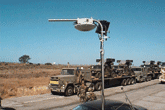
By reading radio tags remotely and sending data to a database automatically, ITV lets logistics officials keep close track of far-flung shipments.

Courtesy of SAV Technology

The Army's Ann Scotti says she expects that ITV will become a joint requirement.

Henrik G. de Gyor


One tag worth 1,000 words


X
This website uses cookies to enhance user experience and to analyze performance and traffic on our website. We also share information about your use of our site with our social media, advertising and analytics partners. Learn More / Do Not Sell My Personal Information
Accept Cookies
X
Cookie Preferences Cookie List

Do Not Sell My Personal Information

When you visit our website, we store cookies on your browser to collect information. The information collected might relate to you, your preferences or your device, and is mostly used to make the site work as you expect it to and to provide a more personalized web experience. However, you can choose not to allow certain types of cookies, which may impact your experience of the site and the services we are able to offer. Click on the different category headings to find out more and change our default settings according to your preference. You cannot opt-out of our First Party Strictly Necessary Cookies as they are deployed in order to ensure the proper functioning of our website (such as prompting the cookie banner and remembering your settings, to log into your account, to redirect you when you log out, etc.). For more information about the First and Third Party Cookies used please follow this link.

Allow All Cookies

Manage Consent Preferences

Strictly Necessary Cookies - Always Active

We do not allow you to opt-out of our certain cookies, as they are necessary to ensure the proper functioning of our website (such as prompting our cookie banner and remembering your privacy choices) and/or to monitor site performance. These cookies are not used in a way that constitutes a “sale” of your data under the CCPA. You can set your browser to block or alert you about these cookies, but some parts of the site will not work as intended if you do so. You can usually find these settings in the Options or Preferences menu of your browser. Visit www.allaboutcookies.org to learn more.

Sale of Personal Data, Targeting & Social Media Cookies

Under the California Consumer Privacy Act, you have the right to opt-out of the sale of your personal information to third parties. These cookies collect information for analytics and to personalize your experience with targeted ads. You may exercise your right to opt out of the sale of personal information by using this toggle switch. If you opt out we will not be able to offer you personalised ads and will not hand over your personal information to any third parties. Additionally, you may contact our legal department for further clarification about your rights as a California consumer by using this Exercise My Rights link

If you have enabled privacy controls on your browser (such as a plugin), we have to take that as a valid request to opt-out. Therefore we would not be able to track your activity through the web. This may affect our ability to personalize ads according to your preferences.

Targeting cookies may be set through our site by our advertising partners. They may be used by those companies to build a profile of your interests and show you relevant adverts on other sites. They do not store directly personal information, but are based on uniquely identifying your browser and internet device. If you do not allow these cookies, you will experience less targeted advertising.

Social media cookies are set by a range of social media services that we have added to the site to enable you to share our content with your friends and networks. They are capable of tracking your browser across other sites and building up a profile of your interests. This may impact the content and messages you see on other websites you visit. If you do not allow these cookies you may not be able to use or see these sharing tools.

If you want to opt out of all of our lead reports and lists, please submit a privacy request at our Do Not Sell page.

Save Settings
Cookie Preferences Cookie List

Cookie List

A cookie is a small piece of data (text file) that a website – when visited by a user – asks your browser to store on your device in order to remember information about you, such as your language preference or login information. Those cookies are set by us and called first-party cookies. We also use third-party cookies – which are cookies from a domain different than the domain of the website you are visiting – for our advertising and marketing efforts. More specifically, we use cookies and other tracking technologies for the following purposes:

Strictly Necessary Cookies

We do not allow you to opt-out of our certain cookies, as they are necessary to ensure the proper functioning of our website (such as prompting our cookie banner and remembering your privacy choices) and/or to monitor site performance. These cookies are not used in a way that constitutes a “sale” of your data under the CCPA. You can set your browser to block or alert you about these cookies, but some parts of the site will not work as intended if you do so. You can usually find these settings in the Options or Preferences menu of your browser. Visit www.allaboutcookies.org to learn more.

Functional Cookies

We do not allow you to opt-out of our certain cookies, as they are necessary to ensure the proper functioning of our website (such as prompting our cookie banner and remembering your privacy choices) and/or to monitor site performance. These cookies are not used in a way that constitutes a “sale” of your data under the CCPA. You can set your browser to block or alert you about these cookies, but some parts of the site will not work as intended if you do so. You can usually find these settings in the Options or Preferences menu of your browser. Visit www.allaboutcookies.org to learn more.

Performance Cookies

We do not allow you to opt-out of our certain cookies, as they are necessary to ensure the proper functioning of our website (such as prompting our cookie banner and remembering your privacy choices) and/or to monitor site performance. These cookies are not used in a way that constitutes a “sale” of your data under the CCPA. You can set your browser to block or alert you about these cookies, but some parts of the site will not work as intended if you do so. You can usually find these settings in the Options or Preferences menu of your browser. Visit www.allaboutcookies.org to learn more.

Sale of Personal Data

We also use cookies to personalize your experience on our websites, including by determining the most relevant content and advertisements to show you, and to monitor site traffic and performance, so that we may improve our websites and your experience. You may opt out of our use of such cookies (and the associated “sale” of your Personal Information) by using this toggle switch. You will still see some advertising, regardless of your selection. Because we do not track you across different devices, browsers and GEMG properties, your selection will take effect only on this browser, this device and this website.

Social Media Cookies

We also use cookies to personalize your experience on our websites, including by determining the most relevant content and advertisements to show you, and to monitor site traffic and performance, so that we may improve our websites and your experience. You may opt out of our use of such cookies (and the associated “sale” of your Personal Information) by using this toggle switch. You will still see some advertising, regardless of your selection. Because we do not track you across different devices, browsers and GEMG properties, your selection will take effect only on this browser, this device and this website.

Targeting Cookies

We also use cookies to personalize your experience on our websites, including by determining the most relevant content and advertisements to show you, and to monitor site traffic and performance, so that we may improve our websites and your experience. You may opt out of our use of such cookies (and the associated “sale” of your Personal Information) by using this toggle switch. You will still see some advertising, regardless of your selection. Because we do not track you across different devices, browsers and GEMG properties, your selection will take effect only on this browser, this device and this website.