State lawmakers call for stronger digital identity, data privacy frameworks
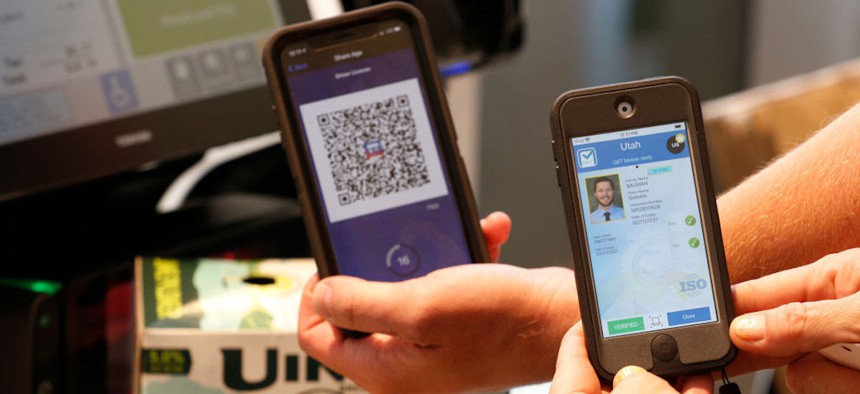
A Harmons Grocery Store employee does a demonstration as she scans a QR Code (R) from a customers phone (L) to verify his age on a beer purchase at a Harmons Grocery store on Aug. 4, 2021, in Salt Lake City. Utah is the first state in the nation to start to convert and offer digital driver licenses on mobile devices

A Harmons Grocery Store employee does a demonstration as she scans a QR Code (R) from a customers phone (L) to verify his age on a beer purchase at a Harmons Grocery store on Aug. 4, 2021, in Salt Lake City. Utah is the first state in the nation to start to convert and offer digital driver licenses on mobile devices George Frey via Getty Images

Utah and Colorado are exploring two initiatives that could serve as north stars for other lawmakers looking to expand their digital or mobile identification programs.

Digital identification programs have proliferated across the states in recent years, and a recent panel of state lawmakers said they are keen to establish foundational identification and privacy guardrails as digital credentials become more commonplace. 

For state lawmakers looking to stay abreast of evolving tech trends to better serve their residents, “the question is not, ‘Will you be a part of a digital identity program?’” said Utah Rep. Paul Cutler, speaking during a panel session at the National Conference of State Legislatures 2026 Legislative Summit in Chicago last week. 

“The question is, ‘What type will it be, and what are the policy decisions that we need to make as we go down these roads?” he said. 

“We should be viewing digital identity and the things that underpin it as infrastructure — more importantly — as critical infrastructure akin to utilities [like] electricity and water, because they are so important for the continuity of what is the American existence, especially in a growing digital economy,” said Jordan Burris, vice president and head of public sector at Socure, a digital identity and verification company. 

Inside Colorado’s expansion of digital identity programs

Colorado is developing a new digital identity management program that is slated to launch by the end of the year, Sarah Tuneberg, chief information officer and executive director of the Colorado Office of Information Technology, said during the panel. 

The state’s “data backpack” framework will serve as a “more user-centered, more privacy-prepared version of document storage,” she explained. The initiative also builds upon the state’s broader digital identity strategy, which is driven by a “state-owned” mindset that puts data security and government efficiency at the forefront, she said. 

The data backpack will be a centralized profile through which Colorado residents can upload and securely store documents like income verification forms, public assistance applications and other personal information across state services. The framework can help reduce duplicative or erroneous data inputs and state costs to verify resident information, Tuneberg said.  

“When [residents are] applying for benefits, we're asking people for the same pieces of information sometimes 12, 15 [or] 25 times,” she told Route Fifty in an interview. “If we can create a secure place where they can store them and then enable them to share it much more easily … then it reduces the [administrative] friction. It also reduces the error rate for things like [the Supplemental Nutrition Assistance Program] because we can verify a credential, like income, and residents can store it and share it with the people they need to.” 

Such privacy measures are increasingly pertinent without a federal framework, particularly as states face mounting pressure to share sensitive resident information, such as voter rolls or driver’s license data, with the Trump administration, Tuneberg told Route Fifty

Utah’s national digital identity and data privacy approach 

“The demand in the future to have verifiable identity is going to be undeniable,” Christopher Bramwell, chief privacy officer of Utah, said during the session. He added that “there's a point in time where all the [identity] data that's going to be collected is going to be in verifiable form for digital identity, and so you can encumber that with new protections.” 

To get ahead of incoming complications with digital credential implementation, lawmakers in the Beehive State unanimously passed a bill establishing Utah’s state-endorsed digital identity, or SEDI, framework earlier this year, Bramwell said. It went into effect in May. Utah has maintained a mobile driver's license program since 2021. 

It includes, for instance, a digital identity bill of rights, which outlines Utahns’ rights to not surrender mobile devices when presenting digital credentials and not use a mobile ID if they do not want to, among others. 

The bill also creates stringent privacy protections for digital and mobile driver’s licenses programs in the state. For example, the bill bans issuers of mobile IDs from including mechanisms that could be used to monitor, track or surveil the ID holder. 

Additionally, the law requires digital credentials to enable selective disclosure — a feature that allows the ID holder to display information confirming that they are a certain age without disclosing unnecessary information, such as their home address. Selective disclosure settings are also available in Colorado’s mobile ID program, Tuneberg said. 

Utah is looking to gather other state leaders to help build and expand upon the state’s digital identity framework, Bramwell said. The state is collaborating with the American Civil Liberties Union, business associations and other state officials to help develop “a comprehensive, balanced privacy strategy that will balance privacy, transparency and [the] use of data across government and the private sector,” he explained. 

Topics like digital identity and data privacy can be a lot for state lawmakers to digest and implement, but “if you set a [digital identity] foundation, it’s going to actually be a comprehensive strategy to solve a lot of the problems and harms that are faced to our constituents,” Bramwell said.

X
This website uses cookies to enhance user experience and to analyze performance and traffic on our website. We also share information about your use of our site with our social media, advertising and analytics partners. Learn More / Do Not Sell My Personal Information
Accept Cookies
X
Cookie Preferences Cookie List

Do Not Sell My Personal Information

When you visit our website, we store cookies on your browser to collect information. The information collected might relate to you, your preferences or your device, and is mostly used to make the site work as you expect it to and to provide a more personalized web experience. However, you can choose not to allow certain types of cookies, which may impact your experience of the site and the services we are able to offer. Click on the different category headings to find out more and change our default settings according to your preference. You cannot opt-out of our First Party Strictly Necessary Cookies as they are deployed in order to ensure the proper functioning of our website (such as prompting the cookie banner and remembering your settings, to log into your account, to redirect you when you log out, etc.). For more information about the First and Third Party Cookies used please follow this link.

Allow All Cookies

Manage Consent Preferences

Strictly Necessary Cookies - Always Active

We do not allow you to opt-out of our certain cookies, as they are necessary to ensure the proper functioning of our website (such as prompting our cookie banner and remembering your privacy choices) and/or to monitor site performance. These cookies are not used in a way that constitutes a “sale” of your data under the CCPA. You can set your browser to block or alert you about these cookies, but some parts of the site will not work as intended if you do so. You can usually find these settings in the Options or Preferences menu of your browser. Visit www.allaboutcookies.org to learn more.

Sale of Personal Data, Targeting & Social Media Cookies

Under the California Consumer Privacy Act, you have the right to opt-out of the sale of your personal information to third parties. These cookies collect information for analytics and to personalize your experience with targeted ads. You may exercise your right to opt out of the sale of personal information by using this toggle switch. If you opt out we will not be able to offer you personalised ads and will not hand over your personal information to any third parties. Additionally, you may contact our legal department for further clarification about your rights as a California consumer by using this Exercise My Rights link

If you have enabled privacy controls on your browser (such as a plugin), we have to take that as a valid request to opt-out. Therefore we would not be able to track your activity through the web. This may affect our ability to personalize ads according to your preferences.

Targeting cookies may be set through our site by our advertising partners. They may be used by those companies to build a profile of your interests and show you relevant adverts on other sites. They do not store directly personal information, but are based on uniquely identifying your browser and internet device. If you do not allow these cookies, you will experience less targeted advertising.

Social media cookies are set by a range of social media services that we have added to the site to enable you to share our content with your friends and networks. They are capable of tracking your browser across other sites and building up a profile of your interests. This may impact the content and messages you see on other websites you visit. If you do not allow these cookies you may not be able to use or see these sharing tools.

If you want to opt out of all of our lead reports and lists, please submit a privacy request at our Do Not Sell page.

Save Settings
Cookie Preferences Cookie List

Cookie List

A cookie is a small piece of data (text file) that a website – when visited by a user – asks your browser to store on your device in order to remember information about you, such as your language preference or login information. Those cookies are set by us and called first-party cookies. We also use third-party cookies – which are cookies from a domain different than the domain of the website you are visiting – for our advertising and marketing efforts. More specifically, we use cookies and other tracking technologies for the following purposes:

Strictly Necessary Cookies

We do not allow you to opt-out of our certain cookies, as they are necessary to ensure the proper functioning of our website (such as prompting our cookie banner and remembering your privacy choices) and/or to monitor site performance. These cookies are not used in a way that constitutes a “sale” of your data under the CCPA. You can set your browser to block or alert you about these cookies, but some parts of the site will not work as intended if you do so. You can usually find these settings in the Options or Preferences menu of your browser. Visit www.allaboutcookies.org to learn more.

Functional Cookies

We do not allow you to opt-out of our certain cookies, as they are necessary to ensure the proper functioning of our website (such as prompting our cookie banner and remembering your privacy choices) and/or to monitor site performance. These cookies are not used in a way that constitutes a “sale” of your data under the CCPA. You can set your browser to block or alert you about these cookies, but some parts of the site will not work as intended if you do so. You can usually find these settings in the Options or Preferences menu of your browser. Visit www.allaboutcookies.org to learn more.

Performance Cookies

We do not allow you to opt-out of our certain cookies, as they are necessary to ensure the proper functioning of our website (such as prompting our cookie banner and remembering your privacy choices) and/or to monitor site performance. These cookies are not used in a way that constitutes a “sale” of your data under the CCPA. You can set your browser to block or alert you about these cookies, but some parts of the site will not work as intended if you do so. You can usually find these settings in the Options or Preferences menu of your browser. Visit www.allaboutcookies.org to learn more.

Sale of Personal Data

We also use cookies to personalize your experience on our websites, including by determining the most relevant content and advertisements to show you, and to monitor site traffic and performance, so that we may improve our websites and your experience. You may opt out of our use of such cookies (and the associated “sale” of your Personal Information) by using this toggle switch. You will still see some advertising, regardless of your selection. Because we do not track you across different devices, browsers and GEMG properties, your selection will take effect only on this browser, this device and this website.

Social Media Cookies

We also use cookies to personalize your experience on our websites, including by determining the most relevant content and advertisements to show you, and to monitor site traffic and performance, so that we may improve our websites and your experience. You may opt out of our use of such cookies (and the associated “sale” of your Personal Information) by using this toggle switch. You will still see some advertising, regardless of your selection. Because we do not track you across different devices, browsers and GEMG properties, your selection will take effect only on this browser, this device and this website.

Targeting Cookies

We also use cookies to personalize your experience on our websites, including by determining the most relevant content and advertisements to show you, and to monitor site traffic and performance, so that we may improve our websites and your experience. You may opt out of our use of such cookies (and the associated “sale” of your Personal Information) by using this toggle switch. You will still see some advertising, regardless of your selection. Because we do not track you across different devices, browsers and GEMG properties, your selection will take effect only on this browser, this device and this website.