
State efforts to fill the ‘void’ left by the federal Direct File are underway
RamilF via Getty Images






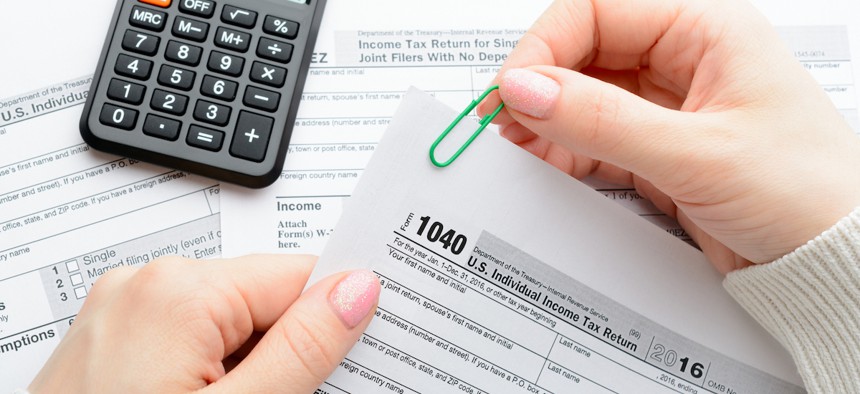
Nearly a year after the free, government-backed tax filing service from the IRS ended, states are trying to replicate it or find other ways to make tax filing easier for residents.
As states prepare for the 2026 tax year, several are striving to emulate the success and effectiveness of Direct File, the free and government-backed tax filing program through which eligible residents could dually process their federal and state taxes.
The program was lauded by many for its user-friendly and plain language design that simplified the filing process for users. Several states also saw the program as a major step toward the modernization of government service delivery.
The IRS ended the Direct File program — which 25 states were participating in at the time — last November after the service was initially piloted in 12 states in 2024. Federal officials cited low uptake of the program and the availability of private-sector alternatives to Direct File for suspending the service.
More than 296,500 people were able to submit tax returns with Direct File in 2025, and 94% of surveyed people reported that their experience using the “beloved” program was “excellent” or “above average,” according to an internal IRS report obtained by NextgovFCW last year.
“There’s been a void that has been left by the closure of Direct File,” Annelise Grimm, program director of the civic tech nonprofit Code for America, told Route Fifty. At the same time, there’s “a really strong belief that, if this is a core requirement of being a resident of this country to file a tax return, [government] should provide a way for people to do that for free, and that currently isn't the case,” she explained.
Colorado and New Jersey are two states trying to address the service gap left by Direct File. The states partnered with Code for America in July to launch SimpleFile, an online tool through which residents can submit a “simplified” state-only tax return within 15 minutes, according to the nonprofit.
The tool was developed in particular with low-income households and no tax obligation in mind, Grimm said. Such populations are at a higher risk of struggling or failing to complete the filing process, ultimately losing out on potential tax benefits.
Using SimpleFile, Colorado and New Jersey residents are prompted to fill out a few questions and provide additional data to verify their eligibility for state tax credits.
“While the federal government strips free tax filing away from families across the country, New Jersey is doing the opposite …. SimpleFile makes sure families can access the credit they qualify for today and turns a budget win into real money in the hands of our families,” New Jersey Gov. Mikie Sherrill said in a July statement announcing the state’s launch of SimpleFile.
SimpleFile is not a replacement for Direct File, but states could “see the same challenges” that plagued tax filing systems before the federal service became available to them if they do not act, such as time-consuming duplicative and manual data entry, filing backlogs and errors in forms.
“There are a lot of folks who have seen what is possible now,” with services like Direct File, “and have the fire in the belly to not accept the status quo as it is anymore,” she said.
The Maryland Office of the Comptroller in June announced its plans to modernize its tax portal to include pathways for individual taxpayers to file and monitor their state income taxes. The free, online Maryland Tax Connect portal went live earlier this month and “took inspiration” from Direct File’s interview-based questions and data prepopulation features, Comptroller Brooke Lierman told Route Fifty in a previous interview.
Similar work is underway in Virginia. Gov. Abigail Spanberger signed a bill in March directing the Virginia Department of Taxation to develop a free individual tax filing program for residents akin to the federal Direct File service.
The legislation requires the agency to “consider the compatibility, security, and integration of such program with the publicly available source code of the IRS Direct File Program as it existed during the 2025 tax filing season,” and that the new program “is updated as needed for compatibility with any free direct tax e-file system offered by the federal government.”
The bill went into effect in July and requires that the service be available beginning Jan. 1, 2028.
While stand-alone state tax filing systems have long been in operation, they are often not as popular to use among residents because “almost everyone is going to file their state return through the same [system] they file their federal return because it's easier that way” since state tax returns are based on federal tax returns, Gabriel Zucker, a fellow at the Economic Security Project, told Route Fifty.
“It puts states in a funny position because states really went out on a limb here to invest … and put a lot of resources into building the state connections to Direct File, believing this was the sea change that a lot of us believed and hoped it would be …. then the rug was pulled out from under them by the current administration,” he said.
“When the federal government retreats from that mission of making tax filing easier, it’s quite hard for states to pick up the slack,” Zucker explained.
Minnesota lawmakers are trying to further plug the gap. Gov. Tim Waltz signed an omnibus tax bill in May that states the Minnesota tax commissioner “may establish an electronic filing system through which individual taxpayers may file a federal income tax return for free.”
The omnibus also requires the commissioner to establish a free electronic system for filing individual income tax returns. Under the legislation, the tax commissioner is allowed to contract with a vendor to develop the filing system, and “to the extent feasible,” it must “coordinate” with “any federal systems established for free filing of federal tax returns.”
The service for individual taxpayers is required to be available starting Dec. 31, 2026.
While state momentum to develop tax filing solutions in lieu of Direct File perseveres, “I think uptake for state-based portals will be highest if it's paired with a federal return, because that's how most people think about their taxes: the federal and state together,” Grimm said, adding that “we really do need to figure out a solution for the the federal return as well, and I hope that that comes through the IRS and Treasury.”