
How did this state become the data center capital of the world?
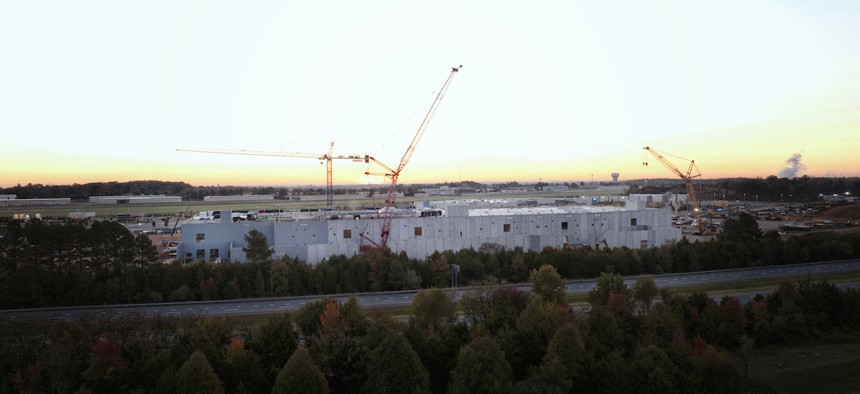
Construction of Microsoft Azure data center campus, known as IAD01-1 and IAD01-2 in Leesburg, Virginia, on Oct. 19, 2024. Gerville via Getty Images





From America Online to the rise of AI, Virginia has been good for an industry now transforming the economy and grid. Has the industry returned the favor?
This article originally appeared on Inside Climate News, a nonprofit, non-partisan news organization that covers climate, energy and the environment. Sign up for their newsletter here.
ASHBURN, Va.—Driving up the six-lane Route 28 in Loudoun County, Virginia, there’s a dark blue one on the left. Further up the way in a small clearing of trees, there’s a gray one on the right. Across the landscape, metal cables criss-cross in every direction to connect power to the sprawling buildings.
They’re not big-box stores like Ikea or Target. They’re bigger. They’re data centers that house the computers processing the internet and artificial intelligence. And they’re all over these suburban counties outside of Washington, D.C.
Virginia, especially Northern Virginia, leads the world in development, far outpacing other top markets such as Beijing.
So how did it happen that this region came to dominate data centers, an industry whose growth now fuels debates about electricity bills, climate change and the role of technology in our lives? The answer is a combination of government support, the presence of infrastructure used by internet pioneers such as America Online, cheap electricity and the availability of land.
“There was all that land next to Dulles airport that was unused, and so it was cheap, available and large enough, and getting a major internet connection was easy,” said Shane Greenstein, a professor at Harvard Business School who has written about the economic geography of data centers.
Considering those factors, it’s “really not a surprise” that Virginia took the lead and maintained it, he said.
Now, with the rise of AI, the size of some recent and planned data centers exceeds even what could have been imagined a few years ago. The region and the state remain attractive locations for many of the same reasons that explained previous growth, but this is a new era in which rapid development is happening across the country.
For example, Columbus, Ohio, and Phoenix have emerged as data center boom towns, although Virginia’s current infrastructure and slate of future projects are deep enough that no city or region will overtake it any time soon.
The state had 6,247 megawatts of data centers and 2,610 megawatts under construction as of June, according to a report from the real estate firm Cushman & Wakefield. Together, those 8,857 megawatts are nearly triple the operating and under-construction capacity of the next market, Columbus.
But the most striking figure for Virginia in the report is the 24,103 megawatts for planned data center capacity.
No market in the world comes anywhere close to this.
Behind those big numbers is a small one. Data centers don’t need many employees, and they had just 12,140 operational jobs in Virginia in 2023, according to figures from the Northern Virginia Technology Council, a trade group. For context, that’s slightly less than the number of school bus drivers in the state that year. If we zoom out to include all jobs that have direct or indirect ties to data centers in the state, the number rose to 78,140, including operations, construction and other roles.
Environmental advocates have argued that the costs of this development far exceed the benefits. The downsides are local, including vanishing farmland, and national, with electricity demand rising at a pace that is incompatible with the imperative to reduce greenhouse gas emissions.
Chris Miller, president of the Piedmont Environmental Council, points to a 2.2-million-square-foot proposal that would’ve needed 800 megawatts in Remington, Virginia, a rural town of about 600 people located just south of Loudoun County. The developers withdrew their pitch and expect to submit plans for a smaller data center less than half that size. But the initial proposal would’ve gobbled up nearly as much power as a rural state.
“There’s a lot of ways you can produce a gigawatt but at the end of the day, the impacts start to add up because of the scale of the amount of power that is,” Miller said. “The only way I can help people wrap their heads around how big it is, is that’s almost the entire peak load of the state of Vermont.”
Paving the Information Super Highway
The scale of this industry, measured in dollars, acres and gigawatts, has grown at a staggering pace. It’s unrecognizable when compared to its early days.
Virginia was well-positioned to be a hub for the early internet because of its proximity to the federal government in Washington, D.C., and the research institution now known as the Defense Advanced Research Projects Agency, or DARPA. In the 1960s, the agency led a project to develop ARPANET, a computer network that was a building block for the internet.
Various businesses with ties to the early internet were located in the D.C. area, but it wasn’t until the 1990s that one of them, America Online, broke through to become a giant. The company was based in Fairfax County and then moved a short distance to Loudoun County in 1996, helping to transform a mostly rural area.
A 1997 Time magazine cover demonstrates the prominence of America Online, with its chairman, Steve Case, smirking in a photo illustration with data cables attached to his body. The cover line was: “AOL’s Big Coup,” about the company’s recent purchase of CompuServe and its attempts to fend off competition from Microsoft.
America Online’s presence in Loudoun County attracted other internet businesses and contributed to investment in fiber-optic cables, enabling the easy movement of data.
In 1998, a start-up called Equinix built a data center in Northern Virginia to serve America Online and other companies. It was a novel concept, a building that would store data for other companies. The facility was likely the region’s first data center and Equinix remains a major player in its industry.
Following the dot-com bust in 2000 and the rise of internet activity, like shopping from a couch, Loudoun County began marketing vacant buildings, including some vacated because of the decline of America Online. The buyers included some of the first-generation internet giants, such as Amazon, which opened its first data center in the region in 2006.
Much of this activity was to support cloud computing.
“The world’s changed,” said Buddy Rizer, a Loudoun County economic development official, in a video posted in 2012. “Everyone wants whatever information they have right now from wherever they are and the only way you can do that is to store it in the cloud. Cloud computing is one of those terms that everybody seems so excited by or mystified by. It’s really pretty simple: All of your information is available to you anywhere, at any time. That happens because this data is being transmitted through and from data centers.”
Cloud computing took off, driving the demand for more expansive data centers.
Dominion Energy, Virginia’s biggest electric utility, played a role in attracting this new development by offering competitive electricity prices to big power users, which were lower than those in many competing markets.
In 2008, Virginia lawmakers approved legislation that established the state’s sales and use tax exemption on certain data center equipment. Companies that invested at least $75 million in a locality with an unemployment rate above 4.9 percent were eligible. This provided a financial incentive for companies to invest in the state and was one of several state and local government actions that helped to accelerate development.
Two years later, Microsoft announced a $500 million center in the bill’s sponsor district in Southside near the North Carolina border.
The projects that followed required more space than before, reflecting the rising demand for cloud computing and other data storage. Amazon, Facebook and Google spent billions of dollars to build data centers in Northern Virginia and elsewhere in the state.
Amazon’s investment was notable for its level of commitment, including an announcement in 2018 that it would spend $2.5 billion on a second headquarters in Arlington, a Northern Virginia city, to go along with its main headquarters in Seattle. The company followed it up with $35 billion in spending for data centers across the state.
The trend had become clear, with these gigantic boxes visible from main roads.
Regulatory filings show how this industry grew into a gigantic electricity consumer. In 29024, Virginia data centers served by Dominion had demand of 3,583 megawatts, which is nearly seven times more than in 2013.
The utility has said that data centers are the main reason it is projecting a drastic increase in demand to serve all of its Virginia customers, rising from 17,300 megawatts last year to 26,600 megawatts by 2039.
The scale of this growth is largely because of the emergence in the early 2020s of a new kind of data center that runs the computer models for artificial intelligence. Most new AI data centers are larger than those used for cloud computing and require much more electricity.
That brings us to today, which analysts say is still the early stages of AI data center development. The factors that helped Virginia secure its initial foothold have contributed to forecasts of its sustained momentum.
Was This Worth It?
Virginia’s transformation into the data center capital of the world could be regarded as a business success story when measured by the dollars invested.
Loudoun County officials point to data centers providing $1 billion in annual local tax revenue, funding about one-third of the county’s budget. Elected leaders have lowered the residential tax rate by 48 cents per $100 since 2012, saving the average Loudoun homeowner $3,000 to $4,000 per year.
But the state has reached a point where it’s a mainstream viewpoint to question whether the benefits of this development boom are enough to justify the costs of lost land, increased water consumption for cooling, rising carbon emissions, worsening climate disasters and the potential for surging electricity bills.
“The world’s largest data center market is facing increasing pushback from multiple directions,” according to the development report from Cushman & Wakefield.
Some of the most intense resistance is in Loudoun County, which has taken steps to increase regulatory scrutiny of new projects and give the public more opportunities to voice concerns about proposals. Development has become a campaign issue in local elections.
“People are overwhelmingly unhappy” about the pace of development and changes to the landscape, said Nan McCarry, who was born and raised in Loudoun County. She is now a volunteer for conservation organizations.
She remembers Ashburn as a tiny village when she was a child in the 1960s and has watched it transform into a magnet for property developers because of its proximity to Washington. She lives in western Loudoun County, which retains much of its rural charm, but also views the area as threatened by the encroachment of home construction and data centers.
One of the most ardent critics of the data center boom has been the Piedmont Environmental Council, an advocacy group for Virginia’s Piedmont region, which runs down the center of the state and includes Loudoun County.
Miller, the council’s president, acknowledges that data centers have helped the region in some ways.
“Loudoun County has benefited dramatically, no question,” he said. “What they’ve been able to do is pay for a lot of schools, and a lot of public services,” Miller said.
But he thinks the downsides could outweigh the benefits, especially when planning for continued development.
The downsides include increased electricity rates. Virginia’s utility regulator, the State Corporation Commission, is reviewing Dominion’s request to increase the typical household bill by about $21 per month by 2027 because of grid upgrades, inflation and supply chain issues, a 15 percent increase.
To meet this demand, Dominion is proposing a substantial ramp-up in power plant construction with solar and natural gas as its primary energy sources.
Another concern is damage to ecosystems and the rapid loss of rural land.
The state’s Joint Legislative and Audit Review Commission, a policy research arm of the legislature, studied the economic and environmental impacts of data centers. The report suggested that the industry could cause energy demands in Virginia to triple, while adding “74,000 jobs, $5.5 billion in labor income, and $9.1 billion in GDP to Virginia’s economy annually.”
But it stopped short of a forecast of land and water needs and potential air-quality impacts, Miller noted.
“We’re very worried,” Miller said of the lack of information about potential adverse effects. “It’s not that we can’t do a better job. It’s that we’re not even taking the first steps in that direction. … What I often say is, you gotta own the fact that you’re really having a transformational impact. Let’s do a full cost evaluation and make sure that the net benefit is what you think it is.”
The dilemma for Virginia is that becoming the data center capital of the world has come with inevitable consequences, such as environmental impacts, and still-undefined risks, including questions about whether these big boxes along the road make business sense.
The concentration of data centers resurfaced as a concern last week when Amazon Web Services outages disrupted services for a number of companies across the internet. The issue stemmed from Amazon’s data centers in its “US-EAST-1” zone, based in Northern Virginia.
“We urgently need diversification in cloud computing,” Corinne Cath-Speth, head of digital for Article 19, a free speech advocacy group, said in a statement.
Greenstein, the Harvard professor, said any discussion of the pluses and minuses of data centers needs to acknowledge that they are essentially self-operating. So while Virginia may be the national leader in data centers, the number of jobs is small compared to the enormity of land use and power use.
“My standing joke about data centers is they’re a very big building with a very small parking lot,” he said. “They just don’t employ a lot of people relative to their scale of size.”
So data centers can fill the landscape without having nearly as significant an effect on the number of customers at local restaurants or other benefits that usually come with business investment.
Greenstein also has questions about the viability of the gigantic new data centers cropping up around the country. This aligns with broader concerns among analysts about whether there is an AI investment bubble in which companies will be unable to make enough money to justify their costs and that current technologies may have short shelf lives.
“In 10 years, will we look back on this as foolish, because the output from these things arguably have limited lifespans?” Greenstein asked.
He doesn’t know the answer. Virginia may find out the hard way.