
Lots of questions, but little pushback on Maryland bill to allow driverless cars
P_Wei vai Getty Images



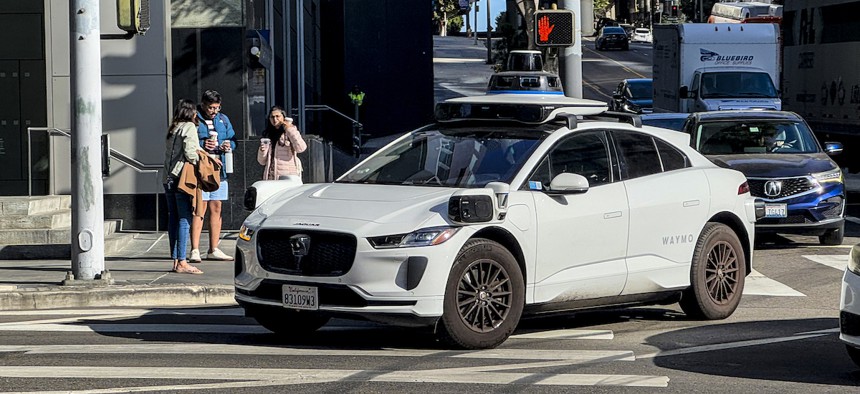
Autonomous vehicles would provide freedom of movement to those who are unable to drive and a safer alternative to human drivers, Sen. Sara Love testified during a hearing on her bill.
This story was published by Maryland Matters.
Waymo executives see an opportunity. Teamsters see a threat. Ronza Othman just sees a chance to get a ride without being discriminated against.
“Just yesterday, I was late to work because a rideshare driver refused to take me,” said Othman, the president of the National Federation of the Blind of Maryland. “He said, quote, ‘It’s not worth the money,’ since he could get more rides in the time it would take for him to help me.”
Othman’s comments came during a Senate Judicial Proceedings Committee hearing Wednesday on Senate Bill 909, Sen. Sara Love’s (D-Montgomery) bill to allow “fully autonomous vehicles” — or driverless cars — to operate in Maryland.
Autonomous vehicles would provide freedom of movement to those who are unable to drive, a safer alternative to human drivers and an opportunity for existing companies to grow around an emerging technology, Love testified during the nearly two hours of hearing on her bill.
SB 909 and a companion bill, House Bill 1295, sponsored by Del. Natalie Ziegler (D-Howard and Montgomery), would allow driverless cars to operate in the state as long as certain technical standards and specifications are met. Senators peppered the witnesses with technical questions about driverless cars, but did not seem to be opposed to the idea.
Othman said autonomous vehicles would be a “true game changer for people with disabilities.”
John Seng, founder and chair of Safe Roads Maryland, a nonprofit focused on improving road safety in Maryland, testified the driverless services like Waymo remove the most dangerous part of driving: the human element. Waymos can’t “drive inebriated, chew edibles, drive distracted or speed,” Seng said.
But where Seng sees a positive in removing the human element, drivers see a concern. Thomas Doyle, the state program director for the International Brotherhood of Teamsters, testified that there are thousands of Teamsters within the state who drive professionally for a living.
“These Teamsters, and all professional drivers are relevant stakeholders whose concerns need to be heard when we are examining this bill,” Doyle said. “Do we really believe that the technology’s there?”
In addition to technological concerns, Doyle noted that the bill would allow “fleet technicians” — humans in a driverless car who can take over remotely if needed — who are not licensed drivers in Maryland and may be unfamiliar with our roads and rules.
But Ethan Teicher, a spokesperson for autonomous driving technology company Waymo, said autonomous vehicles are often safer than human drivers.
“The data shows that the [Waymo] technology is involved in 90% fewer serious injuries or worse crashes compared to human drivers,” said Teicher, who showed off one of the company’s cars outside the State House earlier Wednesday.
Waymo currently operates fully autonomous cars in 10 major U.S. cities, including Phoenix, San Francisco, Los Angeles, Houston and Atlanta. The company is looking to expand into Baltimore, Teicher said.
Waymo already has about a dozen cars in the city, driven by professional drivers to acquaint the technology with the city. It is not offering rides to passengers in Baltimore yet, Teicher said.
If the bills are passed, the company would slowly phase out the professional drivers in Baltimore. It would start by using the autonomous technology with professional drivers behind the wheel, and as safety benchmarks are met, the cars could move toward operating without a driver behind the wheel, Teicher said.
When asked about the impacts of autonomous vehicles on rideshare drivers, Teicher said “there’s going to be some kind of transition,” as to what rideshare jobs would look like in the future.
As autonomous vehicle services expand, he said, Waymo will need a team of professionals to support its fleet, such as staff to aid with technology updates, fleet technicians to work on the cars and construction and skilled trade workers to build necessary infrastructure like charging facilities and depots.
“Certainly, we want to partner with the state to make sure those opportunities stay local and get in the hands of people who need them,” Teicher said.
Despite the concerns about jobs, Seng believes the bills will only serve to increase roadway safety.
“No technology or law is a panacea, it’s one size fits all. Increasing road safety means decreasing fatalities, injuries and crashes,” Seng said.
Maryland Matters is part of States Newsroom, a nonprofit news network supported by grants and a coalition of donors as a 501c(3) public charity. Maryland Matters maintains editorial independence. Contact Editor Steve Crane for questions: editor@marylandmatters.org.