Nebraska wants data centers to come clean about water usage
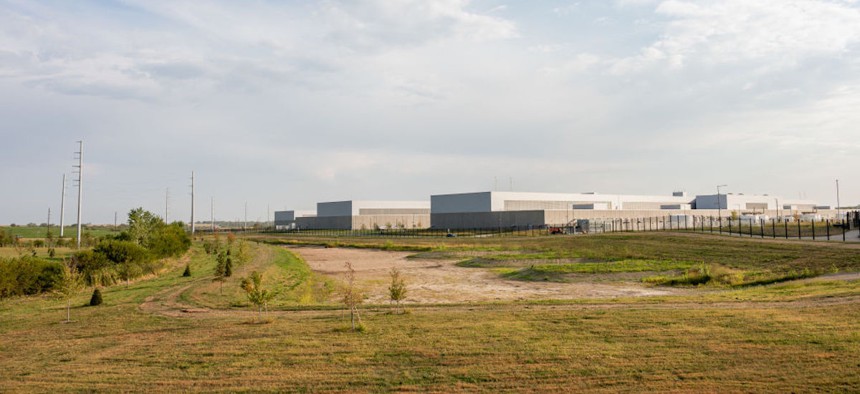
Misty Prochaska for The Washington Post via Getty Images


The industry can be a black box of information. But as the state deals with persistent drought, residents and regulators want more answers.

This story was originally published by Grist. Sign up for Grist's weekly newsletter here.

Often seen as a black box of information, data centers in Nebraska will be forced to reveal more about their operations, like their annual water use and power demand, to the state, following the recent passing of a new law by the Nebraska Legislature. Jesse Bradley, director of the Department of Water, Energy, and Environment said the state agency will then see what information gaps remain, but that the legislation is a “great start” and will help with future planning. 

In addition to electricity production, water has emerged as a point of contention as companies look to build more data centers in Nebraska. Local residents, researchers, and regulators worry that new data centers could bring about water shortages in a state where water availability can vary widely and where wide swaths of this agricultural state are suffering through extreme drought. For now, the best available information about how much water data centers use comes directly from the data center companies themselves — if they choose to be transparent.

For instance, in Nebraska, there isn’t even an official count of how many data centers there are in the state. Of the ones that have reported their water usage, the amounts vary. Google’s Nebraska data centers consumed about 732 million gallons of water in 2025, according to the company. Google, a subsidiary of Alphabet, expects its water consumption from data centers to grow. From 2020 to 2024, Meta’s four million square-foot Sarpy County data center withdrew anywhere from 26.7 million gallons to 37.5 million gallons from the local water supply, depending on the year.

Data centers use water to cool the buildings and the computer servers inside. Keeping everything at optimal temperatures ensures the equipment doesn’t malfunction. Some cooling methods, like evaporative cooling systems, typically use large amounts of water. Air-cooled chiller systems, however, deploy a “closed loop” containing water, a chemical coolant, or sometimes both and can operate without needing to be replenished for years. While closed loop systems use less water, they tend to use more electricity — the production of which can also require water.

“What’s best?” said Eric Masanet, a University of California, Santa Barbara engineering professor. “It depends on the data center, its design, the local climate, if you have enough water, if you have enough power, what people want, what they’re willing to devote their resources to.”

Google decides which cooling system to use depending on how much water is available in a given location, according to Ben Townsend, the company’s head of infrastructure and sustainability. The company assesses local watersheds before and after building a data center. Meta’s Sarpy County data center uses a combination of evaporative and closed loop cooling.

While data centers have typically been built in urban areas, developments have started to move further out to suburbs and rural areas as fiber optic cables and infrastructure has improved, said Dan Diorio, vice president of state policy at the Data Center Coalition. This expansion raises concerns for areas of Nebraska that either don’t have enough water already or whose water supply is already fully allocated. Most of the state’s water is used for irrigation to support the agriculture-based economy. 

With water use expected to rise due to droughts and higher temperatures from climate change, water policy and allocation are top of mind, said Crystal Powers, water extension educator at the University of Nebraska-Lincoln. 

“From a logical, common sense perspective, we really need to stop putting industry in areas where they can’t be supported,” by natural resources like water, said John Winkler, general manager of the Papio-Missouri River Natural Resource District. “It doesn’t make sense to put a data center in an area that’s very water insecure to begin with.”

Masanet and fellow researcher Jonathan Koomey said the pressure is being put on the data center industry to be more efficient and transparent.

“I work with a lot of people in the tech industry. They’re pouring trillions into this industry,” Masanet said. “We should hold them to account and make them install the very best technologies that minimize energy and water.”

This article originally appeared in Grist at https://grist.org/climate-energy/nebraska-wants-data-centers-to-come-clean-about-water-usage/Grist is a nonprofit, independent media organization dedicated to reporting on climate change.

X
This website uses cookies to enhance user experience and to analyze performance and traffic on our website. We also share information about your use of our site with our social media, advertising and analytics partners. Learn More / Do Not Sell My Personal Information
Accept Cookies
X
Cookie Preferences Cookie List

Do Not Sell My Personal Information

When you visit our website, we store cookies on your browser to collect information. The information collected might relate to you, your preferences or your device, and is mostly used to make the site work as you expect it to and to provide a more personalized web experience. However, you can choose not to allow certain types of cookies, which may impact your experience of the site and the services we are able to offer. Click on the different category headings to find out more and change our default settings according to your preference. You cannot opt-out of our First Party Strictly Necessary Cookies as they are deployed in order to ensure the proper functioning of our website (such as prompting the cookie banner and remembering your settings, to log into your account, to redirect you when you log out, etc.). For more information about the First and Third Party Cookies used please follow this link.

Allow All Cookies

Manage Consent Preferences

Strictly Necessary Cookies - Always Active

We do not allow you to opt-out of our certain cookies, as they are necessary to ensure the proper functioning of our website (such as prompting our cookie banner and remembering your privacy choices) and/or to monitor site performance. These cookies are not used in a way that constitutes a “sale” of your data under the CCPA. You can set your browser to block or alert you about these cookies, but some parts of the site will not work as intended if you do so. You can usually find these settings in the Options or Preferences menu of your browser. Visit www.allaboutcookies.org to learn more.

Sale of Personal Data, Targeting & Social Media Cookies

Under the California Consumer Privacy Act, you have the right to opt-out of the sale of your personal information to third parties. These cookies collect information for analytics and to personalize your experience with targeted ads. You may exercise your right to opt out of the sale of personal information by using this toggle switch. If you opt out we will not be able to offer you personalised ads and will not hand over your personal information to any third parties. Additionally, you may contact our legal department for further clarification about your rights as a California consumer by using this Exercise My Rights link

If you have enabled privacy controls on your browser (such as a plugin), we have to take that as a valid request to opt-out. Therefore we would not be able to track your activity through the web. This may affect our ability to personalize ads according to your preferences.

Targeting cookies may be set through our site by our advertising partners. They may be used by those companies to build a profile of your interests and show you relevant adverts on other sites. They do not store directly personal information, but are based on uniquely identifying your browser and internet device. If you do not allow these cookies, you will experience less targeted advertising.

Social media cookies are set by a range of social media services that we have added to the site to enable you to share our content with your friends and networks. They are capable of tracking your browser across other sites and building up a profile of your interests. This may impact the content and messages you see on other websites you visit. If you do not allow these cookies you may not be able to use or see these sharing tools.

If you want to opt out of all of our lead reports and lists, please submit a privacy request at our Do Not Sell page.

Save Settings
Cookie Preferences Cookie List

Cookie List

A cookie is a small piece of data (text file) that a website – when visited by a user – asks your browser to store on your device in order to remember information about you, such as your language preference or login information. Those cookies are set by us and called first-party cookies. We also use third-party cookies – which are cookies from a domain different than the domain of the website you are visiting – for our advertising and marketing efforts. More specifically, we use cookies and other tracking technologies for the following purposes:

Strictly Necessary Cookies

We do not allow you to opt-out of our certain cookies, as they are necessary to ensure the proper functioning of our website (such as prompting our cookie banner and remembering your privacy choices) and/or to monitor site performance. These cookies are not used in a way that constitutes a “sale” of your data under the CCPA. You can set your browser to block or alert you about these cookies, but some parts of the site will not work as intended if you do so. You can usually find these settings in the Options or Preferences menu of your browser. Visit www.allaboutcookies.org to learn more.

Functional Cookies

We do not allow you to opt-out of our certain cookies, as they are necessary to ensure the proper functioning of our website (such as prompting our cookie banner and remembering your privacy choices) and/or to monitor site performance. These cookies are not used in a way that constitutes a “sale” of your data under the CCPA. You can set your browser to block or alert you about these cookies, but some parts of the site will not work as intended if you do so. You can usually find these settings in the Options or Preferences menu of your browser. Visit www.allaboutcookies.org to learn more.

Performance Cookies

We do not allow you to opt-out of our certain cookies, as they are necessary to ensure the proper functioning of our website (such as prompting our cookie banner and remembering your privacy choices) and/or to monitor site performance. These cookies are not used in a way that constitutes a “sale” of your data under the CCPA. You can set your browser to block or alert you about these cookies, but some parts of the site will not work as intended if you do so. You can usually find these settings in the Options or Preferences menu of your browser. Visit www.allaboutcookies.org to learn more.

Sale of Personal Data

We also use cookies to personalize your experience on our websites, including by determining the most relevant content and advertisements to show you, and to monitor site traffic and performance, so that we may improve our websites and your experience. You may opt out of our use of such cookies (and the associated “sale” of your Personal Information) by using this toggle switch. You will still see some advertising, regardless of your selection. Because we do not track you across different devices, browsers and GEMG properties, your selection will take effect only on this browser, this device and this website.

Social Media Cookies

We also use cookies to personalize your experience on our websites, including by determining the most relevant content and advertisements to show you, and to monitor site traffic and performance, so that we may improve our websites and your experience. You may opt out of our use of such cookies (and the associated “sale” of your Personal Information) by using this toggle switch. You will still see some advertising, regardless of your selection. Because we do not track you across different devices, browsers and GEMG properties, your selection will take effect only on this browser, this device and this website.

Targeting Cookies

We also use cookies to personalize your experience on our websites, including by determining the most relevant content and advertisements to show you, and to monitor site traffic and performance, so that we may improve our websites and your experience. You may opt out of our use of such cookies (and the associated “sale” of your Personal Information) by using this toggle switch. You will still see some advertising, regardless of your selection. Because we do not track you across different devices, browsers and GEMG properties, your selection will take effect only on this browser, this device and this website.