
As Trump demands voter data, this fiercely independent Red State says no
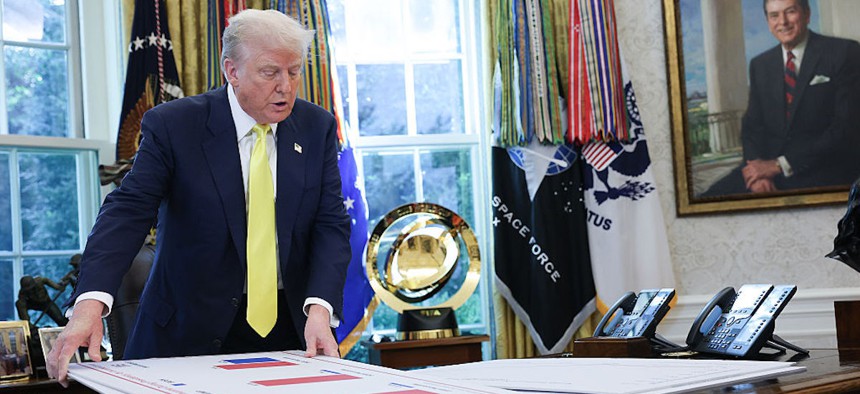
U.S. President Donald Trump shuffles through charts on his desk with economic data in the Oval Office on Aug. 7, 2025, in Washington, DC. Win McNamee/Getty Images





Wary of federal intrusion, Idaho passed a law three decades ago allowing it to sidestep so-called motor-voter laws. The exemption and the sentiment behind it are fueling resistance to President Donald Trump’s Justice Department.
This story was originally published by ProPublica.
States were on notice from the U.S. Department of Justice that if they didn’t fall in line, the federal government would force them into compliance.
It wasn’t President Donald Trump’s administration applying pressure. It was the early 1990s, and President Bill Clinton had signed the “motor voter” law requiring states to offer voter registration when someone applies for a driver’s license.
Idaho, with its fiercely independent streak, didn’t want to participate. So instead of going along with the federal government’s new National Voter Registration Act, state legislators followed the recommendation of Idaho’s top election officials and scrambled for a way out. Because the federal voter law said states with same-day voter registration could be exempt, Idaho lawmakers passed a bill almost unanimously, with full support from Republicans, to adopt same-day registration.
Idaho’s chief deputy secretary of state at the time, Ben Ysursa, described the move as an almost existential response to “an insidious federal intrusion into state election procedures.”
The Clinton Justice Department eventually sued three states for not complying with its demands. By then, Idaho’s had a shield against litigation due to its exemption.
Three decades later, the exemption and the philosophy that led to it are at the heart of Idaho’s refusal to comply with a very different demand by the Trump Justice Department. The state’s top election official cites the exemption as one reason he will not sign a deal to give the Trump administration all the voter data his office holds, including sensitive personal information like partial Social Security and driver’s license numbers.
Idaho Secretary of State Phil McGrane is one of about a dozen Republicans nationally to resist the administration’s efforts to gather sensitive voter data ahead of the 2026 midterm elections, in the face of litigation threats from the Justice Department.
In a state that Trump won in 2024 by one of the largest margins in the country, an effort that the administration touts as essential to weeding out noncitizen voters has tested the limits of what a committed Trump stronghold will tolerate when it comes to privacy and federal power.
Lists of voter addresses and party affiliations are often available to the public through an open records request. McGrane provided the government with this version. But state election administrators also keep more sensitive information such as a person’s exact date of birth and partial Social Security number. In Idaho, the law says this information can’t be given out — and that’s what the Trump administration is still after.
Among the other five states exempt from the law, three have refused to give up their voters’ sensitive information and have since been sued by the Justice Department. Wyoming handed over its data without a lawsuit. Other states that are not exempt have also been sued.
McGrane, who is an attorney, told the Justice Department in letters that he doesn’t see any legal reason why he should honor the government’s request — and that, given the administration’s recent admissions over its handling of sensitive data, he couldn’t be sure the department would keep it safe, which is his duty under state law.
The trimmed-down version of voter info he’d already handed over should be enough for “any legitimate inquiry” by the government into how effectively Idaho maintains its voter lists, McGrane wrote.
Through a spokesperson, McGrane declined an interview request from ProPublica, citing the possibility of an impending lawsuit from the Justice Department. A spokesperson for the Justice Department also declined to comment.
A Justice Department attorney threatened to sue Idaho in December, in a halting voicemail with McGrane’s office that was obtained by ProPublica and previously reported on by the Idaho Capital Sun.
“I need to get some clarification as to what you’re going to be doing. Or not doing. So, again, I need a response from you,” the lawyer says in the recording. “You may have seen in the news that we have sued six states earlier this week for refusing to provide their voter registration lists, and we’re preparing additional lawsuits.”
The lawyer then tells the secretary of state’s office he would “like to keep everyone out of that as possible — as much as possible, but I haven’t heard anything back from you.”
Ysursa, who served three terms as secretary of state until 2015, said McGrane is “in a much more politically volatile situation than I ever was.”
“Going against Trump in Idaho on certain things, that’s a fine line,” Ysursa said. “And I think he’s doing a good job. He’s doing the right thing.”
Public policy surveys in Idaho conducted since the 1990s have surfaced a current of “distrust or wariness towards federal control or national control,” said Matthew May, survey research director at the Boise State University School of Public Service.
The polling over time has revealed Idahoans’ strong belief in independence, May said.
In the months since McGrane’s refusal, more than 130 constituents have called, emailed and sent handwritten cards and letters to his office. Of those, just one person said they wanted McGrane to provide information to the Trump administration. The others were supportive, appreciative or, in some cases, seemingly panicked by the prospect of their private information being released.
Although the senders skewed more Democratic than Idaho’s electorate, just over half the messages came from Republicans and unaffiliated voters, based on a review of voter registration data for commenters who left their names.
“Mr McGrane has done a masterful job of dancing around the US Justice Dept request for the full voter records of Idaho voters,” wrote one registered Republican. “When the dancing no longer works, I expect Mr McGrane to give them a big fat NO!
“Voting is our one sacred right in this country,” the person continued. “DOJ has no legitimate business receiving our PRIVATE voter information. They may threaten to sue, but so will the voters of Idaho if you grant their request. Do not give them our personal voter information. Thank you.”
Ysursa told ProPublica that he has urged McGrane to “hold the line,” even amid threats of repercussions. Ysursa is one of nine former secretaries of state who filed an amicus brief in federal court, arguing against the administration’s demands for full voter information.
The Trump administration’s creep toward nationalizing elections runs counter to the ethos of “keep your federal hands off Idaho,” Ysursa said.
McGrane is a self-described election nerd who worked his way up through elections offices, as opposed to cultivating a resume as a professional politician. He served as a county elections chief and gained a reputation for approaching voting day with a Super Bowl level of enthusiasm. He also became known for his ability to resist the political winds.
McGrane was one of seven people featured on the cover of Time magazine in 2022 as “the defenders” of America’s elections. That year, McGrane was the only Idaho Republican candidate for secretary of state who did not back the false claim that fraud was responsible for Trump’s loss in the 2020 election.
In perhaps the strongest sign that Trump’s base in Idaho has not been inflamed by McGrane’s pushback on the administration’s demand for voter rolls — which received plenty of media attention locally — he drew no challenger by last month’s deadline to enter the Idaho Republican primary for his position.
While the Constitution gives states the authority to run elections, the National Voter Registration Act gives the federal government an oversight role when it comes to ensuring voter lists are properly maintained. The law says election officials must make a “reasonable effort” to keep ineligible voters off of the rolls, and typical oversight comes in the form of lawsuits claiming that states aren’t doing a good enough job.
Under Trump, the Justice Department has gone a step further. The department claims it has the right to seize states’ unredacted voter rolls without proving its case in court, citing in lawsuits the powers that agency officials say they have under the National Voter Registration Act, the Help America Vote Act and the Civil Rights Act.
The Justice Department has privately told states more about its intentions, according to emails obtained by ProPublica through public records requests.
In Montana, a federal lawyer told the secretary of state’s legal counsel that the department was requesting voter rolls to “facilitate a review for noncitizens and dead voters,” adding that federal officials would be able to assess whether there are duplicate registrations as well.
The demands come as part of the Trump administration’s focus on hunting down noncitizens on the voter rolls, a long-standing preoccupation for the president. He has long claimed, without evidence, that noncitizens have infiltrated the rolls to influence elections.
Three judges who have considered the government’s lawsuits fully so far have dismissed them, saying that the federal laws the Trump administration cites as the basis for its demands do not apply — especially not where voters’ private information is concerned.
In Oregon, U.S. District Judge Mustafa Kasubhai wrote that the Justice Department’s claims were “troubling,” representing federal overreach.
In California, U.S. District Judge David Carter said the centralization of the information would have a chilling effect on voter registration, leading to decreased turnout as people worry their data could be used for an “inappropriate or unlawful purpose.”
“This risk threatens the right to vote which is the cornerstone of American democracy,” Carter wrote.
In Michigan, U.S. District Judge Hala Y. Jarbou echoed that interpretation, writing that “the risk of having one’s personal information misused will deter people from registering to vote.”
The Justice Department has appealed all of the courts’ decisions.
Leaders in Republican-led states that have held back their voter rolls, meanwhile, have taken pains to show they are making other efforts to keep noncitizens from voting.
Idaho started looking for evidence of problems well before the Trump administration’s request. McGrane said in a letter to the Justice Department that his office worked with federal agencies to check the citizenship status of all registered Idaho voters in the lead-up to the 2024 general election.
Given what Idaho has already done and the processes already in place, the federal government has “no legal or practical rationale for duplicative review,” McGrane wrote.
The tools Idaho employed, he said, included a Department of Homeland Security program known as the Systematic Alien Verification for Entitlements.
Idaho’s search found 11 cases of noncitizens registered to vote — none of whom actually cast votes in 2024 — and state police referred those cases to the Justice Department’s chief prosecutor in Idaho for review.
McGrane told the Justice Department that he hadn’t heard anything about those cases since.