
Rural Hoosiers lean on the law to fight drones
Diy13 via Getty Images




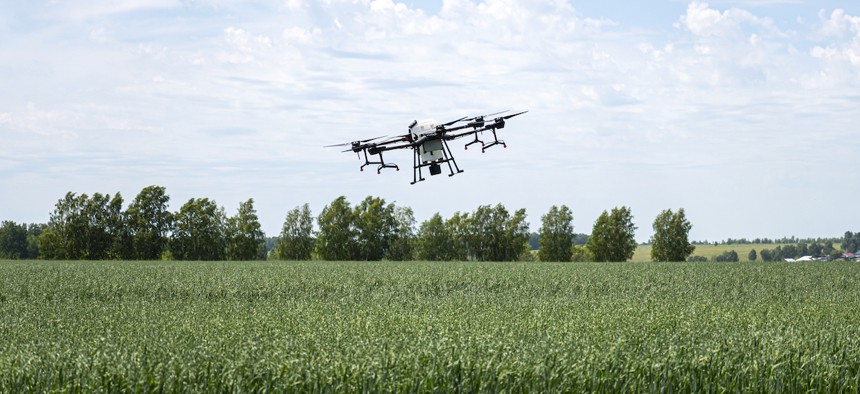
Farmers fearful that drones might be spreading disease among livestock recently persuaded the Indiana General Assembly to pass a law that prohibits the devices from being used to harm or harass farm animals.
This story was originally published by the Indiana Capital Chronicle.
Hoosiers in rural Indiana say drones are unlawfully tracking deer for poachers, inexplicably flying around chicken coops and increasingly just making people uneasy.
The temptation for some is to simply shoot down the pesky contraptions. But, after consulting with law enforcement, many have learned that isn’t a legal option. So they’ve found other ways to combat the rascals.
Neighbors tired of seeing a drone follow a legendary and massive white-tail buck in southeastern Indiana reported the matter to Indiana conservation officers.
An investigation led to charges against two men in what authorities believe may be the first prosecution under Indiana’s law banning the use of drones to track and hunt wildlife.
In northeastern Indiana, farmers fearful that drones might be spreading disease among livestock recently persuaded the Indiana General Assembly to pass a law that prohibits the devices from being used to harm or harass farm animals.
“Something has to move the ball forward here to be able to defend ourselves in the countryside from these kinds of operations,” Jay County farmer Lenny Muhlenkamp told a legislative committee earlier this year.
Unfair Hunt?
Among hunters, the case that has caused the biggest stir unfolded last fall near Madison, along the Ohio River.
For months, some residents saw a drone seemingly tracking a fabled 17-point deer so recognizable and coveted by hunters that they had dubbed it the Nucor Monarch. That’s because the deer frequently bounded across the wooded terrain and open prairie near the Nucor steel fabrication plant.
So when the animal was suddenly bagged by hunters on Oct. 2, just one day into the crossbow hunting season, neighbors quickly grew suspicious, authorities said.
One witness contacted Indiana conservation officers and reported the animal likely had been taken with the aid of a drone in violation of a state law that seeks to prevent unfair hunts.
Investigators say their probe confirmed those concerns.
According to a probable cause affidavit, officers confiscated videos, photos and flight logs recorded by a suspect’s drone that showed the unmanned aerial aircraft was used to track the deer for weeks.
Ultimately, cousins Rodney and Eric Pettit were charged with misdemeanors in the case.
Rodney, who owned and operated the drone and killed the deer, was sentenced in February to 60 days probation. His hunting and fishing license also was revoked for a year.
Eric, who was accused of assisting Rodney in the hunt, agreed to a pretrial diversion program that will lead to dismissal of the charges if certain conditions are met.
Rodney Pettit did not respond to a request for comment for this story.
Eric Pettit, a reserve officer for the Jennings County Sheriff’s Department, chalked the case up to his cousin being a novice drone user who was unfamiliar with the particulars of the law and to jealous hunters who turned him in because they didn’t bag the prized deer themselves.
Conservation officers’ desire to prosecute the first deer-hunting case under the state’s drone law also was a factor, Pettit said. Indiana first banned drone-aided hunting in 2016. It tightened the law in 2024 and also clarified that drones could be used after a kill to help locate and recover a legally taken animal.
“There’s the spirit of the law and the letter of the law. (My cousin) broke the letter of the law, one hundred percent. But he did it unknowingly,” Pettit said. “His character is not one that is, you know, a law breaker.”
He said that while conservation officers made a big deal of the fact that his cousin flew his drone on the morning of the kill, he noted that it captured no video of the Nucor Monarch on that day.
State law, however, prohibits using a drone to track a deer starting 14 days before and throughout hunting season. Authorities said Rodney Pettit used his drone in the areas the deer had been spotted nearly every day in that 14-day leadup.
The great irony of the case is that no one really needed a drone to track the deer, Eric Pettit said. It was frequently spotted traveling the same area near U.S. 421, including on his cousin’s property. Motorists and covetous hunters often stopped along the roadside to get a better look.
But the deer’s prized antlers won’t adorn any hunter’s wall now. Instead, they were confiscated by authorities and are expected to soon be on display in the Department Natural Resources’ “Turn in Poachers” traveling trailer that helps educate the public about the state’s hunting laws.
Indiana conservation officer Josh Thomas, who investigated the Pettit case, said it is the first deer-hunting case to be prosecuted under Indiana’s drone prohibitions and should serve as a warning to others.
He said the law was invoked during earlier investigations. One case involving waterfowl never came to fruition. Another case involved the hunting of coyotes in northern Indiana, but Thomas said he was uncertain of the outcome.
“It’s something that’s hard to enforce, it’s hard to detect and then hard to prove,” the conservation officer explained, while expressing certainty that drone-aided hunting is happening with some frequency.
Thomas said attention brought to the Pettit case by the hunting community has resulted in 15 drone-related tips in his southeastern Indiana district alone, raising the possibility of more prosecutions.
The most troubling aspect of the Pettit case was the level of detail the drone was able to gather about the Nucor Monarch’s movements, Thomas said, essentially turning the hunt into an unfair chase.
““It was unbelievable how much they knew about where that deer was anytime they wanted to,” Thomas said.
Farmer Protections
In northeastern Indiana, concerns from farmers helped drive a new state law aimed at reining in unauthorized drone activity over private property.
The legislation, signed earlier this year and set to take effect July 1, expands Indiana’s “remote aerial harassment” law to cover not just people, but also livestock, crops and farm operations.
It makes it a crime to operate a drone over someone else’s property with the intent to harass or disturb animals, damage crops or interfere with agricultural activity. Violations are Class A misdemeanors, punishable by up to a year in prison and a maximum fine of $5,000.
The push for the new law came after a wave of reports from farmers who described drones flying over barns, hovering near livestock and, in at least one case, entering a poultry barn.
Eric Beer, chief deputy for the Adams County Sheriff’s Department, said complaints about drones poured into his office for nearly a month last year and culminated one January evening with many concerned residents, including some from the Amish community, reporting a cluster of eight drones or more buzzing around poultry farms and elsewhere.
“We heard from different people throughout our county, both north and south, that there was one drone that was about as large as a small car,” Beer said.
At that time, the Indiana Department of Homeland Security issued a news release noting that drones were spotted flying around poultry farms in Adams, Allen, Jay and Jackson counties, where avian flu had been reported.
The news release warned that entry by the drones into infected barns could spread the disease and noted that the FBI and the Federal Aviation Administration were monitoring the airspace in those areas.
When asked April 15 about the January 2025 drone activity, the homeland security department said in a written statement that “reports of unidentified drone sightings were determined to be mostly unfounded, and any drone activity in the area was tied to a legitimate purpose,” such as a local farmer using a drone to spray their crops.
The farmers’ lingering concerns prompted Rep. Kendell Culp, a Rensselaer Republican and vice president of Indiana Farm Bureau, to urge the legislature earlier this year to impose new drone limits.
While his House Bill 1064 failed to win approval, some aspects of it were incorporated into House Bill 1249, which addressed various criminal matters and was signed into law by the governor in March.
Farmers who testified at a House Courts and Criminal Code Committee meeting in January described a sense of vulnerability and frustration with how little they could do about unwanted drone activity.
Barry Miller, a Jay County farmer, told the committee that drones were flying over barns without the operators in sight and causing great anxiety about their intentions.
Others raised fears about biosecurity, noting that some of the drone sightings occurred just before outbreaks of avian flu—though no direct connection has been proven.
“It’s an inconvenient coincidence that wherever these drones were, that’s where we were also seeing bird flu happen,” said Muhlenkamp, a fellow Jay County farmer.
He also recounted an Amish farmer’s claim that a drone sprayed a substance into a barn, leaving a nearby child with respiratory problems for a week.
Farm industry groups say the concerns highlight how state law has struggled to keep pace with rapidly evolving drone technology.
“The proliferation has outpaced the legal development,” Ryan Hoff, Indiana Farm Bureau’s senior director of government affairs, said during committee testimony.
Hoff said in an interview this month that the updated law is meant to clarify that some property rights extend to low-altitude airspace by ensuring that unauthorized drone use — particularly when it threatens livestock or farm operations — can carry legal consequences.
At the same time, lawmakers tried to strike a balance by preserving legitimate uses of drones in agriculture, such as crop monitoring and chemical application, so long as those activities are conducted with a landowner’s permission.
Even with the changes, officials and industry advocates say the issue is far from settled — and that additional legislation is likely as drones become more common.
An Uneasy Balance
For Sandy Rush, the idea of balancing competing interests in rural communities isn’t abstract.
As a recently retired employee of the Shelby County Co-op ag service, Rush has seen firsthand how drones are becoming part of modern agriculture — and why farmers rely on them.
“They’re good,” she said. “They have their place.”
Drones can apply fertilizer when heavy equipment can’t reach muddy fields, monitor crops and help farmers respond quickly to changing conditions.
For someone who spent a career around agriculture, those benefits are obvious. But Rush also has also experienced the other side.
Last fall, a hunter on nearby property told her he was followed out of the woods by a drone. Then one night, Rush saw one herself — hovering just outside her home near Shelbyville..
She estimates it was only about 50 to 60 feet from the house, close enough to feel like it was watching her through a window.
“To me it was obvious that it was watching us,” Rush said. “And that kind of freaks me out.”
Rush doesn’t know who was operating the drone or why. But like many rural residents, she also knows there’s little she can legally do to stop them.
Drones are largely regulated by the Federal Aviation Administration, which controls the airspace and allows the devices to fly over people’s homes.
If the drones are being used in the commission of a crime, the operators can be prosecuted. But gathering enough evidence to prove invasion of privacy can be tricky, authorities acknowledge.
“You’d really like to just go out and shoot the darn thing,” Rush said, while recognizing that’s not allowed.
For her, the answer isn’t banning drones. It’s finding a way to draw clearer lines about what’s allowed and what isn’t and protecting privacy when possible.
Indiana Capital Chronicle is part of States Newsroom, a nonprofit news network supported by grants and a coalition of donors as a 501c(3) public charity. Indiana Capital Chronicle maintains editorial independence. Contact Editor Niki Kelly for questions: info@indianacapitalchronicle.com.