
Texas secretary of state raised concerns about the federal tool used to flag potential noncitizen voters
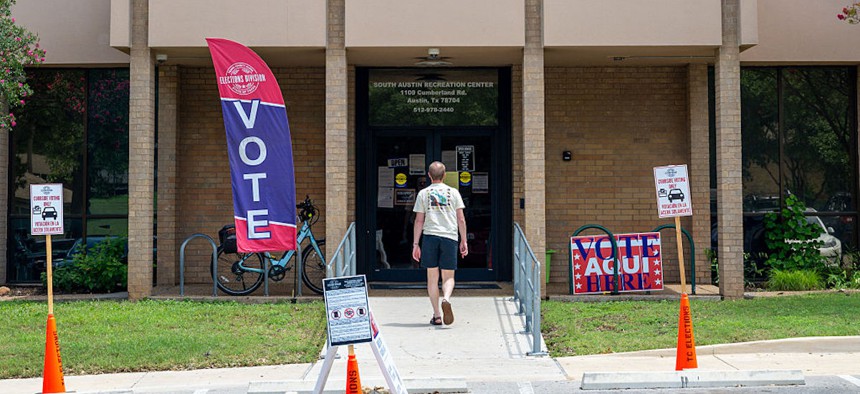
A person prepares to vote at the South Austin Recreation Center on May 26, 2026, in Austin, Texas Brandon Bell/Getty Images





Secretary of State Jane Nelson wrote a letter to federal immigration officials in April after the SAVE program incorrectly flagged U.S. citizens.
This story was originally published by Votebeat, a nonprofit news organization reporting on voting access and election administration across the U.S. Sign up for Votebeat Texas’ free newsletter here.
The Texas Secretary of State’s Office used a controversial federal data tool to flag more than 2,000 potential noncitizens on the state’s voter roll last year. But in an April letter to federal immigration officials, Secretary of State Jane Nelson raised concerns about its accuracy.
In that letter to U.S. Citizenship and Immigration Services officials, obtained as part of a public records request by Democracy Forward — a nonprofit legal organization advocating for democracy through litigation and public policy — and shared with Votebeat, Nelson said her office wanted “to make sure that you are using the most accurate data,” and asked agency officials to notify her office if they are able to “confirm the citizenship of any individuals previously identified as non-citizens” in the Systematic Alien Verification for Entitlements, or SAVE, system.
Alicia Pierce, a spokesperson for the secretary of state’s office, said the agency has not yet received a response from USCIS. Nelson resigned from her role last month. Her last day is July 17, and the governor has not yet appointed a replacement.
The Trump administration overhauled SAVE last year, making it free for states to use and easier to search, and has urged election officials around the country to use it to search for potential noncitizens on their voter rolls. Texas was notably among the first states to start using the program to check voter eligibility.
But experts and election officials have raised concerns about the SAVE program’s accuracy, and officials in multiple states have said it incorrectly flagged at least some citizens.
“Texas’s use of DHS’s illegally-expanded SAVE system has always raised significant risks of voter disenfranchisement, given that system’s known inaccuracies—and these records prove that state election officials are concerned about this as well,” said Dan McGrath, special counsel, oversight at Democracy Forward, in an emailed statement to Votebeat.
States’ use of the revamped SAVE tool is currently in limbo in the wake of multiple court rulings. In June, a federal judge blocked the overhaul of the SAVE program, saying it violated privacy and voting rights. That ruling prompted the Trump administration to pause certain features in the SAVE system to comply. Earlier this month, though, a different federal judge ordered Homeland Security to restore access to the revamped system for four states — Florida, Ohio, Iowa, and Indiana — due to an earlier settlement agreement.
The rulings also do not prevent Texas or other states that previously used the revamped program from continuing to investigate the status of any potential noncitizens it flagged on the voter roll. In Texas, those investigations are still ongoing, but Nelson’s letter pointed to the fact that they have raised questions about SAVE’s accuracy.
“As my staff has informed you, county voter registrars have obtained citizenship documentation from some Texas voters who were identified in the SAVE system as potential Non-citizens,” Nelson’s letter says. “We are aware of instances in which state driver’s license records inaccurately reflect a person’s current citizenship status. In addition, we have learned of individuals who were mistakenly registered to vote—such as due to a clerical error by a voter registrar—even though they acknowledged on a voter registration application that they are not U.S. citizens.”
Nelson added that those examples are why her office urges county election officials to “use all available sources to confirm a person’s citizenship status.”
She praised the Trump administration’s move to make the tool free for states to use and said SAVE has “proven to be a critically important data set,” describing it as one of the many sources her office will use to ensure only qualified voters cast ballots.
Additional records obtained in the records request also show that Nelson’s staff in March met with Homeland Security officials, suggesting the meeting touched on the questions Nelson raised in her letter.
The Texas Secretary of State’s Office last fall sent counties the list of potential noncitizens generated by checking the state’s voter roll of more than 18 million registered voters against the SAVE program. Soon after the state released the list, counties began to investigate the eligibility of the flagged registrants and mail notices asking them to provide documented proof of citizenship.
County election officials have since confirmed some of the flagged voters were citizens, though it isn’t clear exactly how many. They’ve also found that hundreds of the flagged voters had registered through the Texas Department of Public Safety, which requires proof of citizenship, such as a passport, and keeps copies of such documents on file.
The Texas Secretary of State’s Office in December told Votebeat and the Texas Tribune that it did not initially check the registrants flagged as potential noncitizens against DPS’ records before sending the list to county election officials to investigate. That decision prompted a March lawsuit from voting rights groups and some Texas voters who said the state should have done so. The lawsuit is still pending in federal court.
In May, Votebeat reported that the secretary of state’s office later asked DPS to check the list of 2,724 potential noncitizens flagged by the SAVE program against its records to verify whether any of them had already provided proof of citizenship. In a meeting with election officials, Christina Adkins, the agency’s elections division director, said there were “discrepancies” between DPS data and the data provided by the SAVE.
Pierce said DPS has provided the data the agency requested, and that state officials are reviewing it and “will send to counties soon.”
Natalia Contreras covers election administration and voting access for Votebeat in partnership with the Texas Tribune. Natalia is based in Corpus Christi. Contact her at ncontreras@votebeat.org.
Votebeat is a nonprofit news organization covering local election integrity and voting access. Sign up for their newsletters here.