
New Jersey reaches its goal to eliminate veteran homelessness
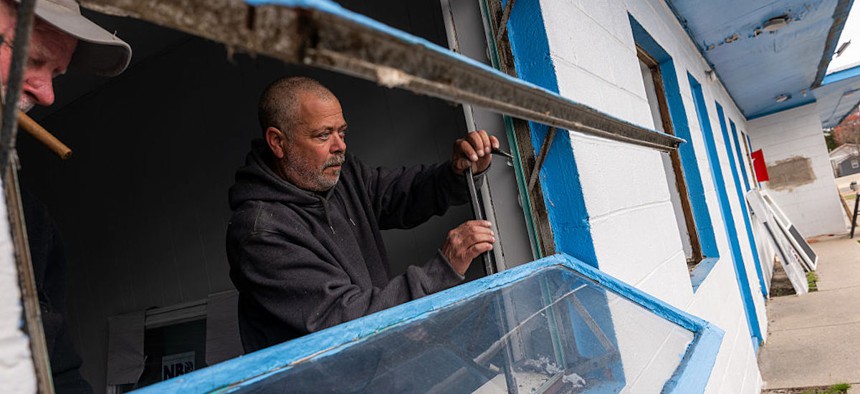
Renovations are made to rooms at the Veterans Village of Absecon, a renovated motel that housed up to 26 veterans in need of a place to live on April 21, 2025, in Absecon, New Jersey. Spencer Platt via Getty Images






Tech and data tools that enable communication and care coordination across state agencies and other service providers were a critical tool in fulfilling their mission, state officials say.
New Jersey has hit its goal of reducing the number of unhoused veterans to a “functional zero” this summer, state officials announced last month.
A cloud-enabled platform was one tool that helped the state end veteran homelessness by July 1, 2026, a goal set by the New Jersey Department of Community Affairs and Department of Veterans Affairs in March 2025.
The agencies aimed to connect more than 300 veterans with permanent or secure housing and other assistive services to reach its goal. The progress made in that time builds upon the state’s broader Bringing Veterans Home initiative that launched in late 2024.
State leaders said more than 2,500 former servicemembers have been connected to stable housing through the BVH initiative, which was supported by $30 million in state and federal funding, over the last year and a half.
“One of the biggest things we recognize is that government bureaucracies and red tape often make it hard for people to navigate these homelessness systems, so what we need to do as a state is organize ourselves around the outcome and deploy our resources to achieve that outcome,” Jaclynn Trakalo, project director for DCA, told Route Fifty.
The U.S. Department of Housing and Urban Development estimated that 32,495 veterans nationwide, defined as people who served on active duty in the armed forces, were experiencing homelessness in Jan. 2025. More broadly, about 40% of unhoused veterans were unsheltered, or living in spaces not habitable for people, such as sidewalks or parks.
A web-based operations platform from government operations platform provider Civic Roundtable helped optimize and streamline employees’ work to communicate across organizations, share case information and data and conduct referrals to other services. For instance, the platform serves as a central location where users can access policy documents, referral information and forms and provider directories, as well as other resources for state agencies, local providers and other partners that coordinate veteran care across six regional hubs in the state.
“The broad vision writ large in this department is moving … toward a vision of data for action,” Gavin Rozzi, director of DCA’s Division of Housing and Community Resources Data Center, told Route Fifty. The platform, for example, has helped standardize housing-related information and services for state staff and service providers across the state to ensure veterans receive accurate and timely assistance, he said.
Additionally, New Jersey is using an internally built platform to track BVH program analytics, such as the number of referrals made and by what organization, to monitor the initiative’s progress. The state is also using a software tool from SimpliGov to track veterans’ interactions with a self-referral form for housing assistance, and ultimately, providers’ efforts to address and resolve those self-referrals, Rozzi said.
Housing assistance providers are expected to contact a veteran within 24 hours and develop a “plan of action toward housing within 96 hours of that initial contact, [which] gives us a way to measure our speed and our accuracy and the way that these providers are engaging with the veterans,” Trakalo said.
“What was really amazing to me was how, with a relatively small team here and working with some of our external tools, we were able to really keep cranking out solutions for a lot of the complex needs that came up with standing up some of the referral infrastructures and being able to follow the journey of of the veterans through the system,” Rozzi said.
Ultimately, “a number is just a number, and we need to make sure these systems are enhanced so we can sustain” such goals, including efforts to address homelessness in other vulnerable populations, like children or survivors of domestic abuse, Trakalo said.