
Public outcry over facial recognition technology leads Milwaukee police to ban it, for now
RECVISUAL via Getty Images




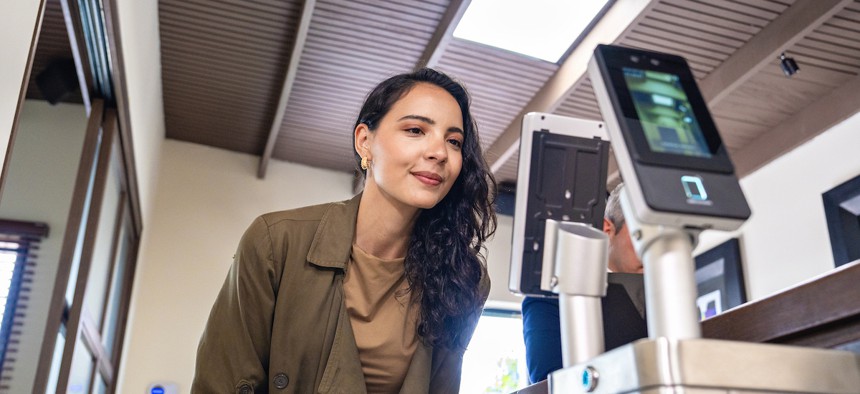
The Milwaukee Police Department has banned use of facial recognition technology, for now, after a contentious public hearing.
This story was originally published by the Wisconsin Examiner.
A years-long debate over the use of facial recognition software by the Milwaukee Police Department (MPD) came to a head at a contentious Thursday meeting of the city’s Fire and Police Commission (FPC) attended by more than 60 local residents. Over the course of questioning, stretching late into the evening hours, commissioners learned from MPD leadership that the department had continued using facial recognition software, even as a draft policy to put guardrails on the technology was still being developed outside of the FPC’s control.
By meeting’s end, FPC vice chairwoman Bree Spencer expressed a desire for the commission to consider finding some way to push for a pause to MPD’s use of facial recognition software, though the FPC itself did not take any immediate formal action. Less than 24 hours later, MPD Chief Jeffrey Norman announced that the department would ban the use of facial recognition technology, and discontinue its efforts to acquire permanent access to the technology.
During the Thursday meeting, Norman and his staff were grilled by FPC commissioners after hours of impassioned public testimony. The sweltering meeting room was packed almost shoulder-to-shoulder, with every seat taken and people standing along the wall in spaces not already taken by the local news station’s bulky cameras. Many others waited in the hallway, as an overflow room had not been set up.
One by one, local residents expressed a variety of grievances about facial recognition. Some decried MPD’s prior use of software without disclosure to the public or FPC, while others expressed fears about how the technology could be used against Milwaukeeans by what many called an authoritarian federal government.
Paul Smith, a member of the Oneida Nation who serves on Milwaukee’s Equal Rights Commission, was the first to speak. Smith described how his relatives had been among the first to come down from the Oneida reservation to Milwaukee seeking factory work. “We are also people who have to carry two IDs all the time,” said Smith. He suggested that facial recognition and other camera technologies are methods the government uses to track people it considers enemies.
“I live in fear every day,” said Smith, describing how his heart rate accelerates when he drives out of Milwaukee County. Smith added that facial recognition technology is unreliable. “My dad can use my phone because his face looks like mine,” he said. “These cameras don’t work and they punish people, and there’s no presumption of innocence when you’re being watched all the time.”
Nadiyah Johnson, founder and CEO of the Milky Way Tech Hub, highlighted the notoriously high error rates facial recognition software has for people of color. Johnson said that federal tests have shown false positive rates as much as 10 to 100 times higher for Black people. “I’m sure that we all can understand why that would be a problem for the city of Milwaukee,” said Johnson. She added that “guardrails do not fix the core problem.”
When surveillance infrastructure is created, Johnson said, the scope of who is targeted expands. She and other community members who spoke brought up Flock license plate reader cameras which, like facial recognition, are AI-powered and a top concern for many who attended Thursday night’s FPC meeting. Flock has attracted criticism for being used for vague or unlawful reasons by police, and for leaving some feeds exposed on the open internet. “This is not a future concern, this is already happening nationally,” said Johnson. “The public cannot meaningfully consent to systems we can not see, audit, or challenge.”
Amanda Merkwae, advocacy director for the American Civil Liberties Union of Wisconsin, recounted her attempts to learn more about MPD’s use of facial recognition by filing open records requests. After waiting five months and threatening to sue, the ACLU was sent a response that the MPD does not track requests made for use of facial recognition in individual investigations. When the city’s IT department ran an email search, the term “facial recognition” appeared in 196,688 emails from 2020-2025.
When the ACLU narrowed the request to 16 cases which MPD cited in presentations to city commissions, they found that “in a handful of those cases” which had been “hand picked” by MPD for those presentations, “the police reports did not mention [Facial Recognition Technology] at all,” Merkwae told the FPC. “In conversations with some defense attorneys, it appears that [Facial Recognition Technology] use was not turned over to the defense in discovery in some cases,” said Merkwae. “In cases where attorneys filed pre-trial motions to get insight into the notoriously racially biased [Facial Recognition Technology] algorithms, they hit a brick wall because that information is proprietary.”
In its presentations to city officials, MPD had said that facial recognition helped identify suspects in cases including sexual assault and shooting investigations.
Much of the public testimony Thursday focused on the potential for surveillance technologies to harm democracy. Speakers focused on the immigration crackdown in Minnesota, where thousands of people have been arrested and two people killed by federal agents. Videos posted online show immigration agents taking pictures of protesters, legal observers and vehicles, using facial recognition technology to identify detainees, and taunting members of the public by saying their pictures were going to be uploaded to a database of domestic terrorists. An immigrants’ rights group recently discovered what it describes as a watchlist of immigration attorneys created by ICE.
Taleavia Cole and her husband Caliph Muab-El have experienced police surveillance after protesting the killing of Cole’s brother Alvin. Several of Cole’s family members, their lawyers and dozens of others were placed on a list created by the Wauwatosa Police Department. The list, which also included a Wisconsin Examiner reporter, was shared with numerous state, local, and federal agencies and was also referred to by police as a “target list”.
Muab-El said Black and brown communities have been used as test subjects for surveillance and militarized policing. This is how he views MPD’s deal with the data company Biometrica, which has offered to trade 2.5 million jail and booking photos from Milwaukee for MPD to have access to facial recognition software.
“We’re talking about people,” said Muab-El. “And when we’re talking about people, we need to focus on the things that are most important for people to thrive in circumstances like this. Everything in our society and our community has been gutted from us almost. The resources are very scarce already…To institute something like this that will exacerbate the circumstances of our already falling and broken-in-pieces communities is definitely an attack on justice on our people.”
He stressed that “anybody can be misidentified at any time,” and that the city will not be able to prevent federal agencies from accessing the data it collects using facial recognition software. “No one is safe,” said Muab-El. “Bystanders who believe in justice and the cause of people, these people are going to become more vulnerable. These attacks are going to become more prevalent…They’re going to become more intense.”
Cole recounted her own experiences of being placed on the target list, and her belief that even her family’s phone calls were being monitored. “So whose side are you on is the real question, because someday it could be your family member,” she said. “And next thing you know, they want to know what you know, what you’re saying, what you’re doing. Like you’re a criminal, like you’re nobody.”
Testimony went on for several hours, pausing for a presentation on facial recognition technology from the New York University Law School Policing Project. The presenters said that while facial recognition can assist law enforcement investigations, the technology also carries serious constitutional and civil risks. Whether a city or town uses facial recognition software should be a decision made by the entire community, the presenters said, adding that having guardrails to prevent abuse of the technology is important.
Late in the meeting, after many people had left, Chief Norman and MPD staff provided an update and took questions from the FPC. Norman said a draft policy his department’s use of facial recognition technology had not yet been finalized, and that he was “slow walking” the process to get as much input as possible. He stressed that facial recognition software is used to develop leads, and cannot be used as the sole basis for establishing probable cause for an arrest. The department had also begun logging uses of facial recognition, but those records only captured uses since 2024.
Under sharp questioning from FPC Commissioner Krissie Fung the commission learned that MPD had continued using facial recognition technology even as the drafting of a policy was ongoing. Some sort of of a draft policy — described by Fung as a “draft of a draft of a draft” — appeared to have been viewed by at least some members of the city’s common council, but not the FPC.
Although several commissioners expressed concerns about facial recognition technology and MPD’s deal with Biometrica, the FPC’s power to do anything about it is limited, since the Republican-controlled Legislature had worked to eliminate the FPC’s policy-making powers for the Milwaukee police. The debate over the use of facial recognition software in Milwaukee had gone on since last year, with members of the public speaking against its adoption consistently and in great numbers. Spencer, the FPC’s vice-chairwoman, said that the public shouldn’t have to attend more meetings to say the same things, and that her own trust in the department on the issue had eroded.
In a statement issued Friday, Heather Hough, Norman’s chief of staff, said the police department understands “the public concern, particularly in light of national circumstances…Despite our belief that this is useful technology…we recognize that public trust is far more valuable.” Hough’s statement continued, “therefore, effective immediately, Chief (Jeffrey) Norman will issue a department directive banning the use of facial recognition for all members.”
Hough said that MPD will continue work on creating a policy, but will not use facial recognition technology until that process is complete. While MPD appeared to be responding to the public outcry, the Milwaukee Police Association (the department’s union) said in a statement that it was “deeply concerned and disappointed” by the decision to restrict facial recognition technology. The police association was also irked by recent restrictions on vehicle pursuits saying that both policy shifts do not “eliminate crime or danger,” but instead “risks shifting that danger onto Milwaukee residents and the officers sworn to protect them.”
The union’s statement described facial recognition as “an investigative tool that can assist detectives in generating leads in violent crime cases. It does not replace traditional police work or serve as a basis for arrest without further investigation. When used responsibly and with appropriate safeguards, this technology can help identify violent offenders, support victims, and improve case clearance rates.”
Wisconsin Examiner is part of States Newsroom, a nonprofit news network supported by grants and a coalition of donors as a 501c(3) public charity. Wisconsin Examiner maintains editorial independence. Contact Editor Ruth Conniff for questions: info@wisconsinexaminer.com.