Tackling new accessibility rules: How states can provide seamless experiences for people with disabilities.

Presented by Adobe 2025 Adobe 2025's logo

In April 2024, the Department of Justice (DOJ) finalized updates to its rules requiring that web content and mobile applications be accessible to people with disabilities. The regulations mandate compliance with the Web Content Accessibility Guidelines (WCAG) 2.1 Level AA guidelines for state and local government (SLG) agencies with jurisdictions of 50,000 or more residents by April 2026.

However, even with this upcoming deadline, the National Association of State Chief Information Officers (NASCIO) 2025 member survey revealed disparate efforts across states. While 70% of state CIOs said improving accessibility is among their top priorities, only 46% reported having dedicated funding for accessibility initiatives. Even more concerning, only one state indicated it had fully implemented its accessibility plan.

WCAG is designed to make web content more accessible to people with disabilities, addressing a wide range of needs across sensory, motor, and cognitive dimensions. It is critical that people with disabilities have ready access to public services, and the data indicates the need for greater accountability from governments.

  • According to the World Economic Forum, people with disabilities represent about 17% of the global population — making them the largest minority group worldwide.
  • A recent National Civic League report found that 57% of Americans with disabilities experienced barriers to civic engagement.
  • Adobe’s Digital Government Index revealed that 26 out of 50 U.S state websites had more than 10 accessibility issues.

While this a noble move done for the right reasons, it will be a huge undertaking, even for the largest SLGs. Governments shouldn’t take this on alone if they want to move quickly and efficiently to meet compliance deadlines over the next two years.

Estimating the cost of manual processes.

States are finding that they will need to tag more than 100,000 documents manually after they archive portion of the documents on their public websites. And with manual tagging taking about two to three hours per document, that could mean as much as 300,000 hours of manual effort to meet the DOJ’s mandate for most states.

The challenge — both logistically and financially — is even greater for small jurisdictions, especially since the DOJ has met with some cities and counties and levied fines on localities that have made no progress. To put the task into clearer context, it’s helpful to look at a cost breakdown for each level — from large states to small counties.

State with more than 2,000,000 residents:

  • 100,000+ public-facing documents
  • Archive 25,000
  • Remaining 75,000 documents will need accessibility tagging
  • 150,000 hours to tag manually
  • Final price tag: $2,500,000 in-house project cost at $25/hr

Large city or county with around 1,000,000 residents:

  • 50,000 public-facing documents
  • Archive 15,000
  • Remaining 35,000 documents will need accessibility tagging
  • 70,000 hours to tag manually
  • Final cost: $1,500,000 in-house project cost at $25/hr

Small city or county with about 500,000 residents:

  • 15,000 public-facing documents
  • Archive 3,000
  • Remaining 12,000 documents will need accessibility tagging
  • 24,000 hours to tag manually
  • Final cost: $400,000 in-house project cost at $25/hr

With so many state and local governments facing constrained budgets, it will be challenging to absorb the millions of dollars required to comply with the WCAG guidelines using a manual process. Fortunately, governments don’t have to choose between accessibility and other important budget priorities. By automating accessibility tagging, they can drastically cut costs associated with manual labor while improving accuracy and efficiency.

Automating the challenge.

Adobe can help state and local agencies ensure their digital services are compliant and usable for everyone — including people with disabilities. With advanced content management and accessibility capabilities, agencies can maintain compliance while saving costs and improving outcomes for their residents.

Adobe’s document services offer an automated way to meet common accessibility standards — including WCAG guidelines — while delivering a far more cost-effective experience. Licensing expenses for Adobe Experience Manager Sites are roughly 10% of the labor costs required for manual document tagging. For states, that could translate to savings of more than $2 million.

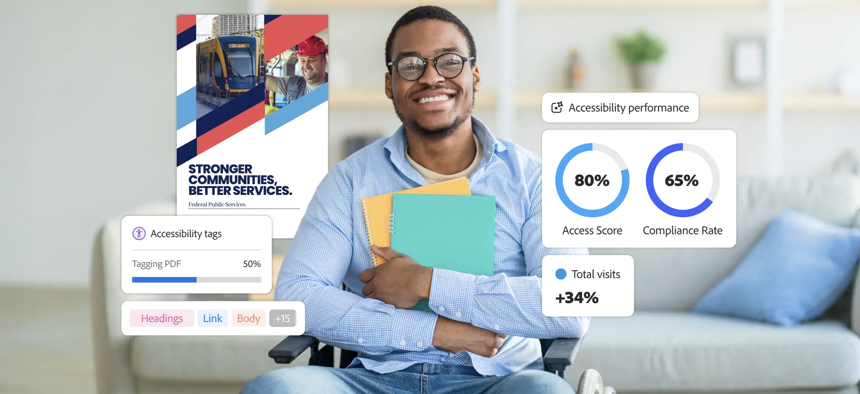
Beyond time and cost savings, Adobe’s automated services deliver exponentially higher accuracy than manual tagging. Adobe Experience Manager Sites achieves about 80% WCAG compliance on the first pass and can establish a scalable standard for accessibility.

Stages:

  • Remediate documents
  • Monitor and assess website accessibility issues
  • Maintain accessibility compliance across digital assets
  • Create accessible sites

Accessibility in action.

To see this in practice, look at how the State of Illinois utilized Adobe solutions to improve its website accessibility and begin complying with the WGAC guidelines.

The state faced several challenges in delivering accessible service to its residents — including declining trust in the state’s digital experience, inconsistent access to services online or on mobile devices for more than 12 million residents, and a lack of a standardized, scalable environment for rapid content deployment.

To address these challenges, state tech leaders turned to Adobe. State of Illinois leveraged Adobe Experience Cloud and Adobe Document Cloud to optimize state websites, mobile apps and overall digital experience. With Adobe Analytics and Adobe Target, the state was then able to personalize and update content in real time. Illinois also migrated 64 web properties to Adobe Experience Manager, building a seamless, dynamic platform that increased content output and reduced error rates.

The process transformed the state’s ability to deliver efficient and accessible digital experience for all residents. The results speak for themselves:

  • 25% average increase in website traffic after deploying 45,000 new site pages
  • 23% greater digital certainty and 7% increase in UX maturity
  • 62% increase in quality assurance and readability
  • 25–63% improvement in website accessibility and quality scores
  • 200+ health programs available online through the Illinois Department of Public Health

Accessibility is vital for SLG websites as it ensures equal access to information and services for all residents, including those with disabilities. With DOJ compliance deadlines approaching next year, meeting WCAG guidelines isn’t just a nice-to-have — it’s essential for legal compliance, equitable access, public trust, and digital efficiency. While it may seem like a daunting task, partnering with Adobe can transform it from a monumental challenge into a meaningful opportunity.

Get started with Adobe.

Partner with Adobe to automate and scale digital accessibility across your state’s web and mobile services — cutting costs, reducing manual labor, and meeting WCAG 2.1 AA compliance deadlines.

To explore these recommendations in depth and discover ways to incorporate them into modernization strategy, contact Brian Chidester, Adobe’s head of industry strategy for public sector at bchidester@adobe.com. Learn more about Adobe Government Solutions here.

Brian Chidester is the head of industry strategy for the public sector at Adobe and host of The Government Huddle with Brian Chidester podcast from GovExec. Previously, he served as industry vice president for global public sector at Genesys and has held leadership roles with OpenText, Arrow ECS, and S&P Global. Chidester holds a B.S. in Communications Studies from Liberty University. He is a board member for the University of South Florida–Muma College of Business, an advisor to the G20 Global Smart Cities Alliance at the World Economic Forum, and a member of the Forbes Technology Council.

This content is made possible by our sponsor Adobe; it is not written by and does not necessarily reflect the views of Route Fifty’s editorial staff.

NEXT STORY: Boosting Resilience: Cloud Solutions for Modern Government

X
This website uses cookies to enhance user experience and to analyze performance and traffic on our website. We also share information about your use of our site with our social media, advertising and analytics partners. Learn More / Do Not Sell My Personal Information
Accept Cookies
X
Cookie Preferences Cookie List

Do Not Sell My Personal Information

When you visit our website, we store cookies on your browser to collect information. The information collected might relate to you, your preferences or your device, and is mostly used to make the site work as you expect it to and to provide a more personalized web experience. However, you can choose not to allow certain types of cookies, which may impact your experience of the site and the services we are able to offer. Click on the different category headings to find out more and change our default settings according to your preference. You cannot opt-out of our First Party Strictly Necessary Cookies as they are deployed in order to ensure the proper functioning of our website (such as prompting the cookie banner and remembering your settings, to log into your account, to redirect you when you log out, etc.). For more information about the First and Third Party Cookies used please follow this link.

Allow All Cookies

Manage Consent Preferences

Strictly Necessary Cookies - Always Active

We do not allow you to opt-out of our certain cookies, as they are necessary to ensure the proper functioning of our website (such as prompting our cookie banner and remembering your privacy choices) and/or to monitor site performance. These cookies are not used in a way that constitutes a “sale” of your data under the CCPA. You can set your browser to block or alert you about these cookies, but some parts of the site will not work as intended if you do so. You can usually find these settings in the Options or Preferences menu of your browser. Visit www.allaboutcookies.org to learn more.

Sale of Personal Data, Targeting & Social Media Cookies

Under the California Consumer Privacy Act, you have the right to opt-out of the sale of your personal information to third parties. These cookies collect information for analytics and to personalize your experience with targeted ads. You may exercise your right to opt out of the sale of personal information by using this toggle switch. If you opt out we will not be able to offer you personalised ads and will not hand over your personal information to any third parties. Additionally, you may contact our legal department for further clarification about your rights as a California consumer by using this Exercise My Rights link

If you have enabled privacy controls on your browser (such as a plugin), we have to take that as a valid request to opt-out. Therefore we would not be able to track your activity through the web. This may affect our ability to personalize ads according to your preferences.

Targeting cookies may be set through our site by our advertising partners. They may be used by those companies to build a profile of your interests and show you relevant adverts on other sites. They do not store directly personal information, but are based on uniquely identifying your browser and internet device. If you do not allow these cookies, you will experience less targeted advertising.

Social media cookies are set by a range of social media services that we have added to the site to enable you to share our content with your friends and networks. They are capable of tracking your browser across other sites and building up a profile of your interests. This may impact the content and messages you see on other websites you visit. If you do not allow these cookies you may not be able to use or see these sharing tools.

If you want to opt out of all of our lead reports and lists, please submit a privacy request at our Do Not Sell page.

Save Settings
Cookie Preferences Cookie List

Cookie List

A cookie is a small piece of data (text file) that a website – when visited by a user – asks your browser to store on your device in order to remember information about you, such as your language preference or login information. Those cookies are set by us and called first-party cookies. We also use third-party cookies – which are cookies from a domain different than the domain of the website you are visiting – for our advertising and marketing efforts. More specifically, we use cookies and other tracking technologies for the following purposes:

Strictly Necessary Cookies

We do not allow you to opt-out of our certain cookies, as they are necessary to ensure the proper functioning of our website (such as prompting our cookie banner and remembering your privacy choices) and/or to monitor site performance. These cookies are not used in a way that constitutes a “sale” of your data under the CCPA. You can set your browser to block or alert you about these cookies, but some parts of the site will not work as intended if you do so. You can usually find these settings in the Options or Preferences menu of your browser. Visit www.allaboutcookies.org to learn more.

Functional Cookies

We do not allow you to opt-out of our certain cookies, as they are necessary to ensure the proper functioning of our website (such as prompting our cookie banner and remembering your privacy choices) and/or to monitor site performance. These cookies are not used in a way that constitutes a “sale” of your data under the CCPA. You can set your browser to block or alert you about these cookies, but some parts of the site will not work as intended if you do so. You can usually find these settings in the Options or Preferences menu of your browser. Visit www.allaboutcookies.org to learn more.

Performance Cookies

We do not allow you to opt-out of our certain cookies, as they are necessary to ensure the proper functioning of our website (such as prompting our cookie banner and remembering your privacy choices) and/or to monitor site performance. These cookies are not used in a way that constitutes a “sale” of your data under the CCPA. You can set your browser to block or alert you about these cookies, but some parts of the site will not work as intended if you do so. You can usually find these settings in the Options or Preferences menu of your browser. Visit www.allaboutcookies.org to learn more.

Sale of Personal Data

We also use cookies to personalize your experience on our websites, including by determining the most relevant content and advertisements to show you, and to monitor site traffic and performance, so that we may improve our websites and your experience. You may opt out of our use of such cookies (and the associated “sale” of your Personal Information) by using this toggle switch. You will still see some advertising, regardless of your selection. Because we do not track you across different devices, browsers and GEMG properties, your selection will take effect only on this browser, this device and this website.

Social Media Cookies

We also use cookies to personalize your experience on our websites, including by determining the most relevant content and advertisements to show you, and to monitor site traffic and performance, so that we may improve our websites and your experience. You may opt out of our use of such cookies (and the associated “sale” of your Personal Information) by using this toggle switch. You will still see some advertising, regardless of your selection. Because we do not track you across different devices, browsers and GEMG properties, your selection will take effect only on this browser, this device and this website.

Targeting Cookies

We also use cookies to personalize your experience on our websites, including by determining the most relevant content and advertisements to show you, and to monitor site traffic and performance, so that we may improve our websites and your experience. You may opt out of our use of such cookies (and the associated “sale” of your Personal Information) by using this toggle switch. You will still see some advertising, regardless of your selection. Because we do not track you across different devices, browsers and GEMG properties, your selection will take effect only on this browser, this device and this website.